

A ANEEL (National Electric Energy Agency) authorized wind and solar plants, as well as all generation technologies, to provide the ancillary service of reactive support – used to control the voltage of the electrical system. According to the Agency, there are more than 3 thousand candidates to provide this service among solar and wind agents.
The inclusion of renewables was one of the improvements to Normative Resolution 1.030/2022, which contains the rules for the provision and remuneration of ancillary services in the SIN (National Interconnected System), as a result of Public Consultation 83/2021. The new resolution (1.062/23) was published in the Official Gazette last Thursday (4).
To provide the service, agents will be remunerated by the TSA (Ancillary Services Tariff), currently set at R$ 9,02 Mvar-h (Megawatt ampere-hour).
The TSA serves to remunerate the additional costs of operation and maintenance of generating units that are requested by the ONS (National System Operator). “Now it remains to be seen whether agents will want to provide this service for a fee of nine reais”, he commented. Guilherme Camargo, regulatory analyst at Simple Energy.
Theme has gained relevance
The provision of ancillary services is a topic that has gained widespread attention due to the growth in the participation of intermittent renewable sources in the Brazilian electricity matrix.
According to ANEEL, this change has changed the dynamics of the SIN operation, bringing new challenges to the planning, programming and operation of the electrical system by the Operator, who has been required to consider different requirements to compensate for the rapid variation in power throughout the day.
A study by the Thymos Energia, commissioned by Eletrobras, pointed out that the Increased penetration of intermittent sources has led to increased costs of providing ancillary services around the world.
In Ireland, the increase from 10% to 30% in the penetration of renewables led to a 500% increase in the price of ancillary services. The same happened in the United States, France, Sweden, Japan and Australia. In Brazil it is no different. The Northeast region has a renewable energy penetration comparable to the largest countries in the world.
Representing Eletrobras, Vitor Hugo Ribeiro dos Santos, partner at Thymos, showed the impacts of changing the matrix on the operation of hydroelectric plants in the North, Southeast and Northeast.
According to him, calls for the synchronous compensation service increased from 137, in 2016, to 2.342 events in 2021. Regarding the on and off service, in 2015 there were 5.162 events and rose to 11.653 in 2021.
Eletrobras, in fact, understands that the current regulation does not adequately value the benefit brought by hydroelectric plants to the reliability of the electrical system, pointing out that around 90% of the benefit does not return adequately.
According to a José Moisés Machado da Silva, superintendent of Regulatory Affairs at Norte Energia, hydroelectric plants are generating less due to ancillary services.
“We are generating less to have a power reserve to meet oscillations, we provide inertia services, spinning reserves, short circuit power, respond to converter reactive, additional signal to dampen oscillations, load monitoring, in other words , a series of services that are currently unpaid”, he said during the Aneel collegiate meeting held on April 25th.
Future Schedules
In addition to updating Normative Resolution 1.030/2022, ANEEL included an article to allow ONS, with specific authorization from the agency, to test alternative products for the provision of ancillary services in an experimental regulatory environment (sandbox).
The ONS must submit a proposal to the ANEEL, specifying the current and future conditions of the system, the operational problem to be addressed, the products that aim to meet the needs identified, the resources available or possible to be contracted, the respective technical parameters, the deadline for testing and other measures necessary for its implementation.
“This is an advance in the regulation of ancillary services, and a contribution to the sector, which will provide greater efficiency in the provision of ancillary services, at a lower cost for the consumer”, points out Technical Note No. 32/2023/ANEEL.
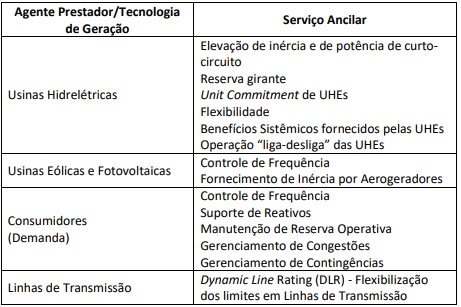
What are ancillary services
Ancillary services are regulated by Normative Resolution 697/2015 updated by REN 1030/22. They serve to ensure that the electrical system, from generation to consumption, functions properly. Currently, ancillary services are paid for by consumer agents, through the System Service Charge (ESS).
Remuneration occurs according to the type of ancillary service:
- Self-restoration: ability of a generator to go from a total stop condition to an operating condition, contributing to the restoration of the electrical system;
- Frequency Control: speed control of generating units to maintain or restore system frequency when there is an imbalance between load and generation;
- Reactive Support: supply or absorption of reactives by generating units. Used to control system voltage.
- Special protection system (SEP): covers systems that, upon detecting risk to the electrical grid, carry out automatic actions to preserve the integrity of the National Interconnected System;
- Maintenance of operating power reserve: thermoelectric dispatch to maintain water in the reservoir of hydroelectric plants that provide frequency control.

Comments
Comments are moderated before publication.Comments should be respectful and contribute to a healthy debate. Offensive comments may be removed. The opinions expressed here are those of the authors and do not necessarily reflect the views of the author. Canal Solar.