
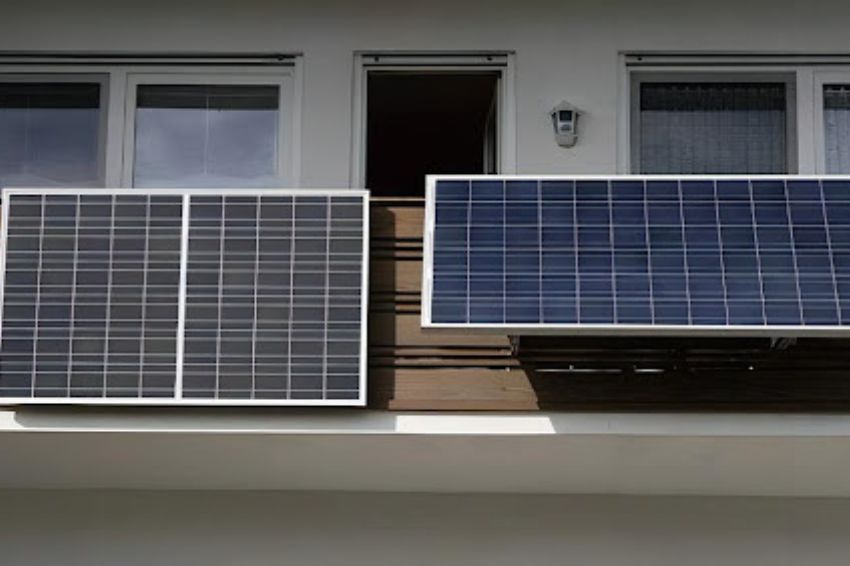
This article presents a very interesting idea that has been emerging in Europe, with the use of small spaces (such as balconies and balconies in buildings) to generate electrical energy.
This type of application is one of the wonders of photovoltaic sources: any available space, where a solar panel can be installed, can be used to produce a little energy.
In Brazil, we can mirror the European experience and follow in their footsteps with the fact that the installation of photovoltaic systems becomes really very simple with the use of microinverters, dispensing with direct current cabling, stringboxes and other accessories that are essential in string photovoltaic systems.
And with this ease, we can think about installing systems in unusual locations, different from traditional rooftops.
It is important to remember that, despite the ease of installation, specialized labor cannot be dispensed with, no matter how simple the system is, even if it only has one photovoltaic module.
Furthermore, we must bear in mind that any type of photovoltaic system connected to the electrical distribution network must be approved in Brazil, which necessarily requires the advice of a specialized company or a professional in the electricity field.
The idea that has been gaining followers in Europe
Since the beginning of winter in 2022, affected by the war in Russia and Ukraine, the problem of energy shortages in Europe has emerged rapidly, and solar energy has become an important energy source.
Recently, there has been a great demand for solar systems installed on balconies and facades in Germany.
This simple plug-and-play solar system requires only an AC electrical connection, no stringbox. In this type of installation, microinverters have become the ideal choice.
Viability
You can build a photovoltaic system simply with one or two solar panels and a microinverter, usually with a cable length of 5 to 10 meters.
In Europe, especially with the rise in electricity prices, investment has proven to be very profitable.
Referring to the general price in Europe, a solar panel costs 200 to 400 euros, while a microinverter costs close to 100 euros. A consumer can have a solar system with two photovoltaic panels with an investment of less than 1000 euros.
The same thinking applies to Brazil, where the photovoltaic system has long been known as a good investment – and the large increase in the use of distributed generation in the last two years by many Brazilian consumers is concrete proof of this.
How to install
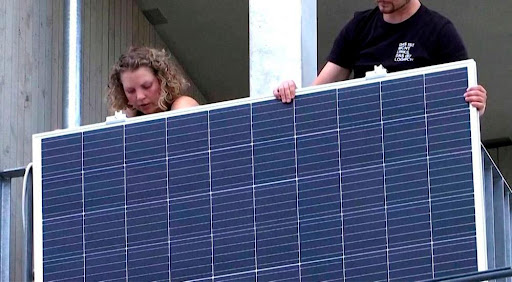
As with any photovoltaic system, it is necessary to know the structural stability of the mounting location, be it a roof, a slab or the railing of a residential balcony or building balcony.
Furthermore, legal aspects must be taken into account. In most residential buildings and condominiums, the installation of artifacts that cause aesthetic changes is prohibited. And the fixing of machines and equipment is not always allowed in external areas, both for aesthetic reasons and for reasons of structural risk to the building.
If the installation of photovoltaic modules in the external area of the building or condominium is permitted, the first step is to check the condition of the grids to verify their stability.
It is also necessary to evaluate the solar irradiation condition of the location. A place always exposed to shade may not be interesting. In Brazil, installing photovoltaic modules on facades facing the geographic north is always more interesting, as it will allow greater capture of sunlight.
Regardless of the location chosen for installation, the photovoltaic module installation manual must always be consulted and followed. The module must be rigidly fixed to the grid or specific support to guarantee maximum stability and complete safety of the installation.
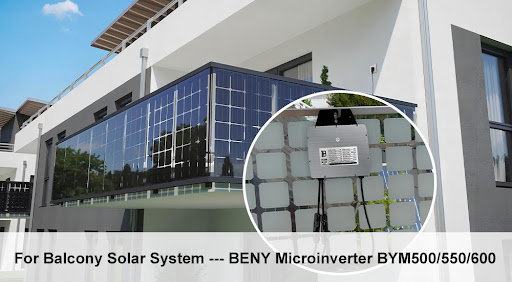
Microinverter: It is without a doubt the preferred technology for this type of installation, as it avoids the use of additional cabling and protection boxes. The microinverter can be accommodated in a very elegant way on the back of the photovoltaic module, taking up little space and causing little or no aesthetic impact, even if the back of the photovoltaic module is visible, depending on the way it is installed.
Connecting the system only requires an access point to the alternating current electrical network, which should preferably be done using a cable installed especially for this purpose, with the connection starting from the existing distribution board in the residence. It is recommended to avoid using pre-existing circuits (for example, socket or shower circuits).
How the solar system with microinverter works
Once everything is ready, the solar panel will generate direct current electricity. This energy will be converted into alternating current by the microinverter and will be immediately injected into the home's electrical installation, allowing it to be used by existing appliances and appliances.
Eventually, if there is no energy consumption simultaneously with energy generation, the excess energy will be sent to the distribution network and produce energy credits that will be offset in the next electricity bill.
How to improve the performance of the solar system?
- Orientation (azimuth): In most of the Brazilian territory, located in the southern hemisphere, the panels should preferably face the geographic north.
- Tilt angle: The best tilt angle corresponds to the latitude angle of the installation location. When installing on facades, this inclination will not always be possible and the modules will simply be installed at a right angle, which will cause some loss of generation.
- Temperature: As the temperature increases, the maximum output power of the solar panel will decrease, and the conversion efficiency of the microinverter will also decrease. In order to avoid the influence of temperature on energy production, the panel must be kept in good ventilation conditions.
- Loss due to dirt: The panel is placed outdoors, and dust on it will cause a loss of generating capacity. Panels installed on balconies or balconies are easier to clean than those installed on roofs, and should be cleaned frequently to reduce the impact of dust on energy production.
- MPPT: MPPT (Maximum Power Point Tracking) is a technique used to track the maximum power output point of a solar panel. The MPPT function is performed by the microinverter. There are microinverters that perform the MPPT per module (individually), while some microinverters perform the MPPT for each set of two modules. This is not serious, as long as the two modules connected to the same MPPT input have the same operating conditions (especially the same solar irradiation).
Important facts when choosing a microinverter
BENY microinverters with powers of 500W/550W/600W can be used in any type of photovoltaic system and are very suitable for small systems installed in any type of location. The characteristics shown below refer, for example, to the BYM600 model.
- MPPT: MPPT is an important feature of the microinverter and impacts its overall conversion efficiency. The MPPT efficiency of BENY BYM600 microinverter can reach 99,8% efficiency, maximizing power generation.
- EURO efficiency: European efficiency characterizes the operating efficiency of an inverter weighted according to different operating points according to European solar irradiation conditions. Typically, Euro efficiency is a metric adopted to compare different equipment. The higher the value, the better the inverter performance. The Euro efficiency of the BENY BYM600 microinverter can reach 96%, which places it among the most efficient on the market.
- Maximum continuous input current: The greater the current supported at the inverter input, the greater the range of supported photovoltaic module models. High-power and bifacial modules are becoming increasingly common on the market, which requires inverters with increasingly higher input currents. The BENY BYM600 microinverter has an input current of 18 A, making it suitable for operating with virtually any type of photovoltaic module available today.
- Communication method: Common microinverter communication methods include Sub1G, PLC, WiFi and Zigbee. The BENY microinverter works with PLC, WiFi and Zigbee systems, enabling safe and stable communication between the inverter and your monitoring system.
- Smart Monitoring: The monitoring platform is an important component for the user of the photovoltaic system. In addition to monitoring production, the platform is important for diagnosing problems. The BYDAS platform is the support system for monitoring, analysis and management of BENY microinverters. Contains detailed operational data. In addition to a platform available on the web, an application is also available for mobile devices.
- IP rating: the microinverter needs to be placed outdoors together with the panel. The higher the protection level, the better the dustproof and waterproof effect. The rating of the BENY BYM600 microinverter is IP67, making it suitable for virtually any installation location.
- Certification: In Brazil, microinverters, like any inverter, must be approved by INMETRO. In Europe there are no mandatory certification standards for solar systems below 800 W, except in Germany, where inverters must be certified according to the VDE standard (VDE AR-N 4105). The BENY BYM600 microinverter is VDE-4105 and CE certified, complies with German and European standards, and is also INMETRO certified, in compliance with Brazilian standards.
- Warranty: The general warranty period of a microinverter is around 10 to 12 years. BENY uses automotive-grade electronics in its equipment, which allows it to provide a 25-year warranty.
Compared to string inverters, microinverters are more suitable for small photovoltaic systems, such as systems installed on facades.
The small dimensions, MPPT per module and high operating efficiency make microinverters ideal for this type of application.
Even if a small photovoltaic system cannot produce all the energy produced by the consumer, the use of a photovoltaic system will always provide some relief on the electricity bill and will help reduce greenhouse gas emissions through the use of a source of clean and renewable energy.
BENY microinverters are one of the highlights of this manufacturer. BENY has invested a lot of energy in R&D (research and development) to create superior quality equipment.

Comments
Comments are moderated before publication.Comments should be respectful and contribute to a healthy debate. Offensive comments may be removed. The opinions expressed here are those of the authors and do not necessarily reflect the views of the author. Canal Solar.