
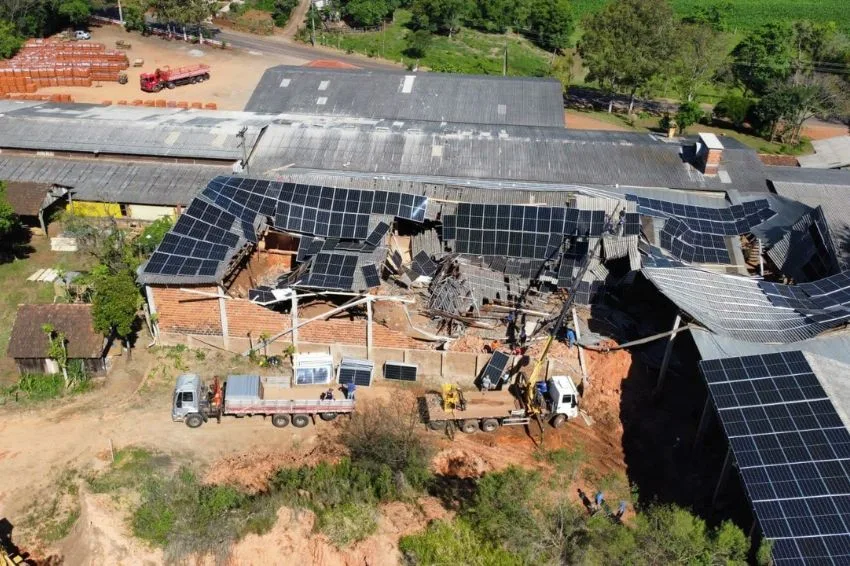
Choosing the wrong coverage can have serious consequences. For a family, this can mean losing a lifetime investment in a matter of seconds. For integrators, a mistake in the installation or maintenance of the photovoltaic system can result in high costs and harm the company's financial health if the necessary protection is not provided.
Therefore, in this article, we will help you identify and choose the solar energy insurance that best meets your needs and those of your customers. Keep reading!
Civil Liability Insurance (RC)
Liability Insurance is an insurance policy designed to protect integrators during the installation and maintenance of photovoltaic systems. It provides coverage for damage to third-party property and accidents involving field team members, whether they are contracted or outsourced employees.
Its main difference is that it covers both new installations and maintenance or after-sales services, ensuring that the professional is always protected when carrying out services on the client's property.
Who is responsible?
For example, if during installation or maintenance a solar panel falls and damages a customer’s or a neighbor’s car, Liability Insurance will cover the damage to the vehicle. Similarly, if a team member suffers an accident that results in permanent disability or death, the insurance will also provide additional protection for the employer.
Engineering Risk Insurance (RE)
Another insurance used by integrators during the installation and assembly of photovoltaic systems is Engineering Risk. It covers damage to the photovoltaic generator kit, third parties and the end customer's property during the work. This means that if a tool falls on the modules, if the panels fall from the truck during unloading, if someone steals the equipment from the site or another incident occurs that is provided for in the coverage table during the installation, the integrator will be covered.
Although Engineering Risk Insurance may seem similar to Civil Liability Insurance, RE does not cover maintenance and repairs. Furthermore, with RE it is necessary to purchase a policy for each installation, while with RC the integrator purchases a single annual policy that covers all installations and maintenance throughout the year.
One tip for choosing between them is to analyze the quantity and complexity of the works served by the integrator. For example, if there is not a large demand for plants to be installed or repaired, it may be more advantageous to hire RE, since its hiring is individual. On the other hand, if the integrator already has a high demand for annual installations, it will be more advantageous to opt for RC, which offers protection for all services for one year.
Solar panel insurance brings benefits to businesses and consumers
In addition to the number of plants, it is essential to consider the degree of difficulty of each installation. If the integrator identifies that he will have to deal with more delicate services, which present a greater risk of accidents, he should opt for RE, because, in addition to protecting third parties and the client's property during the work, it also covers damage to the photovoltaic generator kit, which Civil Liability Insurance does not cover.
However, it is important to highlight that the insurance policies are complementary; one does not exclude the need for the other. Therefore, purchasing both is still the best option for integrators seeking complete coverage, ensuring security at all stages of the project.
Miscellaneous Risk Insurance for Equipment (RD) and Large Plants
Equipment Miscellaneous Risk Insurance is ideal for protecting the end customer's investment. It covers various damages to the photovoltaic generator kit after installation, such as windstorms, hail, fire, electrical damage, theft and a series of other unforeseen events that may cause the consumer to pay more for their energy bill.
As it is one of the most comprehensive insurance policies on the market, it is often used by integrators as a competitive advantage to stand out from competitors and close more and better deals.
Windstorm and insurance coverage in photovoltaic systems
In addition to serving smaller systems, RD is also indicated to protect large photovoltaic plants in operation, that is, after the installation is completed. Its coverage includes modules, inverters, substations, transformers, structures, trackers and all components that make up the plant.
Warranty Insurance
Like other insurance policies, Surety Bonds play a crucial role in the solar energy sector. Their purpose is to ensure that the contractual requirements and obligations assumed by the integrator are met as agreed with the client. To this end, they are divided into two main categories: the first is the Bidder, which is mandatory for those who wish to participate in bids.
The second is the Performance Bond, which is often required by the buyer of the plant. In this case, the investor requests that the integrator take out insurance to guarantee the execution of the contract according to the stipulated terms. Unlike other insurance policies, the Performance Bond does not cover physical damage, but rather the protection of contractual clauses. Therefore, if the integrator fails to comply with what was agreed, the insurer will compensate the client and charge the integrator.
As it is a common requirement in large contracts, the Surety Bond becomes an important ally for integrators who want to participate in bids, helping to ensure that clients trust that the work will be delivered as agreed.
Solar Life Insurance
Unlike other life insurance policies, Solar Life Insurance It serves to specifically protect photovoltaic system installers and other employees working in this sector, since this profession combines the two greatest risks of work accidents: height and electricity.
In addition to offering financial security in the event of accidents during the installation and assembly of solar plants, the insurance also covers accidents in general, in addition to working hours. Because it is personalized and only has the coverage necessary to protect integrators, its cost is even lower compared to other life insurance policies.
He can be hired by integrators, installers, engineers or any employee of your solar energy company, even if outsourced, since the contracts are individual, registered in each person's CPF.
Conclusion
Choosing the right solar energy insurance is essential to ensure peace of mind for both integrators and customers. Therefore, before taking out any insurance, it is best to know exactly what you are purchasing, as well as to analyze the needs of each project and the coverage offered in the policy. In some situations, it may be necessary to take out more than one insurance policy to ensure protection at all stages of the process.
More articles by Mauro Filho
- Atmospheric microburst destroys photovoltaic plants
- Extreme weather events in the South and the use of solar energy insurance
- Does anyone with a guarantee need solar insurance?
The opinions and information expressed are the sole responsibility of the author and do not necessarily represent the official position of the author. Canal Solar.

Comments (1)
Comments are moderated before publication.Comments should be respectful and contribute to a healthy debate. Offensive comments may be removed. The opinions expressed here are those of the authors and do not necessarily reflect the views of the author. Canal Solar.
My name is Domingos Gomes Costa, I am a civil engineer, electrician and now I am working in sales of photovoltaic systems.
I am interested in following the news related to the solar energy system.
thank you very much….