
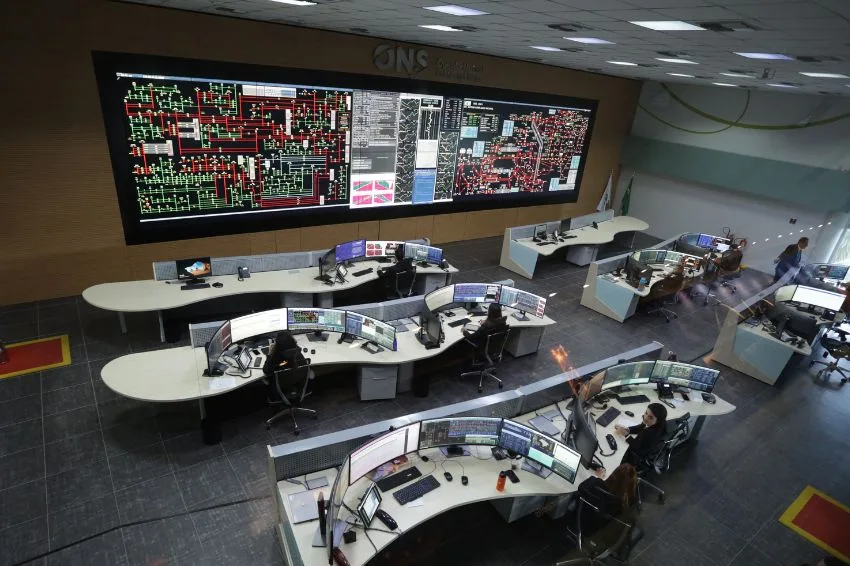
The ONS (National Electric System Operator) must send to ANEEL (National Electric Energy Agency) by October 31st the details of the Excess Energy Management Plan in the Distribution Network.
The plan provides for, in exceptional circumstances, generation curtailment at Type III plants (connected to distribution and not dispatched by the ONS). Protocols for remote mini-generators will then be addressed.
The information was released to the press after a meeting held between the ANEEL, the ONS and ABRADEE (Brazilian Association of Electric Energy Distributors) on Friday afternoon at the Agency's headquarters. The meeting was not public and was not open to the press.
As justification, the Operator reported that “there is an excess of supply in the system during the daytime, mainly due to the accelerated growth of Micro and Mini Distributed Generation (MMGD)”.
“At a time of low energy demand, as recorded on May 4 and August 10, 2025, distributed generation met a high percentage of the load, which meant that the ONS had to implement the reduction/shutdown of a large number of plants dispatched by the Operator, in order to maintain the balance between load and generation, aiming at controlling the system's frequency,” reported the ONS.
The Operator also informed that, if necessary, the ANEEL will evaluate regulatory measures complementary to existing regulations to enable the implementation of the plan.
What are Type III plants?
Plants connected outside the Basic Grid that do not cause impacts on the SIN's electroenergetic operation or self-production projects connected to the Basic Grid, whose demand is permanently greater than generation, are considered in the Type III operating mode.
Plants classified as Type III operating mode do not have centralized programming or dispatch and, for this reason, do not have an operational relationship with the ONS and operate according to the rules of the local distributor.
Some examples include small hydroelectric plants (SHPs) and large hydroelectric plants (CGHs) connected to the distributor grid, at medium voltage, without systemic effects; industrial cogeneration when self-consumption exceeds generation; and small solar plants connected to the distribution network, with local operation. These cases fall under the definition of Submodule 7.2 of the Grid Procedures.
Second ONS open data, there are approximately 1,7 type III plants, of which more than 360 are solar plants.
all the content of Canal Solar is protected by copyright law, and partial or total reproduction of this site in any medium is expressly prohibited. If you are interested in collaborating or reusing part of our material, please contact us by email: redacao@canalsolar.com.br.



Comments
Comments are moderated before publication.Comments should be respectful and contribute to a healthy debate. Offensive comments may be removed. The opinions expressed here are those of the authors and do not necessarily reflect the views of the author. Canal Solar.