
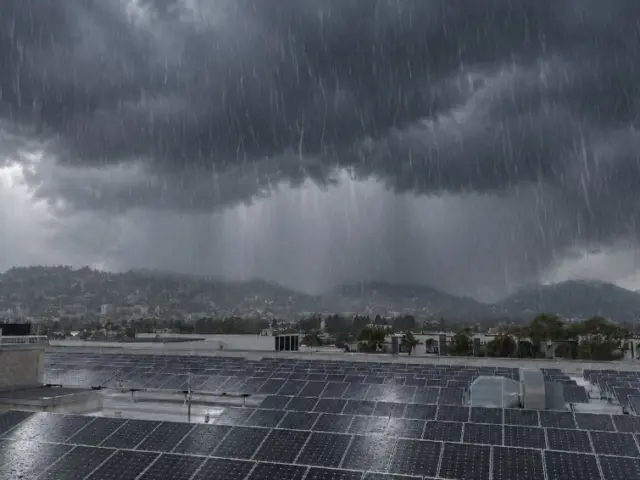
With an investment of R$20,7 million, the Armed Forces Hospital invested in the construction of a solar carport with a capacity of 5 MW. In total, the plant has 9.176 panels in a total area of 25 thousand square meters. The plant has technology MLPE (Module-Level Power Electronics).
When completed, the carport, with over 1,5 spaces, will allow for an estimated monthly savings of approximately R$335 or R$4 million per year, with a payback period of five and a half years. The first stage of the project coincided with the celebration of the hospital's 50th anniversary. During this phase, 1.850 solar panels were installed, representing 20% of the modules that will be installed throughout the project.
Read also
“It took three months to execute the project, two months for the prototype and five months to execute this first stage. We are already 40% complete and delivery is scheduled for August,” says Fábio Lamounier, CEO of Renova Engenharia, the company responsible for carrying out the construction.
The photovoltaic kits used in the plant were supplied by Ecori Solar Energy. “We are very excited to be part of the construction of the largest MLPE plant in Brazil. A highly complex project like this reinforces that MLPE technology is the most modern and suitable for all types of use. In addition, the carport model indicates that it is possible to expand the use of photovoltaic solar energy on a large scale in commercial and service areas within cities,” says Leandro Martins, president of Ecori Energia Solar.
Project particularities
Lamounier says that building a carport is even more complex when it is a hospital, a place that requires extra care. “This project is challenging. We need to adapt our needs to the local reality. All this with the aggravating factor of being a hospital area, where we need to always be vigilant with issues such as power outages, the use of sound tools, among other points that we discover on a daily basis”, he explains.
Another key issue in the construction of the plant is the safety of the structure to withstand traction efforts such as those caused by the wind. To achieve this, the structure and foundation designs were studied until the engineers arrived at the best structure model, with single support posts in the central area between two parking spaces, instead of double posts at the ends of each space.
In other words, with the structure supported at a single point, with a slope of 12 degrees and a minimum height of three meters and a maximum height of 5,2 meters. “This solution was based on several analyzes and expert reports. In addition, a traction procedure was carried out, simulating pulling out by the wind to check whether what was designed would be within the proposed conditions. Thus, the system supported a traction load up to twice as high as expected in the project”, explains Lamounier.
Expanded partnership with the Ministry of Defense
This is the second highly complex solar energy project carried out by Ministry of Defense. The first, inaugurated a year ago, was the installation of a photovoltaic plant with MLPE on the roof of the ministry itself, on the Esplanada dos Ministérios, in Brasília.
The plant, with an installed capacity of 528 kWp, received an investment of R$2,4 million and has around 1.600 panels in an area of 3,2 square meters. The plant supplies around 35% of the energy consumed, which reduced the electricity bill and also made the building more sustainable. All solar energy equipment was supplied by Ecori and sales, engineering and installation were also carried out by Renova Engenharia.
“Our presence in projects like these reinforces our commitment to bringing solar energy within reach of everyone, whether in homes, public buildings, industries, businesses and services. Photovoltaic solar energy is a sustainable and good source for everyone”, highlights Martins.

Comments (1)
Comments are moderated before publication.Comments should be respectful and contribute to a healthy debate. Offensive comments may be removed. The opinions expressed here are those of the authors and do not necessarily reflect the views of the author. Canal Solar.
I've already contacted an Army office (I'm in the military) so that they really wake up to the free and profitable nature of solar energy…….
Armed Forces spend billions a year on electrical energy…. (no more throwing it away to dealerships) they already receive the contracted demand (that's enough)