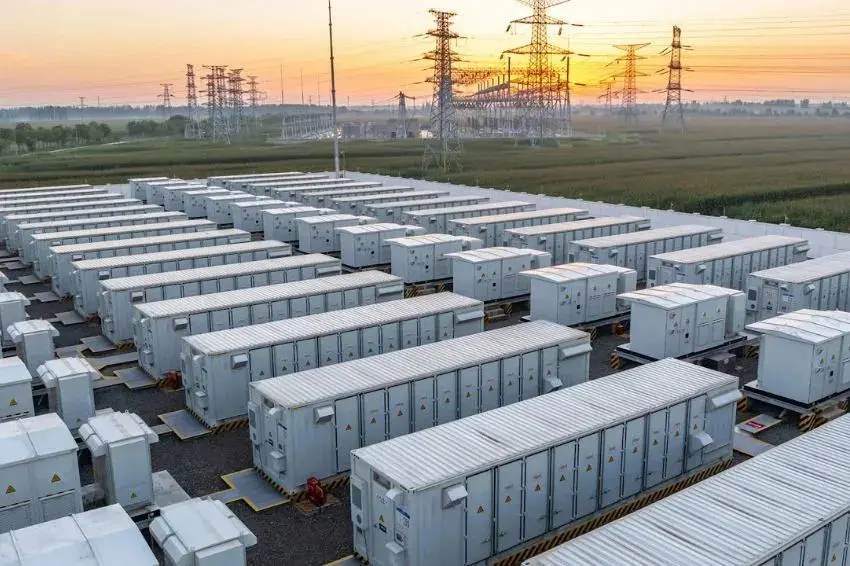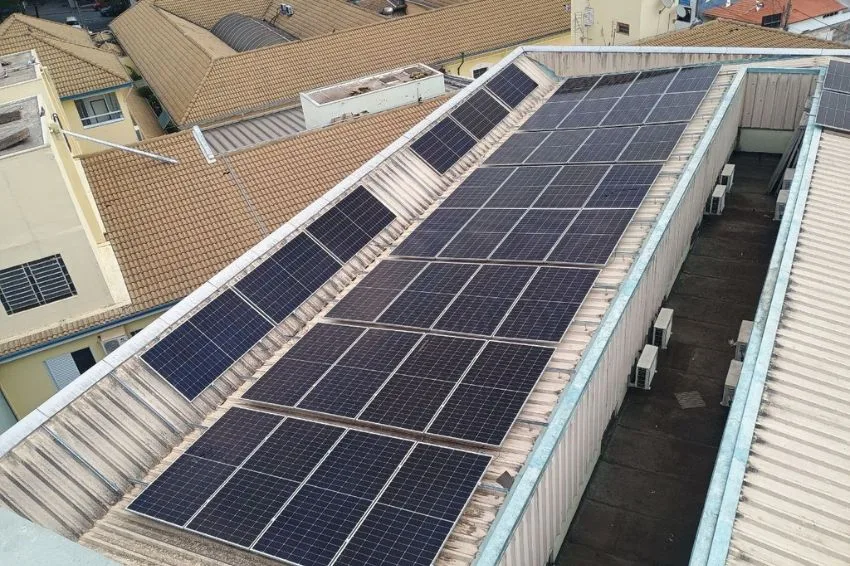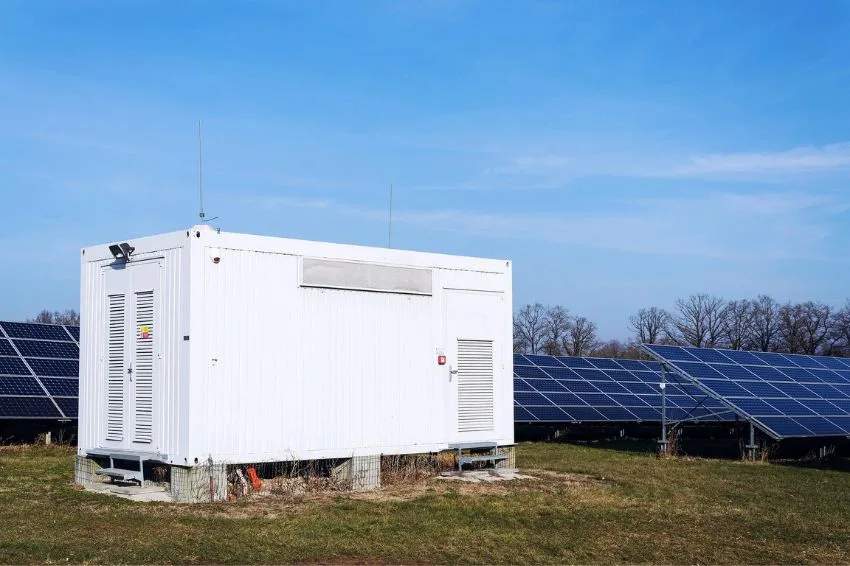

The energy generated by a photovoltaic system is directly proportional to the surface area of its modules, which must be installed in open areas, often occupying large areas, which can reach a few square kilometers in large solar plants.
A direct consequence of the large surface area is the great vulnerability of photovoltaic systems to direct and indirect atmospheric discharges [1], which account worldwide for up to 26% of all failures occurring in these installations [2].
Despite the growth of photovoltaic solar generation in Brazil, many entrepreneurs in this sector do not invest the necessary resources in protection against lightning strikes (PDA) [3], thus making their investments subject to losses that could be minimized if these natural phenomena - significantly frequent in Brazil – received due importance [4].
The absence of adequate protection measures can destroy or damage, totally or partially, photovoltaic systems, delaying the return on investment in their construction. For this to be avoided, it is necessary to provide the photovoltaic market with objective and accurate information about the risks associated with lightning strikes and how to reduce them [5].
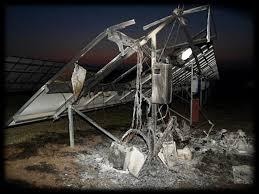
Atmospheric discharges cause damage to structures in four different ways, as shown in the following table.
Table 1 – Prepared by the author based on the technical standard ABNT NBR 5419-1:2015

Protection against atmospheric discharges
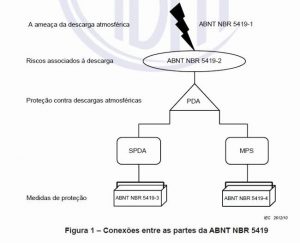
The PDA is divided into SPDA (atmospheric discharge protection systems) and MPS (surge protection measures) [6] (Figure 2). The SPDA is responsible for protecting the structure against the effects of a direct atmospheric discharge (S1), consisting of external protection by the collection, descent and grounding subsystems, and internal protection [7] by the safety distance and equipotentialization.
As each of these elements has its specific characteristics, they must be analyzed, as the standard itself does, individually, and then interconnected in an appropriate way so that they have the efficiency expected from an SPDA.
-

Figure 2 – Structure of the PDA. Source: ABNT NBR 5419:2015
Capture subsystem
The capture subsystem is fundamental for protecting a structure against lightning, because it is the first element of the SPDA to come into contact with the atmospheric discharge, thus preventing it from reaching an object that does not have the capacity to absorb and conduct such a large amount of lightning. amount of energy.
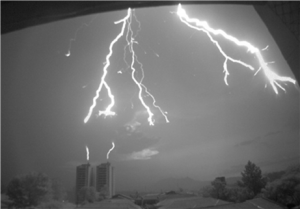
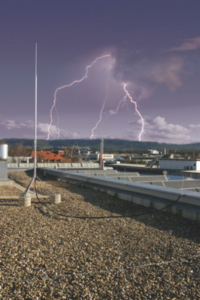
The catchers do not attract, capture or stop the rays, they intercept them by being positioned at strategic points of a structure, from which ascending leaders are emitted that meet the stepped leaders that come out of the clouds, breaking the dielectric strength of the air through jumps , origin of the name staggered.
As the point, among several, where the ascending leader that connects to the echelon comes from is the one that will be struck by lightning, all possible locations capable of emitting ascending leaders must be protected by the captors (Figure 3).
This theory is known as the electrogeometric model and is the basis for calculating the positioning of lightning arresters in a structure. According to technical standard ABNT NBR 5419:2015, the probability of lightning current penetrating a structure is significantly limited by the correct installation of a lightning arrester subsystem.
They are formed by the combination of rods (including masts), suspended conductors and mesh conductors (Figure 4).
Whatever the composition of the capture subsystem, all capture elements must fully comply with the requirements of the standard, and it is the correct positioning of these elements, forming a capture subsystem, which will determine the volume of protection, the region of space protected from the direct impact of an atmospheric discharge.
If individual sensors are used, they must be interconnected at the coverage level to ensure the division of current into at least two paths.
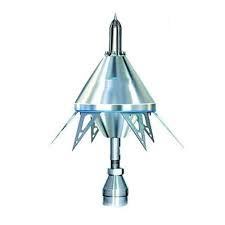
A fundamental point for professionals and users of photovoltaic systems is the non-acceptance by ABNT NBR 5419:2015 of the use of detectors that are intended to attract lightning or prevent them from coming towards the ground.
This standard only specifies capture methods of efficiency recognized by the international scientific community, not recognizing the validity of artificial resources intended to increase the protection radius of the capturers or inhibit the occurrence of atmospheric discharges (Figure 5).
The capture subsystem components installed in the structure must be placed primarily in protruding corners, exposed ends and edges, according to one or more of the following methods:
- Protection angle method;
- Rolling ball method;
- Mesh method.
According to the standard, the rolling sphere and mesh methods are suitable in all cases and the protection angle method is suitable for buildings with a simple shape, being limited by the height of the sensors in relation to the reference plane that it must protect.
Therefore, contrary to what many professionals believe, increasing the height of the sensor mast does not represent a greater protected area, and may even mean the opposite effect.
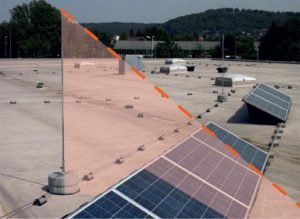
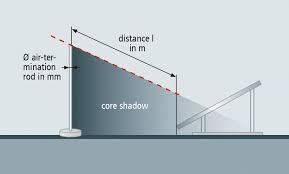
In relation specifically to the protection of photovoltaic systems, it is important to observe the creation of shading areas by the capturers on the photovoltaic modules, which can be avoided by using mini capturers or masts relatively far from the modules, in both cases studying previously the relationship between the effectiveness of capturing versus the efficiency of using sunlight.
Another important aspect in the design of LPS for photovoltaic systems is the option between isolated and non-isolated systems. While an isolated LPS (Figure 7) has no galvanic connection between its sensors and down conductors and the photovoltaic system, a non-isolated LPS (Figure 8) has a metallic connection with the photovoltaic system – therefore the impulse current, a portion of the atmospheric discharge current intercepted by the LPS, circulates through the modules, support structures, cables and inverters, which in this case will require appropriate protection measures to allow this current to pass through.
-

Figure 7 – Isolated SPDA. The lightning current does not pass through the SFV, only induced currents are conducted through it. Source: DEHN
Conclusion
The effectiveness of a capture subsystem depends on the correct positioning of the capture devices, placing any object that should not be directly hit by an atmospheric discharge within its protective volume. In relation to photovoltaic systems on the tops of buildings, their presence will not increase the incidence of atmospheric discharges in these buildings, but it will be necessary for all elements of the photovoltaic system, especially its modules, to be included in the capture subsystem design.
References
- 1) HERNÁNDEZ, JC; JURADO, Francisco; VIDAL, PG; Lightning and Surge Protection in Photovoltaic Installations. IEEE Transactions on Power Delivery. Volume 23, nº4. October 2008.
- 2) ZHANG, Yang; CHEN, Hongcai ; DU, Ya Ping. Considerations of Photovoltaic System Structure Design for Effective Lightning Protection. IEEE Transactions on Electromagnetic Compatibility. May 2020.
- 3) SANTOS, Sergio. Protection against atmospheric discharges in photovoltaic plants. Canal Solar. August 2020. https://canalsolar.com.br/protecao-contra-descargas-atmosfericas-em-usinas-fotovoltaicas/
- 4) Did you know? Atmospheric Electricity Group (ELAT). National Institute for Space Research (INPE). http://www.inpe.br/webelat/homepage/menu/el.atm/perguntas.e.respostas.php
- 5) PINHO, João Tavares; GALDINO, Marco Antonio. Engineering Manual for Photovoltaic Systems. Solar Energy Working Group (GTES). CEPEL, DTE, CRESESB. March 2014.
- 6) Brazilian Association of Technical Standards (ABNT). ABNT NBR 5419-1:2015. Lightning protection Part 1: General principles. https://www.abntcatalogo.com.br/norma.aspx?ID=333548 7) The expression internal protection is used because normally in buildings these are elements installed inside, unlike what generally happens in SFV .