
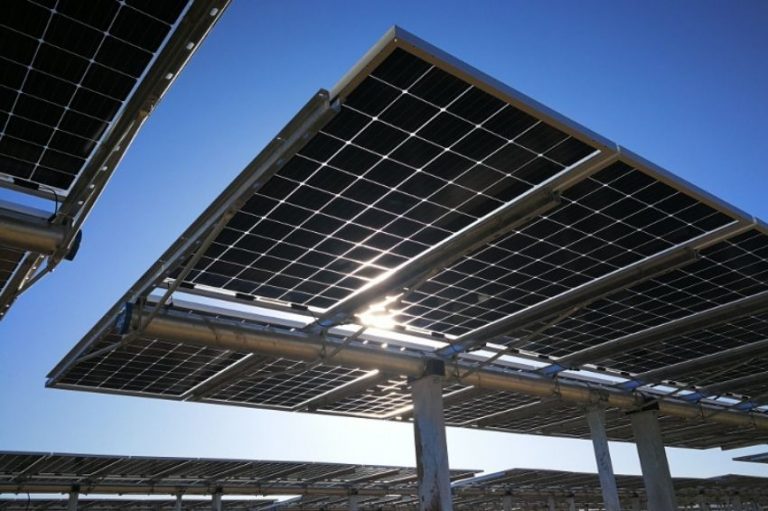
Bifacial photovoltaic modules have been gaining great competitive power in the recent market and, with the variants that occurred on the market in 2020, there will undoubtedly be a “boom” of this product in the distributed generation market in 2021.
Unlike monofacial modules, which are relatively simple to size, this technology requires a much more careful and individualized analysis. So, what are the differences that we should take into account in a project? How much can adjusting just one of the variables influence the electricity generation of my system?
This is what we will bring in this article, mainly addressing the use of the PVSyst tool (the main tool in the photovoltaic market) for correct sizing.
Learn more: Course PV Systems Project with PVSyst and SOLERGO do Canal Solar
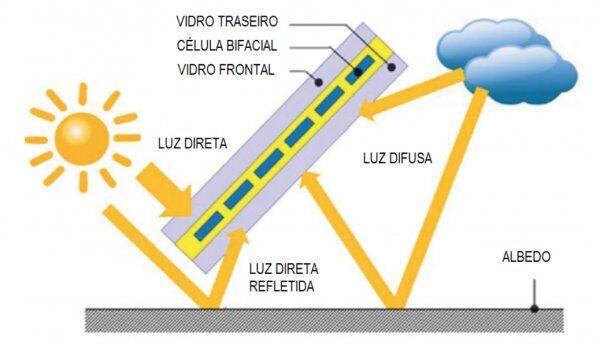
In general, the bifacial module was created with the aim of making even greater use of solar radiation in photovoltaic systems. As we know, solar radiation is abundant and practically inexhaustible, and much of it is not used by photovoltaic modules. This additional generation is obtained by using radiation reflected by the ground and collected by the back of the module.
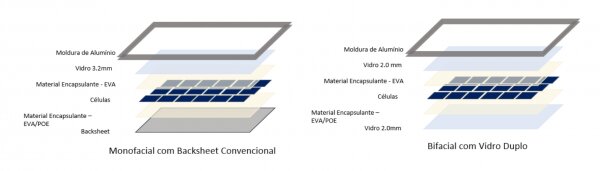
Unlike conventional modules, which have a plastic sheet on the back to protect and insulate the cells, bifacial modules can collect light from both sides. This is possible due to a change in the module's rear coating, where a layer of glass or a transparent coating replaces the traditional white backsheet, as is done in monofacial modules.
In addition, bifacial cells are used, which do not have integral rear metallization, allowing light capture. You can learn more about bifacial modules in the article “Understand bifacial solar modules".
The generation gain of the bifacial module is directly related to the incidence of light (diffuse and direct reflected) on the back of the photovoltaic module, as illustrated below.
The main factors that influence the energy gain from capturing light at the back of the module include: albedo, module height, pitch (distance between tables), shading from the fixing structures and tilt angle. But how should we consider each of these factors in PVSyst? Where can we find these values for a correct simulation? In general, we should follow the following steps to make these modifications:
- Open a new project, select the location and add the orientation and type of fixing;
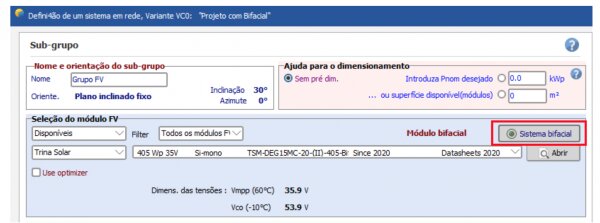
- Select “System” and then choose a module with bifaciality for the system and configure it using “Bifacial System”, as indicated below.

- Use the “Unlimited Sheds 2D Model” model to configure rows of modules in projects with a fixed structure and “Unlimited Trackers 2D Model” for projects with a tracker

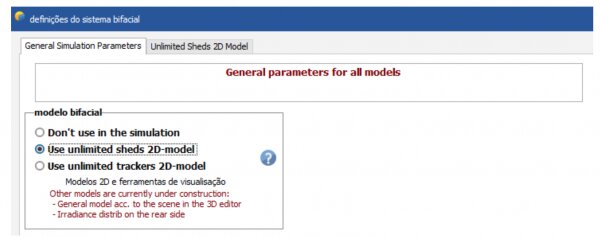
Once this is done, we must modify the parameters in “Unlimited Sheds 2D Model”, where we can change:
Albedo: Reflectivity of the soil where the bifacial modules will be installed. A typical albedo for sand or gravel is usually considered to be around 30% to 35%. This factor has a great impact on the gain of the rear part of the photovoltaic module.
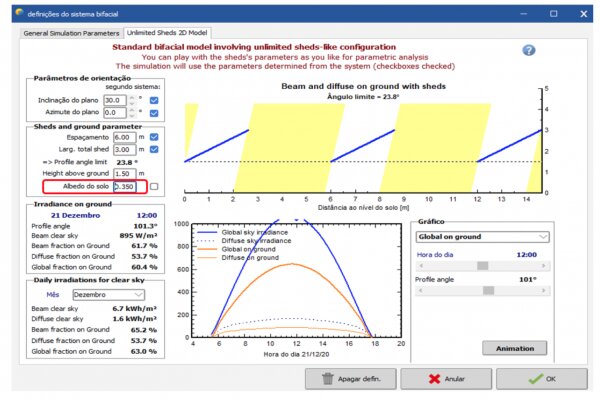
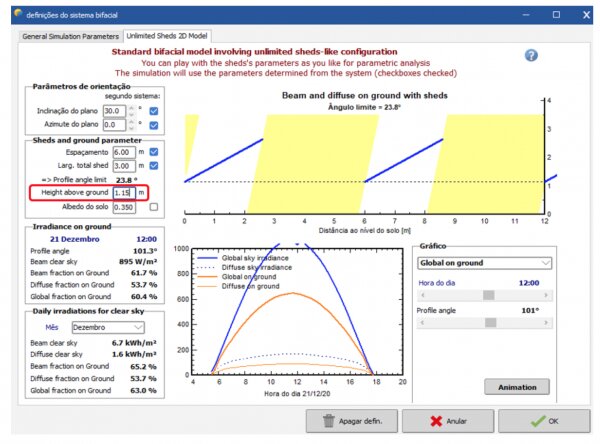
Height above ground: This item varies according to the structures where the modules will be installed. According to what we have today in the structures market, a height between 0,5 m and 1,50 m is considered here. Note that for the fixed structure model, the height refers to the lower point of the photovoltaic module in relation to the ground, while for the model with trackers, the height of the tracker axis in relation to the ground is used.
Spacing between rows of modules: Traditionally in plants with monofacial modules this value is between 5 m and 7 m, however in plants with bifacial modules it is interesting, if possible, to use a greater distance to make better use of the rear gain (a value of around 12 m is recommended) .
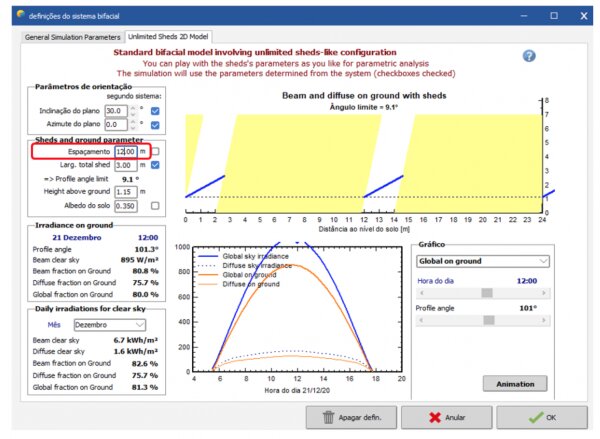
We can consider that these are the 3 main parameters that need to be dimensioned when working with bifacial modules in PVsyst, seeking to optimize generation with this type of module. However, there are some parameters that are not directly related to bifaciality, but that must also be adjusted for a correct simulation, which are related to the higher quality of the material used in manufacturing, mainly due to the glass layer on the back, which causes less degradation over time, thus increasing energy generation over its useful life.
Modules with this feature are entering the market with a 30-year performance guarantee, with annual degradation of around 0,5% per year, while monofacial modules usually have degradation of around 0,6 per year. To change these parameters, after selecting and configuring the system as listed above, click on Advanced Simulation, as highlighted.
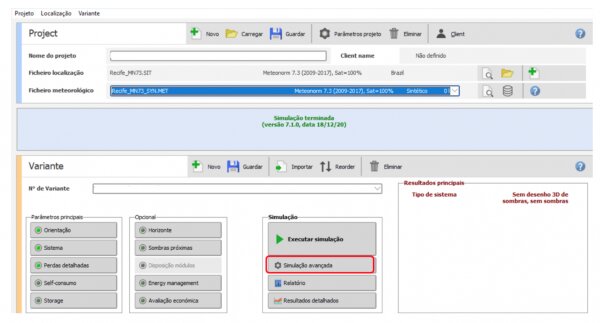
And then click on Aging.
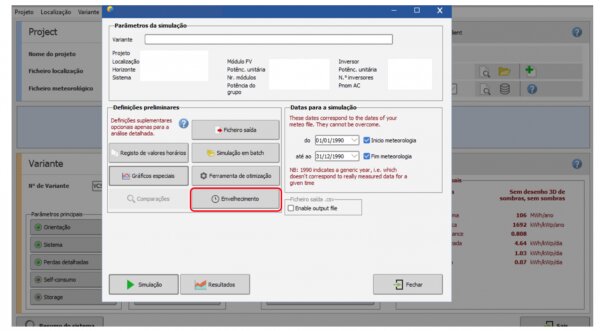
Next, select the detailed loss – aging option, so that the specific options for each module can be accessed.
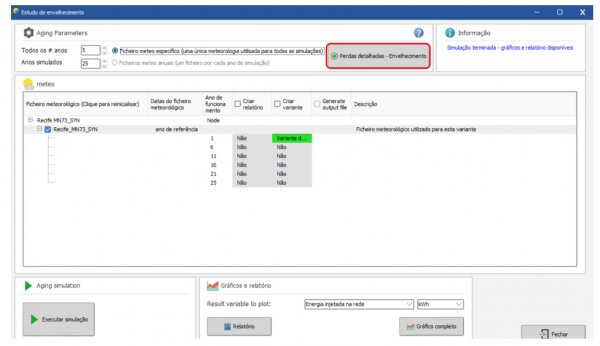
The following window will open, with the characteristics of the selected module:
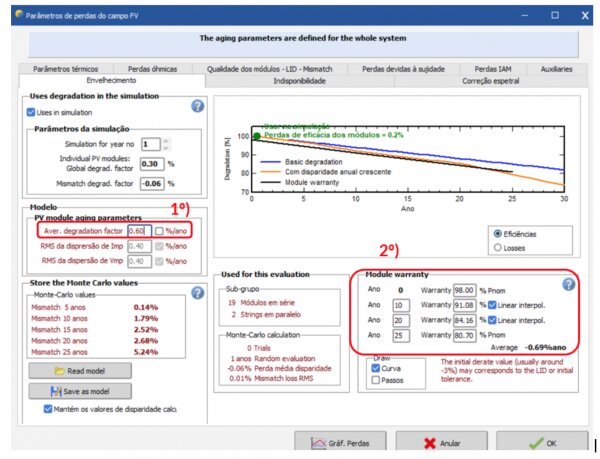
In this tab, it is important to make the following adjustments:
- Annual degradation of the photovoltaic module: Traditional monofacial modules (of good quality) usually have annual degradation of between 0,6-0,7% per year – this information must be available in the equipment's technical data sheet. Bifacial modules, due to the double glass characteristic already mentioned, are less prone to this annual degradation, which is around 0,5% per year.
- Photovoltaic module performance guarantee: It is also important to correct the percentages of power guaranteed by the manufacturer throughout the useful life of the system so that the simulation is more accurate and reflects conditions closer to reality in the operation of both products and we can differentiate each of them. And this window will look like this:
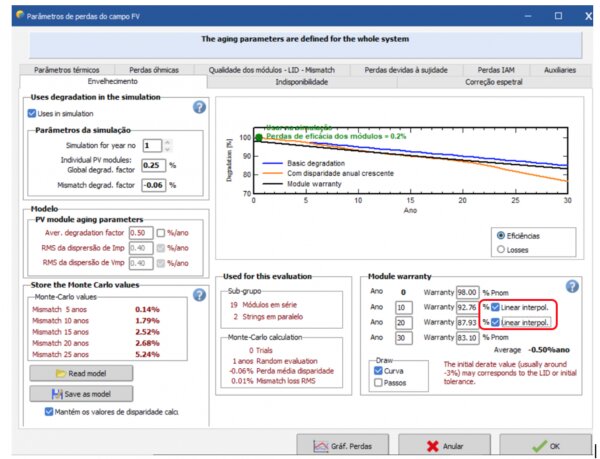
Finally, it is essential that, after changing the performance guarantee values in year 30 (or 25, depending on the module), the checkbox called Linear interpol is selected, as highlighted. This option adjusts (interpolates) the guarantee values for the other intermediate years. After these adjustments, click OK and then the system simulation with a bifacial module can be performed more accurately.
In this first part of the article, we bring the main concepts and variables that must be changed in the PVSyst software so that simulations with bifacial modules are more realistic and better represent the real operating conditions to which this equipment will be subjected in the field.
However, what is the impact of these variables on energy generation? Should I space out the module tables more? Perform a soil treatment for better reflectivity and greater albedo? This is what we will see in the following article, where we will do a case study with these modules.


Comments (5)
Comments are moderated before publication.Comments should be respectful and contribute to a healthy debate. Offensive comments may be removed. The opinions expressed here are those of the authors and do not necessarily reflect the views of the author. Canal Solar.
Top I need to learn more
Hello Jose! Check out our webinar on Bifacial Modules: https://www.youtube.com/watch?v=ICtiWZklHrE&t=397s
I am an electrical engineer experienced in small and large construction projects such as hydroelectric, biomass, alcohol and sugar, wind, photovoltaic, thermal, gas plants, substations and transmission lines up to 500 kV. I graduated from USP in São Carlos SP in 1974. I would like to be a Solar Energy PROMOTER for your company with the right to earn a commission if you make any real sales.
Hello, Nivaldo, how are you? We are not distributors, we are a news channel about solar energy, we offer courses and consultancy in the area. If you are interested in a partnership, send an email to: marketing@canalsolar.com.br
Beautiful material!