
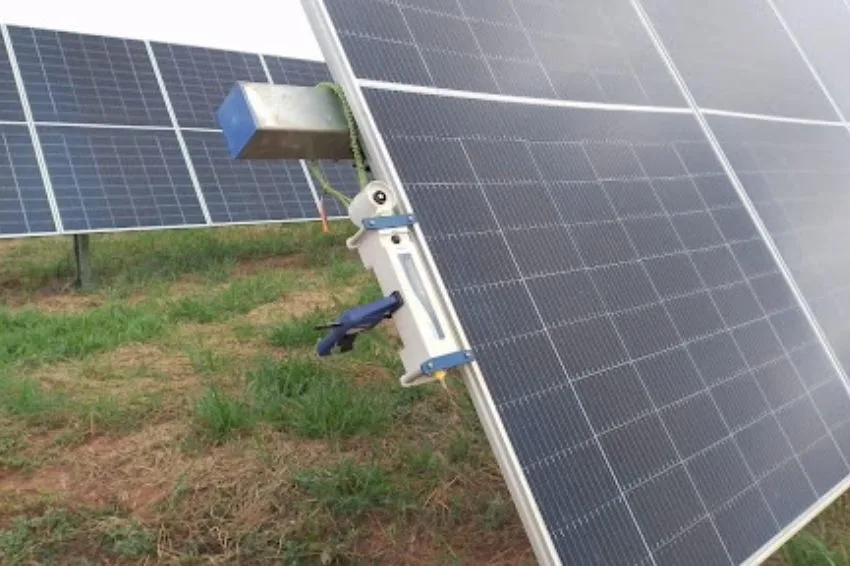
Commissioning tests for photovoltaic systems are basically divided into two categories: category 1 (cold) and category 2 (hot), that is, before and after the power plant is energized. They are indicated not only for large-scale power plants, but for all types of photovoltaic generation.
Although there are no regulations regarding the regularity of tests, in order to guarantee satisfactory operating conditions, plant longevity and safety, it is recommended to carry out periodic tests to know the operational state of the project.
Figure 1 shows an IV curve test performed by CS Consultoria e Serviços at a mini-generation photovoltaic plant.
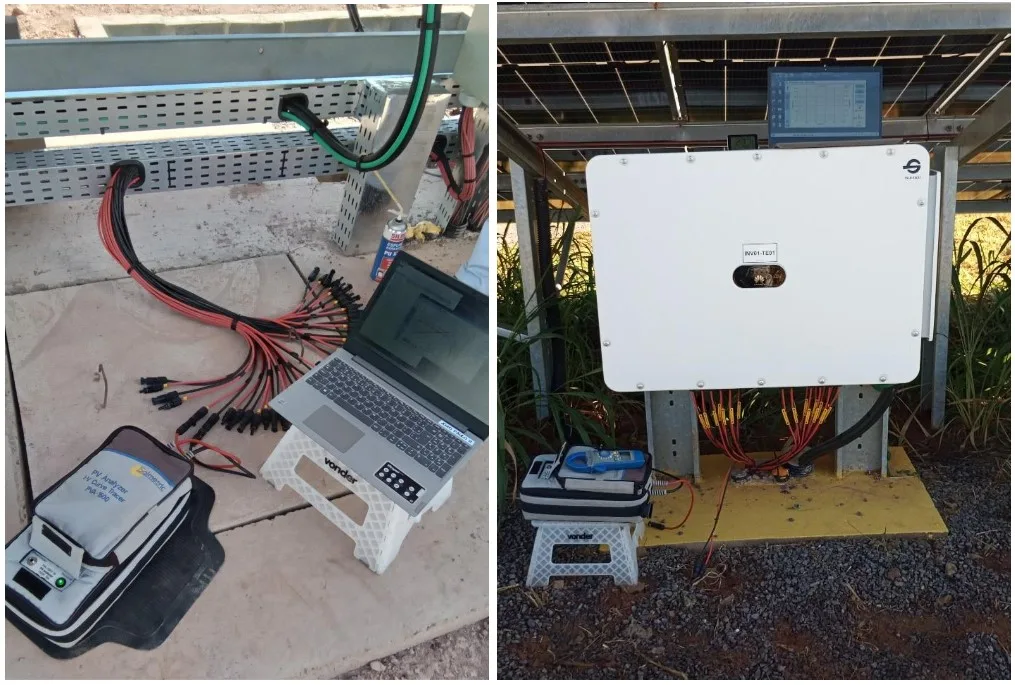
Within the tests classified as category 2, there is the IV Curve test, which is a test foreseen in NBR 16274: Grid-connected photovoltaic systems – Minimum requirements for documentation, commissioning tests, inspection and performance evaluation.
This test is presented in Figure 1 and can be carried out with equipment commonly known in the solar sector as an IV curve tracer.
The IV curve test is one of the best ways to identify anomalies that cannot be easily detected in photovoltaic plants and are directly linked to the plant's efficiency.
In addition, the test provides information regarding the values of open-circuit voltage (Voc), short-circuit current (Isc), maximum power current (Imp), and maximum power voltage (Vmp).
Some equipment can already directly provide other electrical parameters such as: Performance Factor, Maximum Power, Fill Factor, and others. However, these are variables that can be calculated from the basic parameters measured by IV curve devices.
For context, the short-circuit current (Isc) is the maximum electrical current that the module can supply. The open-circuit voltage (Voc) is the maximum voltage that the module presents at its terminals when the series circuit or the module is open.
Maximum power current (Imp) is the current that the module supplies when operating at its maximum power point. Maximum power voltage (Vmp) is the voltage that the module or string presents when operating at its maximum power point. These electrical parameters are crucial for evaluating the performance and efficiency of a photovoltaic power plant.
Are you curious to know more? Download now 23nd edition of the Magazine Canal and read the full article!
The opinions and information expressed are the sole responsibility of the author and do not necessarily represent the official position of the author. Canal Solar.



Comments
Comments are moderated before publication.Comments should be respectful and contribute to a healthy debate. Offensive comments may be removed. The opinions expressed here are those of the authors and do not necessarily reflect the views of the author. Canal Solar.