• Tuesday, January 13, 2026
Facebook X-twitter Instagram Youtube LinkedIn Spotify
  • GC Solar: 17,95 GW
  • GD Solar: 41,3 GW
  • TOPCon Modules: $0,088/W
  • P-Type Cells: $0,034/W
  • N-Type Cells: $0,032/W
  • HJT Modules: $0,10/W
  • N-Type Wafer: US$0,128/pc
  • Polysilicon: US$ 19,00/kg
  • GC Solar: 17,95 GW
  • GD Solar: 41,3 GW
  • TOPCon Modules: $0,088/W
  • P-Type Cells: $0,034/W
  • N-Type Cells: $0,032/W
  • HJT Modules: $0,10/W
  • N-Type Wafer: US$0,128/pc
  • Polysilicon: US$ 19,00/kg
  • advertise here
  • About us
  • Expedient
logo site solar channel
  • News
    • energy storage
    • Market and Prices
    • Investments & Business
    • Policy and Regulation
  • Articles
    • Batteries
    • Photovoltaic structures
    • Photovoltaic inverters
    • Opinion
  • Renewable
  • Latam
  • Blog
  • Solar Energy Companies
  • Integrators
  • Magazine
    • Magazine Canal Solar
    • Conecta Magazine
  • Events
  • Videos
  • Electric Vehicles
  • Consultancy
  • Academics
  • News
    • energy storage
    • Market and Prices
    • Investments & Business
    • Policy and Regulation
  • Articles
    • Batteries
    • Photovoltaic structures
    • Photovoltaic inverters
    • Opinion
  • Renewable
  • Latam
  • Blog
  • Solar Energy Companies
  • Integrators
  • Magazine
    • Magazine Canal Solar
    • Conecta Magazine
  • Events
  • Videos
  • Electric Vehicles
  • Consultancy
  • Academics
  • News
    • Brazil
    • World
    • Technology and inovation
  • Articles
    • technicians
    • Opinion
  • Renewable
  • Latam
  • Blog
  • Solar Energy Companies
  • Integrators
  • Magazine
    • Conecta Magazine
  • Events
  • Videos
  • About Us
  • Advertise Here
  • CS Consulting
  • Canal VE
  • Academics
  • News
    • Brazil
    • World
    • Technology and inovation
  • Articles
    • technicians
    • Opinion
  • Renewable
  • Latam
  • Blog
  • Solar Energy Companies
  • Integrators
  • Magazine
    • Conecta Magazine
  • Events
  • Videos
  • About Us
  • Advertise Here
  • CS Consulting
  • Canal VE
  • Academics
logo site solar channel
Home / News / Derating in photovoltaic inverters: power loss and how to deal with it.

Derating in photovoltaic inverters: power loss and how to deal with it.

Understand the factors that limit solar energy generation and practical measures to prevent a reduction in efficiency.
Follow on Whatsapp
  • Photo by Youssef Barreiros Youssef Barreiros
  • November 21, 2025, at 10:36 PM
4 min 50 sec read
Derating in photovoltaic inverters: power loss and how to deal with it.
Photo: Canva

Under conditions where the inverter risks operating with internal temperatures above the nominal level or with an overpower on the direct current (DC) side exceeding the nominal power of the alternating current (AC) output of the inverter, a limitation of the generation curve is observed, i.e., the performance of the PV plant is reduced. 

This behavior, called derating, consists of the inverter automatically limiting the output power in order to keep the operation within safe thermal and electrical limits, thus reducing the risk of overheating and stress on the components.

Derating involves a controlled reduction in power generation and delivery so that the inverter does not operate under conditions that could compromise the reliability and limitations of its internal components. 

This self-protection strategy does not interrupt generation, but regulates it temporarily and, over time, contributes to greater reliability and a longer lifespan for the system.

It's important to note that each piece of equipment has its own operating limits and a reduction scheme based on its temperature. Not all behave the same way: some may reduce power in less severe temperatures or conditions than other brands.
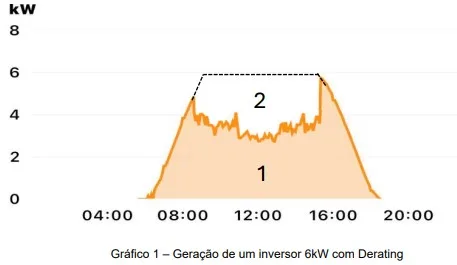
1 - Region corresponding to the inverter's generation. 2 - Region corresponding to the energy that could have been generated by the inverter.
1 – Region corresponding to the inverter's generation.
2 – Region corresponding to the energy that could have been generated by the inverter.

The most common factor associated with derating is temperature. Every inverter has sensors and control logic that limit power when the temperature exceeds the equipment's operating range. Conditions such as poorly ventilated environments and direct sunlight contribute to derating.

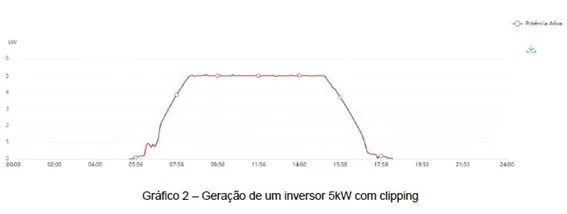
Another common factor is clipping: when the photovoltaic module array delivers more energy than the inverter's output limit, the excess is cut off. A slight DC/AC oversizing tends to be beneficial for annual utilization; the problem lies in excess, which raises the temperature of the array and increases the likelihood of derating.
Furthermore, the electrical grid plays a significant role. Inverters operate with a kVA ceiling; thus, when operation requires reactive power (power factor other than 1), there is less "room" for kW, and the active power delivered drops even without extreme heat. 

Voltage and frequency variations can also trigger support functions that reduce power to stabilize the connection point. 

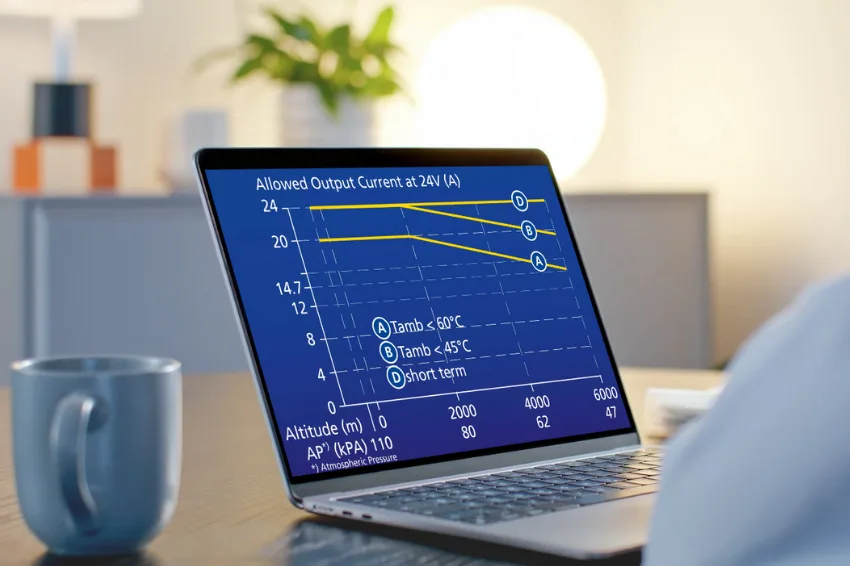
Among the brands present in the market, AUXSOL inverters stand out with some features that help delay derating and maintain stable production. In all their lines, they support overload of up to 100% without derating at 45°C, meaning the nominal power is sustained up to this ambient temperature level.
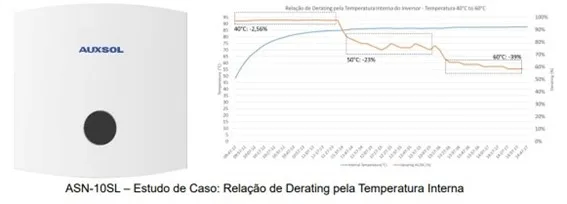
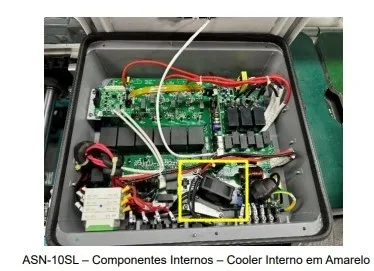
To handle heat, several models employ forced ventilation (fan-cooling) combined with finned heat dissipation, which blends robust heat dissipation with directed airflow. Additionally, the casing is usually constructed from alloys with high thermal conductivity (such as aluminum), which accelerates heat transfer and dissipation. It's worth noting that the entire AUXSOL line features inverters with either a fan or an exhaust fan.
In hybrid systems, AUXSOL also offers intelligent 24-hour energy management, with operating modes and remote diagnostics — features that help smooth out peaks, make better use of generation, and reduce situations that could lead the inverter to operate under unsuitable conditions. 

In practice, those monitoring the data will recognize derating by the curve's shape: on cold days with clear skies, the peak may appear "clipped." On hot days, the power output settles below the expected peak, sometimes fluctuating as the cooling system operates. Platforms often register high-temperature alerts. This is not an "inverter failure": it's the equipment preserving its internal components and operating limitations.

Tips on how to avoid derating: 

  • Install the inverter in a shaded area with enough space for ventilation: avoid enclosed spaces and recirculation of hot air; respect the spacing indicated in the installation manual;
  •  Plan the ventilation of the space: a path of clear air, allowing cool air in and warm air out; keep entrances/exits unobstructed;
  • Adjust the DC/AC ratio to the climate: in hot regions, be more restrained in overload to avoid turning theoretical gain into loss due to temperature derating. 
  • • Ensure that the sizing of the photovoltaic arrays falls within the optimal operating range of the inverters;
  • If reactive power operation is routine, opt for inverters with excess kVA to preserve kW under PF ≠ 1;
  • Keep filters, fins, and ventilation systems clean; ensure firmware is updated and operating parameters are appropriate for the power grid to which the inverter is connected;
  • Where heat is constant, prioritize models with fan-cooling and IP66 protection, which better withstand harsh environments. 

Remember that derating isn't the villain; it's the inverter acting to protect its internal components so they operate within their nominal operating limits. The goal isn't to eliminate it, but rather to prevent it from appearing too early or lasting too long. 

With proper installation and sizing, along with the features AUXSOL offers (high efficiency, active ventilation, IP66 protection, intelligent management, and rated power up to 45°C), your project will operate more efficiently. It will also have a long lifespan, even in regions with high temperatures.

all the content of Canal Solar is protected by copyright law, and partial or total reproduction of this site in any medium is expressly prohibited. If you are interested in collaborating or reusing part of our material, please contact us by email: redacao@canalsolar.com.br.

derating by temperature photovoltaic inverters
Photo by Youssef Barreiros
Youssef Barreiros
Control and Automation Engineer, postgraduate in Photovoltaic Solar Energy from PUC-MG, with 5 years of experience in the sector. Works as a Pre-Sales Engineer at AUXSOL/Nansen Solar, developing technical and commercial solutions for integrators, distributors, and large clients.
PreviousPrevious
NextNext

Leave a comment Cancel reply

Your email address will not be published. Required fields are marked with *

Comments should be respectful and contribute to a healthy debate. Offensive comments may be removed. The opinions expressed here are those of the authors and do not necessarily reflect the views of the author. Canal Solar.

News from Canal Solar in your Email

Posts

Fox ESS offers free online classes to empower solar energy professionals.

Fox ESS offers free online classes to empower solar energy professionals.

Distributed generation is projected to grow 15% in 2026, according to ABGD.

Distributed generation is projected to grow 15% in 2026, according to ABGD.

More news

Read More
The Brazilian electricity sector raised R$ 114,6 billion in 2024, according to PwC Brazil.
  • December 24, 2025
Photo by Caique Amorim
Caique Amorim

The Brazilian electricity sector raised R$ 114,6 billion in 2024, according to PwC Brazil.

Project promoting biodigesters in public facilities advances in Minas Gerais.
  • December 12, 2025
Photo by Raphael Guerra
Raphael Guerra

Project promoting biodigesters in public facilities advances in Minas Gerais.

Can FGTS (Brazilian employee severance fund) be used in Caixa's new program?
  • December 4, 2025
Photo by Henrique Hein
Henrique Hein

Can FGTS (Brazilian employee severance fund) be used to finance solar energy under Caixa's new program?

It is a news and information channel about the photovoltaic solar energy sector. Channel content is protected by copyright law. Partial or total reproduction of this website in any medium is prohibited.

Facebook X-twitter Instagram Youtube LinkedIn Spotify

Site Map

Categories

  • News
  • Articles
  • Interviews
  • Consumer Guide
  • Authors
  • Projects
  • Brazil
  • World
  • Technical Articles
  • Opinion Articles
  • Manufacturer Items
  • Electrical Sector
  • Biddings
  • Products

Channels

  • About Us
  • Contact
  • We’re hiring!
  • Privacy
  • Expedient
  • advertise here

Membership and certifications

Copyright © 2025 Canal Solar, all rights reserved. CNPJ: 29.768.006/0001-95 Address: José Maurício Building – Mackenzie Avenue, 1835 – Floor 3, – Vila Brandina, Campinas – SP, 13092-523

We use cookies to make your experience on this site better Find out more about the cookies we use or turn them off in your .

Receive the latest news

Subscribe to our weekly newsletter

Canal Solar
Powered by  GDPR Cookie Compliance
Privacy

This website uses cookies so that we can provide you with the best user experience possible. Cookie information is stored in your browser and performs functions such as recognizing you when you return to our website and helping our team to understand which sections of the website you find most interesting and useful.

Cookies strictly required

Strictly Necessary Cookie should be at all times so that we can save your preferences for cookie settings.

Cookies for third parties

This website uses Google Analytics to collect anonymous information such as the number of visitors to the site, and the most popular pages.

Keeping this cookie enabled helps us to improve our website.