

With the continued growth of installed solar capacity, the global photovoltaic penetration rate continues to expand rapidly. Observing rooftop photovoltaic generation systems, it has become common for photovoltaic strings to have voltages greater than 1000Vdc.
However, high-voltage direct current systems carry significant safety risks: loose connections, insulation wear, and cold solder joints can result in direct current arcing (DC arc). This "invisible flame" is difficult to detect with the naked eye, but it can start a fire in seconds.
Arc Flash: Hidden Threat in PV Systems and the AFCI Solution
Therefore, preventing electrical arcs from the source and performing rapid shutdowns at the millisecond level has become an indispensable safety requirement for photovoltaic generation systems.
DC Arc and its "counterweight": the AFCI
A direct current (DC) arc occurs when the electric current in a DC circuit is forcibly interrupted in a conductive medium, such as copper, but the voltage remains high enough for the current to continue flowing through the air, creating a continuous discharge. Three characteristics of a direct current electric arc:
- High persistence: In DC arcs, there is no zero crossing point; once formed, the arc is difficult to extinguish naturally; High temperature: can exceed 3000°C, easily igniting surrounding materials;
- High level of concealment: It usually occurs silently in terminals and connectors.
- Common causes include: Poor contact in connectors, cold solder joint in the module junction box, aging or damage to cable insulation, animal bites, or damage during installation. installation.
What is AFCI?
The AFCI (Arc Fault Circuit Interrupter) is a device for detecting and protecting against arc faults. It "listens" to current behavior using intelligent algorithms, identifies characteristic arc signals in the waveform, and quickly interrupts the circuit before the danger escalates into a fire.
Operating principle:
- Signal acquisition: real-time monitoring of DC current and voltage waveforms;
- Feature analysis: extraction of high-frequency features and electrical noise generated by arcing;
- Algorithmic identification: AI algorithms distinguish true arcs from normal fluctuations;
- Rapid protection: upon confirming the presence of an arc, it immediately sends a command to disconnect the circuit.
What is module-level shutdown (RSD)?
The Rapid Shutdown Device (RSD) at the module level is the "emergency shutdown device" of the photovoltaic system. When it detects a hazard or power outage, it reduces the module voltage to a safe level (≤30V) within 30 seconds.
Operation principle
When the inverter or controller sends a shutdown signal, the RSD module installed in each panel automatically interrupts the flow of electrical current, blocking power transmission at the module level, and thus reducing the voltage of the entire string to a safe level.
Advantages of AdvanSol's RSD
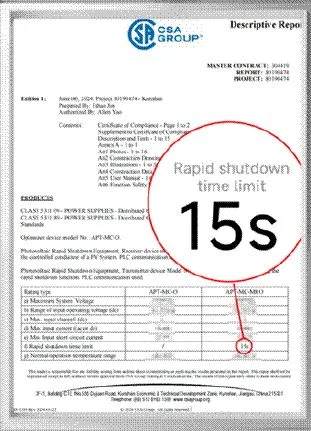
Full compliance with global standards
It rigorously meets the rapid shutdown requirements of the NEC 2017/2020 standards, with international certifications from UL, IEC, and SGS, ensuring full alignment with global safety standards for photovoltaic systems.
optional AFCI
The module-level products support the AFCI function as an option, allowing the equipment to be chosen according to the project's needs.
- Active security at the module level;
- Each module has an independent protection function, making the solution robust and compliant with regulatory requirements;
- High compatibility;
- High compatibility with inverters, monitoring systems, shutdown controllers, and modules of different brands and models;
- Intelligent monitoring;
- Real-time detection of DC arc faults, with interruption of power flow in case of anomalous current;
- AFCI + Module-Level Shutdown: dual line of defense, collaborative protection.
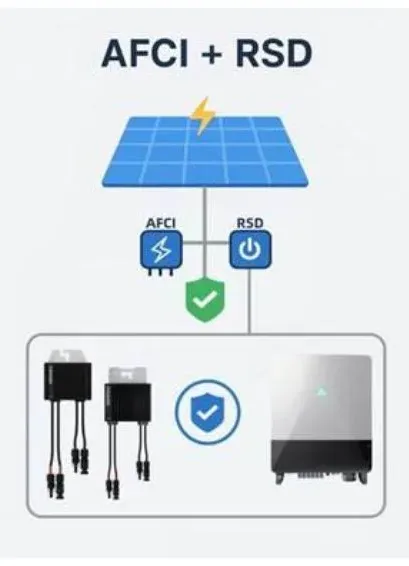
The AFCI is responsible for "detecting the arc and activating the protection," while the RSD is responsible for "performing the shutdown and isolation." The combination of the two creates a complete protection system, from detection to extinction of the electric arc.
When the AFCI (Arc Flash Incident Control) detects arc signals, it can directly trigger the RSD (Radio Shutdown System) to execute the shutdown command, which in turn interrupts the electrical current and the voltage drops rapidly, preventing the arc from continuing and avoiding the propagation of the incident. This "detection + action" mechanism transforms the photovoltaic system from a passive defense to an active and intelligent protection.
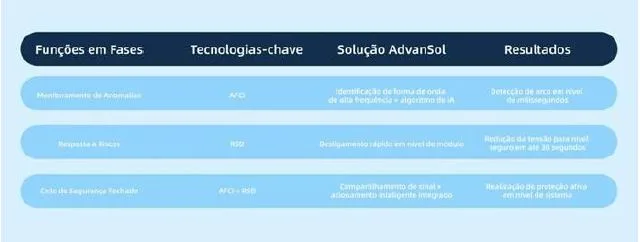
AdvanSol's end-to-end security solution
AdvanSol integrates AFCI, RSD, Optimizer, and String Controller, forming a complete protection system for all arc flash scenarios.
Module-level shutdown device (RSD)
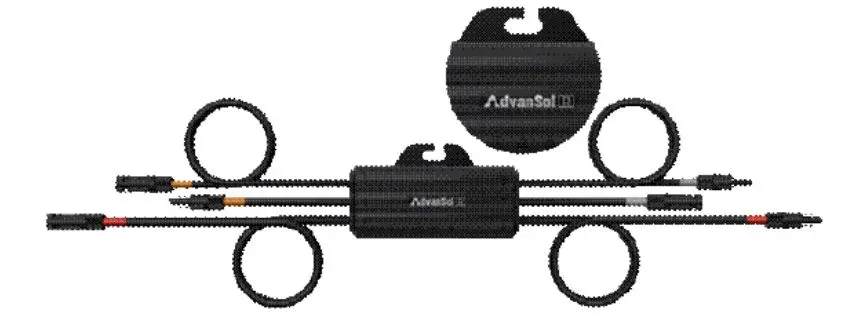
- Patented hardware protection, automatic shutdown;
- Rapid module-level shutdown in as little as 30 seconds;
- AFCI security mechanism at module level (optional);
- Compatible with all modules up to 800W;
- RSD with remote control via mobile app;
- Full UL1741 and UL3741 certifications.
Module-level monitoring and shutdown device (Monitoring RSD)
- Rapid module-level shutdown in as little as 30 seconds;
- AFCI security mechanism at module level (optional);
- Intelligent real-time monitoring with AI and remote shutdown;
- HPLC, without signal loss;
- Hybrid installation with optimizers;
- Full UL1741 and UL3741 certifications.
MRO Series — Full Function Optimizer (Optimizer)
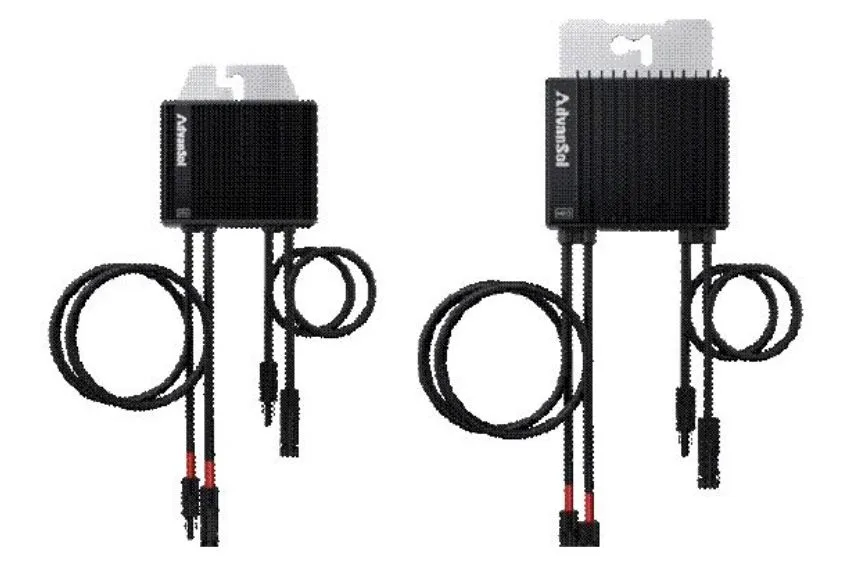
- MPPT optimization at the module level, resulting in a generation increase of over 30%;
- AFCI security mechanism at module level (optional);
- Intelligent real-time monitoring with AI and remote shutdown;
- Rapid module-level shutdown in as little as 30 seconds;
- Hybrid installation with monitoring and shutdown devices;
- Aluminum alloy body with enhanced heat dissipation;
- Full UL1741 and UL3741 certifications.
Intelligent String Controller
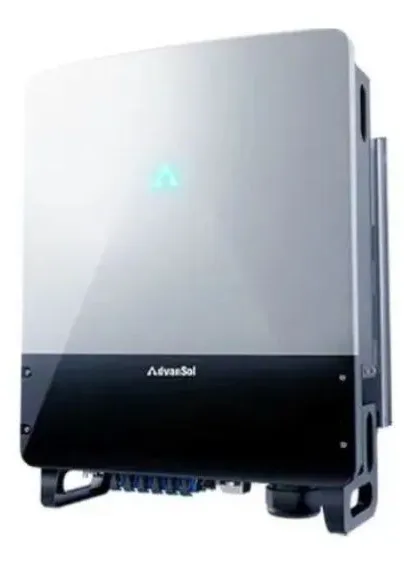
- Perfect compatibility with module-level power optimizers, offering the most cost-effective solution;
- AFCI + RSD at module level for maximum security;
- AI-assisted operation and maintenance in real time for the entire plant;
- Rapid module-level shutdown in as little as 30 seconds;
- Maximum energy production, up to 30% higher compared to traditional string inverters;
- Suitable for all types of projects;
- Recommended application scenarios.

Double protection to ensure complete safety of photovoltaic systems.
The safety of photovoltaic systems should not depend solely on passive protection, but rather on active protection, from the project's conception. AdvanSol It builds a dual safety mechanism with AFCI + module-level shutdown:
- AFCI monitors DC arc faults in real time, quickly identifying anomalous currents;
- Module-level shutdown reduces voltage to safe levels in up to 30 seconds, minimizing the risk of fire and electric shock.
- The coordinated action of this dual protection ensures safety against DC electrical arcs in the photovoltaic system, which in turn reduces the risk of fire in photovoltaic projects.
The opinions and information expressed are the sole responsibility of the author and do not necessarily represent the official position of the author. Canal Solar.


Comments
Comments are moderated before publication.Comments should be respectful and contribute to a healthy debate. Offensive comments may be removed. The opinions expressed here are those of the authors and do not necessarily reflect the views of the author. Canal Solar.