
Updated on February 16, 2026
Shadows are often a major source of concern in photovoltaic systems. Besides reducing system efficiency and causing customer dissatisfaction, in some cases they can generate hotspots (hotspots), when shadows fall in a very localized way on only a few cells of a photovoltaic module.
Many designers are concerned about installing modules away from shadows. Shadows should be avoided at all costs, but we know that in many situations this is simply impossible. PV systems installed in urban areas are subject to shadows caused by trees, antennas, chimneys and neighboring buildings during certain times of the day.
Even with some amount of shadow on part of the photovoltaic modules, the photovoltaic system can still be viable. The designer must understand the consequences of shadowing on the system to make the best decision. The installation location of the modules and the correct choice of inverter are the main decisions that must be made.
The first step towards understanding what happens to the photovoltaic system when it is shaded is to understand how the shadows will fall on the modules and what the consequences will be for them.
Shadows on the photovoltaic system
Shadows can appear for a variety of reasons: clouds, nearby buildings, water tanks, antennas, towers or any object close to the installation. The worst case scenario is what we call partial shading. In other words, it is when shadows fall on only part of the modules of an installation.
This type of shadow is caused by nearby objects that produce localized shadows that partially advance over the surface area of the photovoltaic modules. Partial shade, unlike total shade, modifies the electrical behavior of the photovoltaic system and can lead it to a low-power operating point, significantly reducing energy generation.
To understand the effect of partial shading, let's analyze the electrical curves of current, voltage, and power of photovoltaic modules. Reading the article is recommended. Understanding the IV and PV curves of photovoltaic modules, which explains what the IV (current x voltage) and PV (power x voltage) curves of photovoltaic modules and systems are.
IV curves of modules connected in series
Modules connected in series are very common in photovoltaic systems. Series connection is known as string in the photovoltaic market. The easiest way to analyze the behavior of a system with partial shading is from the IV and PV curves of the strings or photovoltaic arrays (sets of strings connected in parallel).
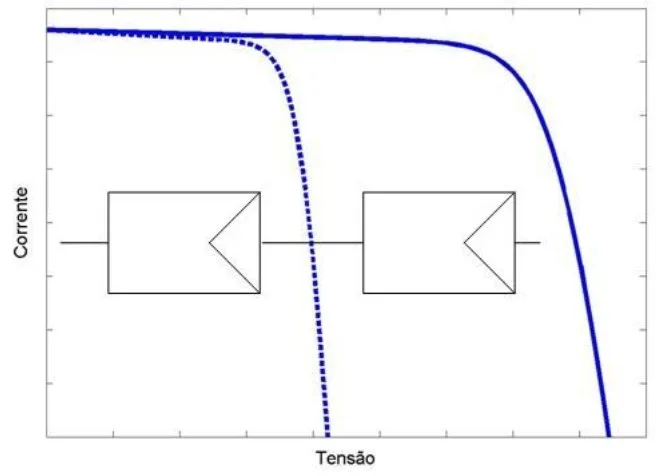
Modules connected in series produce strings with an output voltage equal to the sum of the voltages of each module. The figure below illustrates this. In this example, we have two modules connected in series. The open-circuit voltage (maximum string voltage) is equal to 2 x Voc, where Voc is the open-circuit voltage of only one module. In this case, we are considering that the two modules connected in series are identical.
Still looking at the figure below, we see that the maximum current (Isc) of the string does not change, that is, it continues to be equal to the maximum current of each of the modules connected in series. We call this maximum current the short-circuit current.
You might be interested!
Influence of irradiance
Let's start by analyzing the effect of shadow with the simplest case, which is when the shadow evenly reaches all the modules of a string. In other words, the photovoltaic system receives a smaller amount of light, since it is under the effect of a shadow, but all the modules receive exactly the same solar radiation. This is a typical case of shadow caused by clouds.
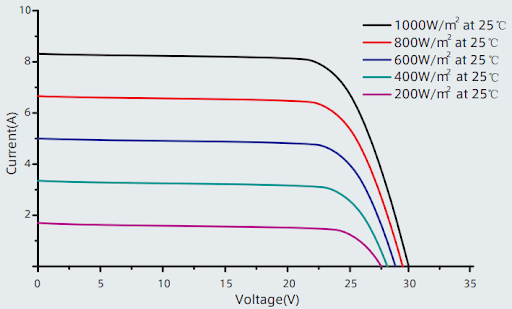
The IV curve of a photovoltaic module changes according to the irradiance received. The image below shows the influence of irradiance on the short-circuit current (Isc) of the string. Irradiance is a measure of light intensity that corresponds to the luminous power (W) per area (m2). For analysis purposes, we can consider that this influence is linear, that is, if the irradiance drops by half, the short-circuit current drops by half.
Thus, we can write the equation below, where k is a constant and G is the irradiance of sunlight (W/m2), which can increase or decrease with the presence of clouds: ISC=kG Since the power supplied by the photovoltaic module is equal to the product of the current and the voltage, the reduction in the intensity of the light received by the module results in a reduction in the power supplied by it.
This is the only effect of uniform shading (which, in other words, is simply the reduction of the intensity of the incident light). This type of situation, however, does not alter the electrical behavior of the modules or the string – that is, it does not modify the shape of the IV curve or the PV curve.
In the figure below, we see the IV curves (current x voltage) of a generic photovoltaic string for different levels of solar irradiance, with irradiances ranging from 200 W/m2 to 1000 W/m2. What we observe is a shift of the graph up or down, without changing the “shape” of the IV curve.
IV and PV curves with partial string shading
Finally, by understanding how IV curves add up horizontally as modules are connected in series, and knowing how irradiance influences the IV curve, it is possible to understand the behavior of an IV curve in a shaded system (fully or partially).
Case 1: String with uniform shading
As a first example, let us consider a string of 10 370 Wp modules (string power = 3,7 kWp), uniformly shaded (this is the case we discussed in the previous section). The BYD mono-PERC 370M6K-36 module [3] was used in the example. This would be a typical case of a cloud shading all the modules identically. The 10 modules, even shaded, receive the same irradiance.
Below, we see the IV and PV curves for this shaded set of modules. The PV curve is generated by multiplying the voltage and current values, point by point, from the IV graph. In the illustrated IV graph, the short-circuit current is slightly higher than 1,6 A, well below the nominal value, indicating that the solar modules are receiving a low intensity of light. The maximum power of the string is around 600 W, as we see in the second graph (PV curve).
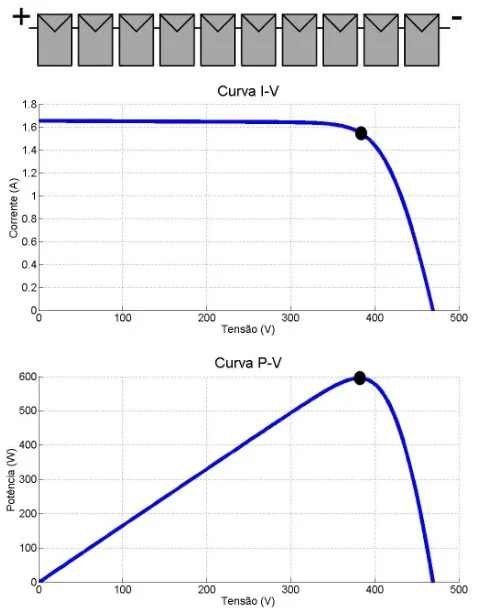
When the string is uniformly shaded (and not partially shaded), the IV curve has only one knee and the PV curve has only one peak or point of maximum power.
In this situation, since there is only one maximum power point, the power of the photovoltaic system will converge to this point without difficulty, through the maximum power point tracking algorithm (MPPT – Maximum Power Point Tracking) in the inverter.
Case 2: string with partial shadowing of modules
As a second example, let us consider the same string of 10 modules, where 8 modules receive 800 W/m² and 2 modules receive 400 W/m². The IV curve of the string is modified, with the appearance of 2 knees. In the PV curve, consequently, two power peaks appear, as we can see in the following graphs.
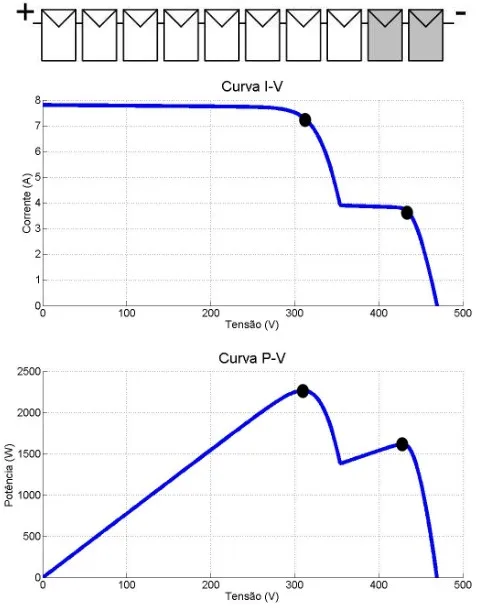
The PV curve of the partially shaded system presents two maximum points, the so-called global maximum point (highest power) and local maximum point (lowest power). The photovoltaic inverter, through its MPPT algorithm, will always seek a maximum power point to operate, with the aim of maximizing the power and energy production of the photovoltaic modules.
When all modules receive the same light intensity, the MPPT algorithm achieves its goal of improving the performance of the photovoltaic system. However, when there are two or more points of maximum power, the inverter may become confused and its operation may converge to a point of low power, reducing the energy production of the photovoltaic system.
The big problem with partial shading of photovoltaic modules lies in the fact that, if left to chance, the inverter can find a local maximum point and remain there the entire time, as long as the shadow is present. A photovoltaic system can perform very poorly because of this.
A typical case where this problem can occur is a roof that is shadowed by a chimney. The shadow will move all the time, according to the movement of the Sun across the sky.
At any time of the day, there will be some shaded modules, causing multiple maximum power points to occur on the PV array curve. It is very likely that in situations like this, most inverters will not be able to maximize the power of the photovoltaic system, as the MPPT algorithm is stuck at a local maximum and does not see the existence of the global maximum, which would be the ideal operating point.
Practical cases
To understand what happens in practice, let's take into account real irradiance values. Let's consider two times: early morning (8 am) and midday (12 pm). In the early morning, an irradiance of 200 W/m² will be considered, and at midday, 1000 W/m². For both, it will be assumed that the percentage of diffuse irradiance is 17% of the global irradiance.
In other words, a shaded module will receive only 17% of the irradiance received by a non-shaded module. The percentage of diffuse irradiation varies depending on the region and season, but 17% is a good value to consider as an example.
Practical case 1: partial shading in the early morning
Considering the same string of 10 modules, with 2 modules shaded by nearby fixed objects, we have the IV and PV curves for the time of 8:00 shown below. The string situation is the same as seen in the previous example, but we reproduce the figure below for convenience.
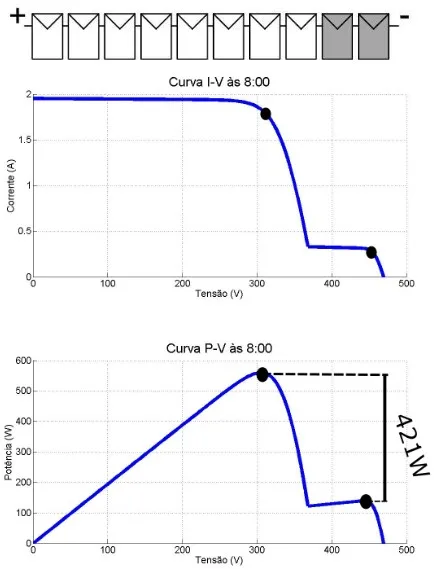
In this case, if the inverter works at the worst point (local maximum), the photovoltaic system will lose 421 W of power, working with power of around 140 W only. If it were working at the global maximum, the peak value of the PV curve, it would be working with a power of 561 W.
Practical case 2: partial shading at midday
In this case, the loss due to working at the local maximum point is much greater, above 2.100 W. At the time of day when the photovoltaic system should have its best performance, its operating point may be stuck at a local maximum.
Depending on how long this shading situation lasts, power generation losses can be very impactful if the inverter does not have the ability to seek the maximum global power, instead of being stuck at some local maximum.
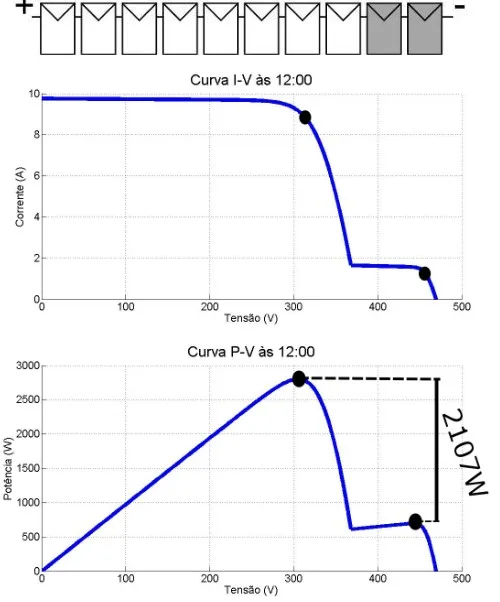
In a case like the one shown above, at 12pm the photovoltaic system would be operating at a very reduced power, well below the maximum power that could theoretically be achieved.
Unfortunately, most inverters available on the market do not have the ability to seek maximum global power and few people know this. Many consumers (and even designers of photovoltaic systems) are not fully aware of the impact caused by partial shading due to this inability of the inverter.
Conclusion
In this article we show that uniform shading and partial shading have different impacts on the behavior of photovoltaic systems. The best shading situation is when all modules are shaded the same way, receiving the same amount of light.
On the other hand, when only some modules of the string or array are shaded, multiple peaks (maximum points) appear on the PV curve, making it difficult for the inverter's MPPT algorithm to track the maximum power point.
In this case, there is a high chance that the inverter will be stuck at a local maximum point, which significantly affects the performance of the photovoltaic system. The design of photovoltaic systems in locations with a lot of partial shadows (caused by chimneys, towers, trees or any nearby objects) must provide some method to minimize the impact caused by this type of shadow.
In other articles we will analyze some strategies for this, which may include the modularization of the photovoltaic system (with smaller module arrangements), the use of microinverters or power optimizers or the use of inverters with MPPT algorithms optimized to search for the global maximum.
Deepen your knowledge!
For a deeper understanding of photovoltaic systems, participation in [course/program/etc.] is recommended. solar energy courses and training, helping to ensure compliance with safety and quality standards.
[elementor-template id="561643″]

Comments (6)
Comments are moderated before publication.Comments should be respectful and contribute to a healthy debate. Offensive comments may be removed. The opinions expressed here are those of the authors and do not necessarily reflect the views of the author. Canal Solar.
Hello, this article is very interesting. I have a question: do these values from the example (17% irradiance) correspond to real values, or are they just an example to illustrate the idea?
Hello! The images are updated. Check out!
I opened the article Understanding the effect of partial shadows on photovoltaic systems, dated March 6, 2020, and figures 01 to 06 do not appear.
I made every attempt to change the browser settings and even disable the antivirus.
Is it possible to send this article in PDF?
Hello José, how are you? See if the images appear now 🙂
Dear,
The images are no longer appearing. Without the graphics, was it difficult to understand what was said? Can you adjust it so I can read the full article with images? thanks!
Hello good morning, the article entitled: “Understanding the effect of partial shadows on photovoltaic systems” is very interesting. I really didn't know that there was such an impact when the modules are subjected to partial shading. I would like to know, if possible, which inverters we have on the market that have the ability to overcome this problem, that is, those that can actually track the point of maximum global power. Thanks in advance.