
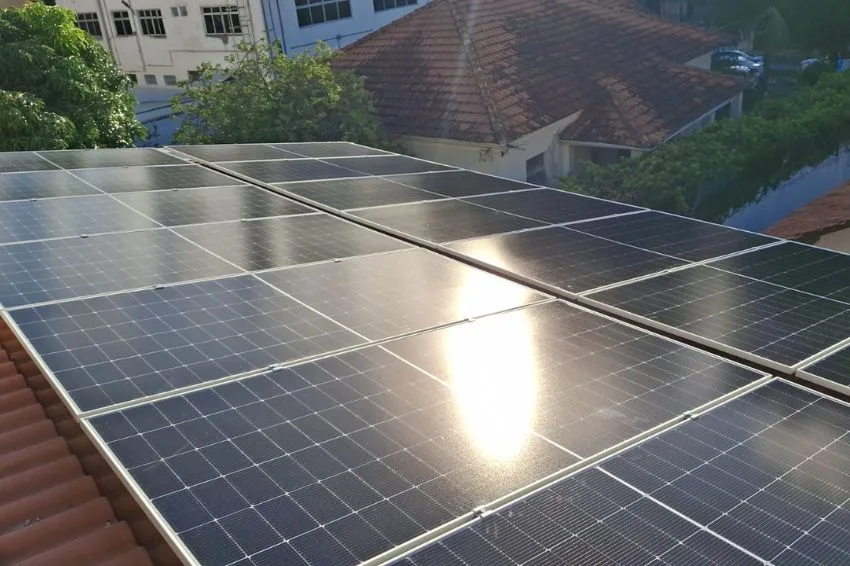
The accelerated expansion of micro and mini-distributed generation (MMGD) in Brazil has profoundly transformed the dynamics of the national electricity sector. Driven by the falling costs of photovoltaic technology, regulatory incentives, and the advancement of the energy transition, distributed generation has become one of the main investment frontiers in the energy sector.
This growth, however, has brought new regulatory challenges. Among them, a phenomenon increasingly observed by distributors and the National Electric Energy Agency stands out (ANEEL): the irregular expansion of the power output of photovoltaic systems after their certification, without proper communication or approval from the utility company.
This behavior, often motivated by the pursuit of greater economic generation and return, may constitute a significant regulatory infraction, generate administrative penalties, and compromise the legal security of investments in the sector.
Given this scenario, it becomes essential to understand the regulatory foundations, legal risks, and strategic implications associated with the unregulated expansion of photovoltaic systems.
2.1 The Regulatory Framework for MMGD
1. Law No. 14.300/2022 – Legal Framework for Distributed Generation;
2. Normative Resolution ANEEL No. 1.000/2021 – Consolidation of distribution rules;
These regulatory instruments establish the procedures for: a) requesting access to the grid; b) project approval; c) system certification; d) measurement of generated energy; and e) offsetting credits in the Electric Energy Compensation System (SCEE).
The central logic of the model is simple: the consumer unit can generate electricity and inject surplus energy into the grid, which will be converted into credits for future compensation.
However, this compensation depends directly on two fundamental regulatory elements: 01) Approved installed capacity; and 02) Metering system approved by the distributor.
Any alteration to these parameters without regulatory updates could compromise the system's regularity.
3. Irregular expansion of photovoltaic systems
According to recent data from the energy market, solar energy already represents a significant portion of the Brazilian electricity matrix and received investments exceeding R$ 32 billion in 2025 alone, consolidating itself as one of the fastest-growing energy sources in the country.
The rapid growth of micro and mini-distributed generation (MMGD) in Brazil has led the National Electric Energy Agency (ANEEL) to intensify the monitoring and control mechanisms over the systems connected to the distribution network, including, in December 2025, beginning to evaluate the possibility of conducting an emergency audit by the Distributors on distributed generation systems.
The topic has gained even more relevance recently, when the ANEEL It initiated an inspection process involving 51 energy distributors, seeking to identify irregularities in micro and mini-distributed generation systems, focusing specifically on clandestine expansions and inconsistencies in measurement.
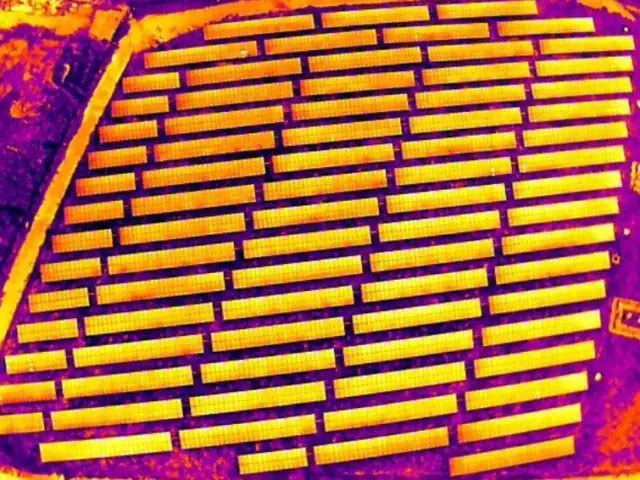
Distribution companies, such as Cemig, Neoenergia, and Energisa, have adopted more sophisticated inspection methods, including the use of satellite imagery and drones, in addition to on-site inspections, to identify discrepancies between the approved and actually installed power. This new approach demonstrates that the era of growth with low supervision has come to an end, giving way to an environment of greater technical rigor and regulatory governance.
Irregular expansion occurs when the owner of the consumer unit makes technical changes to the generation system without notifying or obtaining authorization from the distributor.
According to Article 4, §1, of REN No. 1.000/2021, distributors have a duty to guarantee the provision of adequate service, including continuity, safety, and regularity. When they identify systems that do not meet specifications, they have regulatory backing to interrupt the connection until they are brought into compliance.
Paragraph 2 of the same article imposes on the concessionaire the duty to promote the "expansion and improvement of the service," which includes monitoring irregular expansions and demanding technical adjustments.
.4 Art. 4º The distributor is responsible for providing adequate service to the consumer and other users and for the information necessary to defend individual, collective or diffuse interests.
§ 1. Adequate service is that which satisfies the conditions of regularity, continuity, efficiency, safety, timeliness, universality, courtesy in its provision, and reasonable tariffs.
5 Art. 4º. […]
Brazilian Regulatory Standard 1.000/21 stipulates that the distributor must act continuously to prevent irregular uses of electricity (Art. 589). When there are indications of irregularity, the distributor follows a protocol to prove and characterize the infraction (Art. 590).
Article 590 of REN 1.000/2021 states:
Article 590. In the event of evidence of irregular procedure, the distributor must take the necessary steps to accurately characterize it, compiling a set of evidence through the following procedures:
I – issue the Incident and Inspection Report – TOI, using the appropriate form, prepared according to the instructions of ANEEL;
II – to request metrological verification or expertise, at its discretion or when requested by the consumer;
III – prepare a technical evaluation report when a violation of the meter or other measuring equipment is found, containing technical information and a description of the physical conditions of its parts, components and devices, except when a metrological inspection is requested as per item II;
IV – evaluate the history of consumption and electrical quantities; and
V – implement, when deemed necessary: a) monitoring measurements, with mass storage records for at least 15 consecutive days; and b) visual resources, such as photographs and videos. (BRAZIL, 2021).
Thus, based on article 590 of REN 1.000/2021, the distributor may:
1. Issue a TOI (Incident and Inspection Report) formalizing the suspicion;
2. Request a metrological inspection of the meter;
3. Prepare a detailed technical report if there is a tampering with the measuring equipment;
4. Evaluate the unit's consumption and generation history;
5. Install a monitoring meter with continuous recording;
6. Use visual evidence such as photos and videos (including site visits, satellite imagery, or...) drones).
These actions constitute a body of evidence that can be used to prove the irregularity to the consumer.
According to §2 of Article 590, increasing load or generation without the distributor's authorization and causing a defect in the metering system constitutes an irregular procedure.
Art 590.
[...]
§ 2. An increase in load or generation without the distributor's authorization that causes a defect in the metering system is considered an irregular procedure, which must be proven by the distributor. (BRAZIL, 2021).
§ 2. Current status includes the modernity of techniques, equipment and facilities, and their maintenance, improvement and expansion of the service.
Similarly, Module 3 of PRODIST (Electrical Energy Distribution Procedures) establishes that any technical alteration that implies a variation in installed power or a change in connection parameters must undergo a new access analysis and project update.
According to paragraph 2 of article 590 of REN 1.000/2021, the characterization of the irregular procedure requires that the increase in load or generation without the distributor's authorization causes a defect in the metering system, a circumstance that must be technically proven by the concessionaire.
As a rule, significant changes to the generation system must be communicated to the distributor in advance. However, to characterize an administrative irregularity, it is necessary to prove that the change impacted the power supplied to the grid, the metering system, or the technical connection parameters.
Among the most common practices observed in the market related to unauthorized expansion are: a) increasing the number of photovoltaic modules; b) replacing inverters with higher-power equipment; c) expanding installed capacity without updating the project; d) altering the approved nominal power, among others.
In practice, this amounts to a clandestine increase in generation capacity, a phenomenon that the market often refers to as "irregular overpower" or "unapproved expansion." This behavior generates significant distortions in the energy compensation system.
When a system generates more energy than the authorized power, the credits injected into the grid may exceed the originally approved parameters, compromising the integrity of billing and the technical balance of the distribution network.
4. Regulatory tightening of ANEEL
The rapid growth of distributed generation has led to ANEEL to intensify oversight of irregularities in the sector.
Irregular expansion is not just an individual compliance problem; it generates significant systemic impacts. These include:
1) Tariff distortionsIrregular generation can artificially inflate the volume of offset credits, increasing indirect costs for the system;
2) Operational risksThe increase in power injected into the grid without planning can affect power quality, grid stability, and distribution capacity.
3) Juridical insecurityInstitutional investors, funds, and distributed generation operators rely on regulatory predictability, and when irregularities become recurrent, the investment environment tends to deteriorate.
Detailed information on the measures taken to combat irregularities in distributed generation (DG) systems connected to the electricity grid.
This initiative is part of a process that began in 2025, which assesses the need for an emergency audit of distributed generation, given evidence of illegal expansions and measurement failures.
According to industry analyses, oversight focuses primarily on two critical points: 1) inconsistencies in metering systems; and 2) power increases without formal authorization.
This move indicates a significant shift in the agency's regulatory stance. In the early years of distributed generation, the regulatory focus was on stimulating the expansion of solar energy. Now, the regulatory focus is shifting towards: a) system governance; b) technical control of the grid; and c) integrity of energy compensation.
5. Legal consequences of irregular expansion
The unauthorized expansion of photovoltaic systems can lead to various legal and regulatory consequences.
Regulations governing the electricity sector require consumers to notify the distributor of any and all changes to the power plant project, under penalty of incurring the sanctions outlined in Article 655-F of REN 1.000/2021.
Art. 655-F. In the event of evidence of irregular receipt of benefits associated with the SCEE, the distributor must take steps to accurately characterize this, compiling a set of evidence that proves the irregular receipt of the benefit. (BRAZIL, 2021).
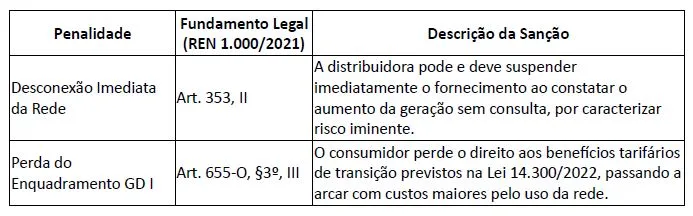
Therefore, the penalties for increasing power without the distributor's authorization, which may be applied cumulatively, are:
1. Loss of Tariff BenefitsThe consumer unit may lose its classification in GD I (art. 655-O, §3º REN 1.000/2021);
2. Ssuspension or review of energy compensationThe distributor may require the system to be regularized or suspend the accounting of credits generated above the approved power (art. 655-F REN 1.000/21);
3. Billing ReviewThe distributor may review the billing of the consumer unit, disregarding the active energy injected into the Electric Energy Compensation System (SCEE) and the benefits received during the period in which the irregularity was found (art. 655-D, § 7º REN 1.000/2021);
4. Refund of amounts received, adjusted for inflation (IPCA), within 36 billing cycles. (art. 655-F REN 1.000/2021);
5. SPower Supply SuspensionIn cases of imminent risk to safety, the distributor may immediately suspend the supply of electricity (Art. 353 REN 1.000/2021)10;
6. Administrative finesDepending on the case, penalties stipulated in the regulations may be applied. ANEEL.
To facilitate understanding, I present a table of the penalties that may be applied and their legal basis:
Article 655-F. In the event of evidence of irregular receipt of benefits associated with the SCEE (Special System for Electricity Distribution), the distributor must take steps to accurately characterize this, compiling a set of evidence that proves the irregular receipt of the benefit.
§2 In the event that irregular receipt of benefits associated with the SCEE is detected, the distributor must take the following measures:
I – disregard the active energy injected by the consumer unit with distributed microgeneration or minigeneration in the SCEE and benefits received in the billings from the moment of detection, until the situation is regularized; and
II – Review the billing of consumer units that were improperly benefited, disregarding the active energy injected by the consumer unit with distributed microgeneration or minigeneration into the SCEE (Brazilian Electricity Regulatory System) and benefits received during the period in which the irregularity was detected, applying the following parameters:
a) the amounts to be received or returned must be adjusted for inflation using the National Consumer Price Index – IPCA;
b) the deadlines for collection or return are up to 36 billing cycles; and
c) the charge may be paid in installments at the distributor's discretion, in accordance with article 344.
Article 353. The distributor must immediately suspend the supply of electricity when a technical or safety deficiency is found in the installations of the consumer and other users, which constitutes an imminent risk of damage to people, property, or the operation of the electrical system.
The distributor may also require technical adjustments to the expansion, including the submission of a new electrical project, an updated access permit, and the replacement of equipment.
In more serious situations, it can happen that Temporary suspension of system operation.until the necessary corrections are made.
6. The regularization and technical defense procedure: strategic steps
Once an irregularity has been identified, inaction is not an option. Adopting a proactive rectification procedure is crucial to mitigate damage and avoid more severe penalties. The following steps are recommended:
1. Technical and Documentary Diagnosis: Hire a qualified professional to conduct a complete system survey, comparing the installed power (inverters and modules) with what is stated in the approved project, descriptive report, and original ART/RRT (Technical Responsibility Certificate/Technical Responsibility Report).
2. Formal communication to the distributor.Submit a new quote request for the connection and expansion, stating your intention to regularize the expansion. This action demonstrates good faith and is the first step in avoiding the characterization of fraud.
3. Preparation of a New Project and ART/RRT (Technical Responsibility Report/Technical Responsibility Report).Submit to the distributor a new technical project that covers the entirety of the installed capacity, accompanied by the respective Technical Responsibility Annotation (ART) or Technical Responsibility Registration (RRT).
4. Presentation of Technical/Legal DefenseThe preparation of a qualified technical and legal defense, conducted by a professional with experience in the regulation of the electricity sector, is essential to assess the legality of the fine and identify any inconsistencies in the technical or methodological criteria used by the concessionaire.
7. Legal defense strategies in cases of infraction notices and TOI (Terms of Irregularity Occurrence).
Legal analysis of several administrative proceedings demonstrates that many of these assessments present significant technical and legal weaknesses. In many situations, the penalties applied by the distributors do not observe the principles governing administrative sanctioning law, nor do they present sufficient evidentiary basis to support burdensome measures such as retroactive rebilling or suspension of regulatory rights.
In this context, specialized legal practice in the electricity sector has identified a consistent set of defense arguments capable of challenging and, in many cases, overturning penalties applied in administrative proceedings involving distributed generation.
The analysis of Notices of Violation and Terms of Occurrence and Inspection (TOI) presented in inspection procedures involving distributed generation reveals the recurrence of certain inconsistencies, such as the absence of reliable technical evidence, the use of presumptive methodologies to characterize the irregularity, and conceptual confusion between installed capacity and energy actually injected into the grid.
Based on the systematization of these practical experiences in regulatory litigation in the electricity sector, it is possible to identify a consistent set of defensive legal arguments applicable to Notices of Violation and Terms of Occurrence and Inspection (TOI) related to the irregular expansion of distributed generation systems.
7.1 Lack of typicality of the imputed conduct
One of the main lines of defense consists of analyzing the administrative classification of the conduct attributed to the distributor.
Although the Regulatory Resolution ANEEL Although Decree No. 1.000/2021 establishes procedures for access to the electricity grid, metering, and billing, the regulation does not clearly and autonomously institute a specific type of infraction called "unauthorized generation expansion."
The application of administrative penalties requires the precise subsumption of conduct to a previously established normative provision, in accordance with the principle of strict legality foreseen in article 5, II, of the Federal Constitution.
Thus, when the distributor alleges irregularity without demonstrating which regulatory provision was actually violated, a clear legal weakness arises in the administrative action.
7.2 Lack of reliable technical evidence of the irregularity
Another recurring argument in administrative defenses involves the absence of robust technical evidence proving the alleged increase in power.
In many cases, distributors base their conclusions on mathematical estimates of maximum generation; visual analysis of installed equipment; and assumptions about the system's generation capacity.
However, administrative sanctions require clear and demonstrable technical justification, as determined by article 50 of Law No. 9.784/1999.11
To technically characterize an irregular expansion, it would be necessary to demonstrate, for example: an effective alteration of the AC power of the system; modification of inverters or protection equipment; an increase in the power effectively made available to the grid; a record of energy injection exceeding the approved limit. In the absence of this technical evidence, the infraction notice tends to lack adequate justification.
7.3 Weakness of the presumptive methodology used by distributors
Another recurring weakness in the assessments lies in the use of presumptive methodologies to characterize the irregularity.
Some distributors use calculation models based on estimates of theoretical generation, obtained by multiplying the registered power by fixed factors of capacity and operating time. This methodology, however, has evident technical limitations.
Photovoltaic generation depends on highly dynamic variables, such as: solar irradiance; ambient temperature; orientation and tilt of the modules; equipment efficiency; unit consumption patterns, etc.
Therefore, exceeding estimated generation values does not, in itself, constitute proof of irregular expansion of the system.
Using theoretical parameters as evidence for sanctions can represent an undue reversal of the burden of proof, transferring to the consumer the obligation to demonstrate that they did not commit the infraction.
7.4. Technical distinction between DC power, AC power and generated energy
Another aspect frequently overlooked in administrative proceedings concerns the distinction between different technical quantities involved in photovoltaic systems.
In simplified terms, it is necessary to differentiate:
• DC power (capacity of photovoltaic modules);
• AC power (inverter output capacity);
• energy generated or injected into the grid (measured in kWh).
11 Art. 50. Administrative acts must be justified, indicating the facts and legal grounds, when: […]
Simply increasing the number of photovoltaic modules does not necessarily imply an increase in the AC power supplied to the electrical grid, as the system output may remain limited by the inverters and protection devices installed.
Therefore, to characterize an irregular expansion, it would be necessary to prove that there was an effective increase in the power delivered to the grid or a relevant alteration at the connection point. The absence of this technical demonstration compromises the validity of the infraction notice.
7.5. Violation of the principles of good faith and legitimate expectation.
Another argument frequently used in administrative defenses involves the application of the principles of objective good faith and the protection of legitimate expectations.
In many cases, consumers hire specialized companies for the installation and eventual expansion of photovoltaic systems, operating in a transparent and documented manner.
When the distributor allows the system to operate normally for a long period and only later applies retroactive penalties, there may be a violation of the consumer's legitimate trust, especially when there was no prior inspection or notification of irregularities.
These principles are recognized in Brazilian administrative law and are based on Article 2 of Law No. 9.784/1999.12
7.6. Impossibility of broad retroactive rebilling
Another point frequently raised in defenses concerns the extent of the price adjustments applied by the distributors.
In many cases, the calculation statements presented by the utility companies fully revise the energy compensated to the consumer unit over several years.
However, even if the existence of irregularities were admitted—a hypothesis that must be proven—any rebilling should observe criteria of proportionality and individualization of the damage.
This means that any difference should only apply to the portion of the power supposedly increased, and not to the total energy compensated by the system.
7.7. Burden of proof on the distributor
12 Art. 2 The Public Administration shall obey, among others, the principles of legality, purpose, motivation, reasonableness, proportionality, morality, full defense, adversarial process, legal certainty, public interest and efficiency.
Within the context of the administrative sanctioning process, the burden of proving the occurrence of the infraction rests with the administration itself that applies the penalty.
Therefore, it is up to the distributor to demonstrate, in a clear and verifiable manner:
1What equipment was changed?
2When did the alleged expansion occur?
3What technical impact did this change have on the network?
4What was the effective period of the irregularity?
Without the presentation of this evidence, the charges may be considered legally unsustainable.
7.8. Change in Regulatory Positioning of ANEEL about Zero Grid/Grid Zero systems
The “Zero Grid” system — also called “Grid Zero” — consists of a photovoltaic power plant intended exclusively for local self-consumption, with electronic blocking of injection into the distributor's grid.
Because it does not export energy, it does not participate in the Electric Energy Compensation System (SCEE) foreseen in Law No. 14.300/2022, and therefore, it did not qualify as microgeneration or distributed minigeneration (MMGD) for the purposes of homologation in the SISGD system, according to the understanding of the [relevant authority/organization]. ANEEL in effect until mid-2024. A ANEEL The following interpretations of Zero Grid systems have emerged over time:
a) Official Letter No. 149/2022 – SRD/ANEEL
In formal response to Banco do Nordeste, ANEEL It was expressly clarified that "Zero Grid" systems are not considered micro or mini-distributed generation, precisely because they do not inject energy into the grid, and therefore are not subject to approval by the distributor or the... ANEEL.
The document states verbatim:
"Given that Zero Grid systems do not inject energy into the grid, they do not participate in the Electric Energy Compensation System and, consequently, do not qualify as micro or mini-distributed generation, under the terms of Law No. 14.300/2022."
Furthermore, the same document acknowledges that such systems can be freely deployed, requiring only notification to the local distributor for safety and electrical integration purposes, without the need for authorization or prior approval.
"As long as the installed capacity is less than or equal to 5 MW, the Zero Grid system is characterized as a reduced-capacity generating plant (...). Reduced-capacity generating plants do not require authorization from the granting authority to be implemented."
This understanding solidified, between 2022 and 2023, the guideline that the use of Zero Grid systems did not depend on any formal approval to operate within the standards of ANEEL.
b) Official Letter No. 188/2024 – STD/ANEEL
Only in May 2024 ANEEL It partially revised its previous position, now recognizing that grid-connected Zero Grid photovoltaic systems could be classified as MMGD (Multi-Grid Distribution), provided that the criteria of Law No. 14.300/2022 and Normative Resolution No. 1.000/2021 are cumulatively met.
However, this interpretation was new, applicable from that date, and not retroactive — the official document itself does not revoke or invalidate the previous understanding, it only complements it in light of the changes brought about by REN No. 1.098/2024:
“In the case of 'zero grid' systems that (…) are connected to the distribution network through consumer units, the characteristics of these systems cause them to fall within the definitions of distributed microgeneration and distributed minigeneration (…).”
Therefore, until the publication of this document, there was no formal obligation for registration, approval, or prior authorization of Zero Grid systems with the ANEEL or to the distributor, provided there was no injection of energy.
c) Official Letter No. 416/2024 – STD/ANEEL
Back in November 2024, in response to a query from ABRADEE, the ANEEL This consolidated the new vision: the "Grid Zero" system could be considered micro or mini-distributed generation, provided it complied with the requirements of article 655-C of REN No. 1.000/2021.
However, the same document reaffirms that the essential characteristic of this model is the absence of energy injection, and that, in the event of any minimal injection, the distributor should only provide guidance on technical adjustments, and not apply sanctions or automatic exclusions.
“For MMGD systems that do not inject into the grid, any injection into the distribution network will not be offset against electricity consumption or accounted for as a credit (...).”
Thus, starting in 2024... ANEEL It has come to be recognized that certain Grid Zero systems connected to the grid can be classified as micro or mini distributed generation, depending on their technical configuration and the way they are connected to the electrical grid.
In this regard, it is important to verify when the Zero Grid system was connected and whether there was formal communication via email or another communication channel with the Distributor.
The regulatory debate surrounding the expansion of photovoltaic systems highlights a challenge typical of the contemporary electricity sector: balancing the accelerated expansion of distributed generation with the need to preserve the technical security of the grid and the integrity of the energy compensation system.
8. Final considerations
The increase in inspections of distributed generation systems indicates a natural trend toward regulatory maturation in the Brazilian electricity sector. However, the application of administrative penalties must always observe the fundamental principles of administrative law, especially legality, proportionality, justification, and legal certainty.
In this context, careful technical and legal analysis of the inspection reports reveals that many fines for alleged irregular expansion may contain significant inconsistencies, opening up opportunities for effective administrative defenses.
Administrative defense must ensure full observance of the principles of adversarial proceedings and the right to a full defense, including its technical aspects.
The consolidation of these legal strategies contributes not only to the protection of consumers and investors in distributed generation, but also to strengthening legal certainty and regulatory predictability in the Brazilian electricity sector.
The opinions and information expressed are the sole responsibility of the author and do not necessarily represent the official position of the author. Canal Solar.


Comments (3)
Comments are moderated before publication.Comments should be respectful and contribute to a healthy debate. Offensive comments may be removed. The opinions expressed here are those of the authors and do not necessarily reflect the views of the author. Canal Solar.
I have news for ANEEL (Brazilian Electricity Regulatory Agency) and everyone in the electricity sector. Seriously, people should be able to request adjustments to the law under which they were registered, not to the madhouse you created. Today it's impossible to install a generation system due to the destruction of the sector. If you cancel mine, I'll go off-grid. Guess who's going to lose? It won't be me. And I'll encourage many others to do the same.
A hybrid solar system was installed on my ranch in a rural area in October 25. It was approved by the utility company with a capacity of 3,000 KW, using 5 modules of 600 W each. Due to production losses for various reasons, the average generation is 2,100 KW. If more modules are installed to reach the approved 3,000 KW output, would this constitute an irregular alteration to the approved project due to the additional number of panels, even if it doesn't exceed the 3,000 KW generation value? Ultimately, does the regulatory body consider only the number of modules or the approved value?
Good day.
The analysis of the topic is very interesting. A question I've always had, and I don't know if it's been addressed in other articles, is how the tariff benefit is calculated if a system duly approved before 2023 is expanded regularly after 2023. Will there be a differentiated benefit? How is the benefit predicted, given that it's not possible to separate the energy from the old and new panels? Would a second meter be necessary for this new system?