• Friday, January 16, 2026
Facebook X-twitter Instagram Youtube LinkedIn Spotify
  • GC Solar: 17,95 GW
  • GD Solar: 41,3 GW
  • TOPCon Modules: $0,088/W
  • P-Type Cells: $0,034/W
  • N-Type Cells: $0,032/W
  • HJT Modules: $0,10/W
  • N-Type Wafer: US$0,128/pc
  • Polysilicon: US$ 19,00/kg
  • GC Solar: 17,95 GW
  • GD Solar: 41,3 GW
  • TOPCon Modules: $0,088/W
  • P-Type Cells: $0,034/W
  • N-Type Cells: $0,032/W
  • HJT Modules: $0,10/W
  • N-Type Wafer: US$0,128/pc
  • Polysilicon: US$ 19,00/kg
  • advertise here
  • About us
  • Expedient
logo site solar channel
  • News
    • energy storage
    • Market and Prices
    • Investments & Business
    • Policy and Regulation
  • Articles
    • Batteries
    • Opinion Article
  • Renewable
  • Latam
  • Blog
  • Solar Energy Companies
  • Integrators
  • Magazine
    • Magazine Canal Solar
    • Conecta Magazine
  • Events
  • Videos
  • Electric Vehicles
  • Consultancy
  • Academics
  • News
    • energy storage
    • Market and Prices
    • Investments & Business
    • Policy and Regulation
  • Articles
    • Batteries
    • Opinion Article
  • Renewable
  • Latam
  • Blog
  • Solar Energy Companies
  • Integrators
  • Magazine
    • Magazine Canal Solar
    • Conecta Magazine
  • Events
  • Videos
  • Electric Vehicles
  • Consultancy
  • Academics
  • News
    • Brazil
    • World
    • Technology and inovation
  • Articles
    • technicians
    • Opinion
  • Renewable
  • Latam
  • Blog
  • Solar Energy Companies
  • Integrators
  • Magazine
    • Conecta Magazine
  • Events
  • Videos
  • About Us
  • Advertise Here
  • CS Consulting
  • Canal VE
  • Academics
  • News
    • Brazil
    • World
    • Technology and inovation
  • Articles
    • technicians
    • Opinion
  • Renewable
  • Latam
  • Blog
  • Solar Energy Companies
  • Integrators
  • Magazine
    • Conecta Magazine
  • Events
  • Videos
  • About Us
  • Advertise Here
  • CS Consulting
  • Canal VE
  • Academics
logo site solar channel
Home / Articles / Technical Article / Is Flash Test Enough? The Importance of Electroluminescence in Photovoltaic Modules

Is Flash Test Enough? The Importance of Electroluminescence in Photovoltaic Modules

Advanced technique uses infrared images to identify hidden defects in cells
Follow on Whatsapp
  • Photo by Lucas Gomes Monteiro Lucas Gomes Monteiro
  • November 21, 2024, at 08:51 PM
3 min 8 sec read
Flash Test is sufficient The importance of electroluminescence in photovoltaic modules
Electroluminescence checking stage at the DMEGC Modules factory. Photo: Disclosure

Since INMETRO launched the Ordinance No. 140, it became mandatory for solar module brands to deliver at least the nominal power specified in the datasheet. This regulation brought an end to “fake power“, where modules performed worse than promised. 

But is simply ensuring the nominal power enough to choose the best photovoltaic module for your project? 

In this article we will justify the importance of electroluminescence in choosing solar modules and how this technique is crucial to go beyond a basic test.

DMEGC Solar believes that the real difference lies in the cells that make up the module and electroluminescence plays a crucial role in exposing this Quality . 

This advanced technique uses infrared images to identify hidden defects in cells, such as microcracks or inactive areas, that would go unnoticed in a traditional flash test, providing a more detailed and reliable analysis of the module's integrity.

The importance of electroluminescence in the choice of solar modules lies in revealing the uniformity and integrity of photovoltaic cells. 

At DMEGC, the superiority of the cells is clear in the electroluminescence images. The brand's modules feature clear and consistent colors, indicating excellence in the manufacturing process and reliability in performance throughout the module's lifespan. 

This uniformity is crucial to ensure system efficiency and avoid serious problems, such as mismatch and hot spots, which can compromise energy generation and cause premature failures.

When compared to low-quality modules, the difference is clear: electroluminescence images of inferior modules show cells with darker and uneven coloration. This is a direct sign of lower cell quality, often caused by imperfections in the manufacturing process. 

These failures increase the risk of problems during the operation of the photovoltaic system, affecting the performance and durability of the modules.
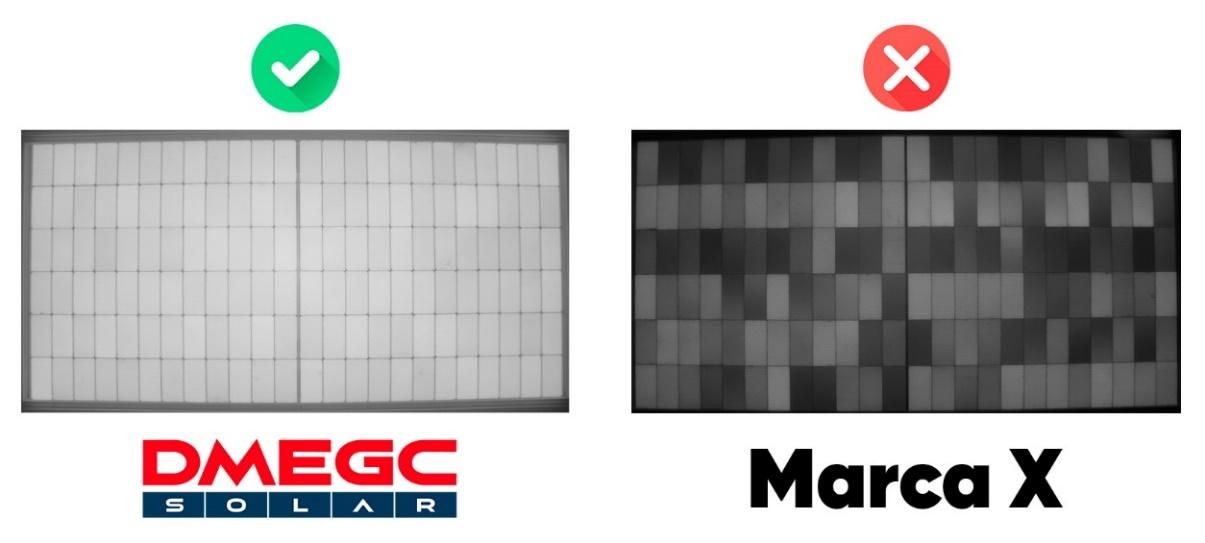
Comparison of electroluminescence module DMEGC with other brand

Electroluminescence not only identifies microcracks, but also reveals the intrinsic quality of the cells used in the module assembly. 

With this technology, we ensure that DMEGC modules are not only efficient but also reliable, minimizing risks for customers.

Electroluminescence is a non-destructive and essential technique for detecting hidden defects that could go unnoticed in other tests. 

Among the main problems that may arise, the following stand out:

  1. Reduced efficiency: Mismatch between cells can limit power generation, as module performance is defined by the weakest cell;
  2. Hot spots: Performance differences between cells can result in localized heating, causing module damage and even irreversible failure;
  3. Power loss: Modules with cells of unequal efficiency can suffer significant losses in energy production;
  4. Long-term damage: Electrical stress generated by microcracks accelerates module degradation, reducing its lifespan and reliability.

Therefore, DMEGC Solar adopts a rigorous electroluminescence verification process, with high-definition images, to ensure greater reliability and durability of the modules. 

This attention to detail positions DMEGC as a superior choice in the solar energy market.

Remember: when choosing a photovoltaic module, go beyond the power test. Electroluminescence is essential when choosing solar modules, ensuring that you are investing in quality and longevity.

The opinions and information expressed are the sole responsibility of the author and do not necessarily represent the official position of the author. Canal Solar.


DMEGC electroluminescence fake power INMETRO (National Institute of Metrology, Quality and Technology)
Photo by Lucas Gomes Monteiro
Lucas Gomes Monteiro
Senior Electrical Engineer at DMEGC Solar Latam. Graduated in electrical engineering from the Federal Institute of Paraíba (IFPB) with an MBA in Electrical Systems Management and Engineering from the Postgraduate Institute (IPOG).
PreviousPrevious
NextNext

Leave a comment Cancel reply

Your email address will not be published. Required fields are marked with *

Comments should be respectful and contribute to a healthy debate. Offensive comments may be removed. The opinions expressed here are those of the authors and do not necessarily reflect the views of the author. Canal Solar.

News from Canal Solar in your Email

Posts

Hot-dip galvanizing: technical parameters, applicable standards and implications

Hot-dip galvanizing: technical parameters, applicable standards and implications

Canal Solar - Zero grid with microinverters: how to minimize flux inversion.

Zero grid with microinverters: how to minimize flux reversal?

More news

Read More
Canal Solar - Enel fined R$ 14 million for power supply failures.
  • January 14, 2026
Photo by Henrique Hein
Henrique Hein

Enel fined R$ 14 million for power supply failures.

Short-term energy market registers 12,5% ​​default rate.
  • January 12, 2026
Photo by Wagner Freire
Wagner Freire

Short-term energy market registers 12,5% ​​default rate.

Government creates working group to study nuclear microreactors.
  • January 7, 2026
Photo by Wagner Freire
Wagner Freire

Government creates working group to study nuclear microreactors.

It is a news and information channel about the photovoltaic solar energy sector. Channel content is protected by copyright law. Partial or total reproduction of this website in any medium is prohibited.

Facebook X-twitter Instagram Youtube LinkedIn Spotify

Site Map

Categories

  • News
  • Articles
  • Interviews
  • Consumer Guide
  • Authors
  • Projects
  • Brazil
  • World
  • Technical Articles
  • Opinion Articles
  • Manufacturer Items
  • Electrical Sector
  • Biddings
  • Products

Channels

  • About Us
  • Contact
  • We’re hiring!
  • Privacy
  • Expedient
  • advertise here

Membership and certifications

Copyright © 2025 Canal Solar, all rights reserved. CNPJ: 29.768.006/0001-95 Address: José Maurício Building – Mackenzie Avenue, 1835 – Floor 3, – Vila Brandina, Campinas – SP, 13092-523

We use cookies to make your experience on this site better Find out more about the cookies we use or turn them off in your .

Receive the latest news

Subscribe to our weekly newsletter

Canal Solar
Powered by  GDPR Cookie Compliance
Privacy

This website uses cookies so that we can provide you with the best user experience possible. Cookie information is stored in your browser and performs functions such as recognizing you when you return to our website and helping our team to understand which sections of the website you find most interesting and useful.

Cookies strictly required

Strictly Necessary Cookie should be at all times so that we can save your preferences for cookie settings.

Cookies for third parties

This website uses Google Analytics to collect anonymous information such as the number of visitors to the site, and the most popular pages.

Keeping this cookie enabled helps us to improve our website.