
In collaboration with Leonardo Balbino
The first quarter of 2021 was marked by government decisions and determinations that corroborate compliance with the electricity sector modernization agenda. We can prove this statement from the presidential sanction of Law 14.120/2021, resulting from the conversion of MP 998/2020 and the publication of MP 1.031/2021, which provides for the capitalization of Eletrobras and allows BNDES (National Bank for Economic and Social Development) to begin studies on capitalization modeling.
In this sense, there was also significant movement regarding DG (distributed generation). But it was at the end of last year, in December 2020, that after the issuance of the TCU Ruling 3.063/2020 the important CNPE resolution 15/2020, defining the guidelines and policies for GD.
Subsequently, on March 8, 2021, deputy Lafayette de Andrada, Republicans/MG, presented a new base text for PL 5829/19, which aims to establish the GD Legal Framework in Brazil.
In view of the favorable scenario for structural changes in the electricity sector and in order to elucidate the future framework for DG, as well as understand the guidelines that should be adopted in the long-awaited reform of the energy compensation system, we must first observe the structure institutional structure of the Brazilian electricity sector.
Because, only then will we be familiar with the main discussions held to advance the regulation that deals with the DG mechanism. In this sense, we ask: after all, what is the CNPE (National Energy Policy Council) and why did it set the guidelines for DG?
The CNPE has the following functions:
- To advise the President of the Republic on the formulation of policies and guidelines for the electricity sector; and
- To suggest actions to be taken by the federal government with technical assistance from regulatory agencies.
Having said that, we can easily understand why the CNPE (National Council for Energy Policy) was chosen to formulate and publish the aforementioned resolution, outlining all the premises that should be adopted for the evolution of distributed generation in the country. It is the CNPE's responsibility to establish policies and guidelines for the energy sector. Furthermore, we highlight the following institutions that also participate in the energy sector's structure.
MME (Ministry of Mines and Energy)
Responsible for formulating and ensuring the implementation of public policies for the sustainable management of energy and mineral resources, contributing to the socioeconomic development of the country.
CMSE (Electricity Sector Monitoring Committee)
Its function is to continuously monitor and evaluate the continuity and security of the electricity supply throughout the national territory.
EPE (Energy Research Company)
Its purpose is to provide services to the Ministry of Mines and Energy (MME) in the area of studies and research aimed at supporting the planning of the energy sector, covering electricity, oil and natural gas and their derivatives, and biofuels.
ANEEL (National Electric Energy Agency)
It is responsible for:
- To regulate the generation, transmission, distribution, and commercialization of electrical energy;
- control, directly or through agreements with state agencies, the concessions, permits and services of electric power;
- To implement the federal government's policies and guidelines regarding the exploitation of electrical energy and the utilization of hydroelectric potential;
- To establish rates;
- To resolve the differences., in the administrative sphere, between agents and between these agents and consumers, and
- To promote the activities of concession grants, permission and authorization of electrical energy projects and services, by delegation from the Federal Government;
The ONS (National Electric System Operator)
Responsible for coordinating and controlling the operation of electricity generation and transmission facilities in the SIN (National Interconnected System) and for planning the operation of the country's isolated systems, under the supervision and regulation of... ANEEL.
CCEE (Chamber of Electric Energy Commercialization)
It operates as a market player in Brazil's electricity sector, focused on enabling a competitive, sustainable, and secure trading environment.
National guidelines for public policies focused on distributed generation.
Having understood the institutional structure of the Brazilian electricity sector, as well as the functions of the institutions, we highlight the national guidelines for public policies aimed at DG, set out in CNPE resolution 15/2020:
- Non-discriminatory consumer access to distributor networks for DG connection purposes;
- Legal and regulatory security, with deadlines for maintaining incentives for current consumers who have GD;
- Allocation of network usage costs and charges stipulated in electricity sector legislation, considering the benefits of distributed generation (DG);
- Transparency and predictability in the processes of developing, implementing, and monitoring public policy, with a defined agenda and deadlines for reviewing the rules for distributed governance; and
- Gradual transition of rules, with the establishment of intermediate stages for the improvement of the rules for GD.
Therefore, regardless, if there is a reform of REN 482/2012 within the scope of ANEEL or if the legal framework for GD is created in the National Congress, all of the above premises must be observed and implemented for the correct evolution of the Energy Compensation System, regardless of the technical position or conceptual divergence on the benefits and impacts of GD in the energy sector.
The point generated debate with the recent position of ANEEL disclosed at the meeting with the main associations in the energy sector about the changes to REN ANEEL 482/2012, which in summary is based on the following modifications:
- The rules for installed systems are maintained only for a period of 12 years (acquired right);
- Applies a more impactful alternative (scenario 5) to the GD mechanism;
- It does not establish a transition rule; and
- It does not consider the benefits of distributed generation (DG) for the system.
This position of ANEEL Does it essentially follow the guidelines set by the CNPE? By a literal interpretation, unless the regulatory agency presents the reasons for its position, it is clear that the guidelines are not being followed. While we now know that the CNPE has the authority to establish the guidelines set out above, we move on to the feasibility analysis of the new base text of PL 5829/19. It is known that the recently presented text was based on the following premises:
- Democratizing the use of solar energy in Brazil;
- Legal certainty, clarity, and predictability for small and large investors who wish to install alternative energy sources on their properties or in their businesses;
- It fully compensates the TUSD (Transmission System Usage Tariff) for wire B of distributors and concessionaires; and
- It creates a 10-year transition period for changing the billing system.
Note below the details regarding the gradual transition of rules prepared by ABGD (Brazilian Association of Distributed Generation):
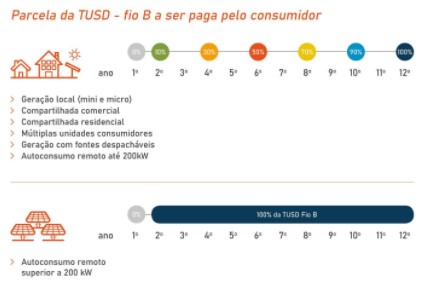
Contrary to what happens with the interpretation of the position of ANEEL, in our assessment, the new basic text of PL 5829/19 meets the guidelines set out in CNPE resolution 15/2020. Therefore, we can expect that the GD rules will soon be changed with the preservation of current rules and necessary guarantees so that existing benefits are gradually reduced, allowing the maintenance of the expansion of the model in the country.
[elementor-template id="561643″]


Comments
Comments are moderated before publication.Comments should be respectful and contribute to a healthy debate. Offensive comments may be removed. The opinions expressed here are those of the authors and do not necessarily reflect the views of the author. Canal Solar.