
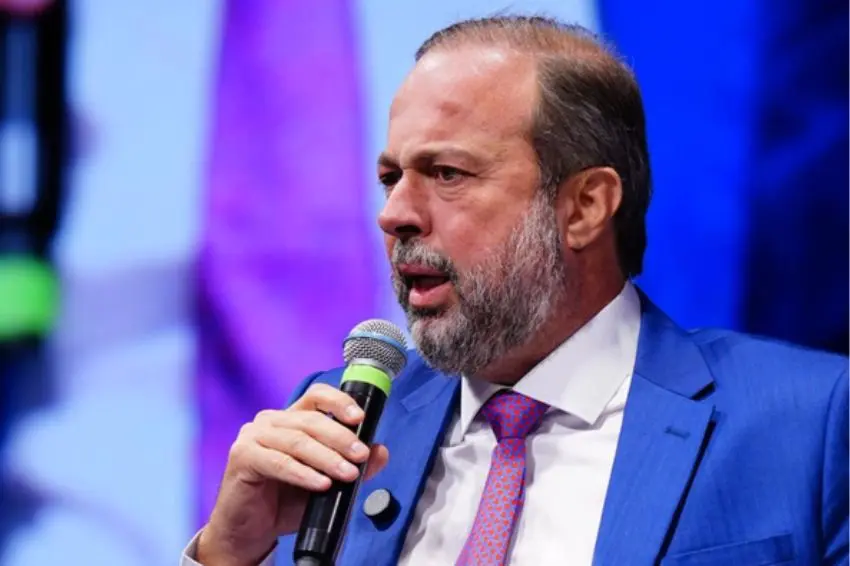
The Minister of Mines and Energy, Alexandre Silveira, stated this Friday (22) that the government should publish in the coming days the decree for the first auction of batteries in Brazil. The announcement was made during participation in the National Sphere Forum, in Guarujá (SP), and once again placed storage at the center of discussions in the electricity sector.
According to the minister, the bidding process should take place in the second half of 2026 and involves the contracting of battery storage systems for operation in the SIN (National Interconnected System).
This announcement comes at a time when the sector is awaiting more concrete definitions regarding the auction model and the role that batteries will play in the system's operation, especially in light of the growth of renewable generation and the increasing challenges of flexibility in the energy matrix.
During the panel, Silveira stated that energy storage will be a central element in integrating renewable sources, reducing losses, and modernizing the Brazilian electrical system. "Energy storage will be a central element in integrating renewables, reducing losses, and modernizing the Brazilian electrical system," he said.
The minister also stated that designing the auction required an extensive round of technical discussions, including analyses of international experiences.
According to him, in several countries storage projects depended on high subsidies, which led the Brazilian government to seek a format considered more suitable to the local reality. "It needed to be a very thorough debate so that we can now, with confidence, launch the auction," he stated.
Another point mentioned by Silveira was the discussion about local content. According to the minister, the government is evaluating progressive mechanisms to stimulate the national production chain of batteries and storage systems. "We need to strengthen the national industry," he stated.
The announcement comes after a long period of market anticipation surrounding the regulation of the auction, seen by industry players as an important step towards scaling up storage in Brazil and creating a clearer economic signal for this type of solution.
all the content of Canal Solar is protected by copyright law, and partial or total reproduction of this site in any medium is expressly prohibited. If you are interested in collaborating or reusing part of our material, please contact us by email: redacao@canalsolar.com.br.


Comments (1)
Comments are moderated before publication.Comments should be respectful and contribute to a healthy debate. Offensive comments may be removed. The opinions expressed here are those of the authors and do not necessarily reflect the views of the author. Canal Solar.
We are significantly behind in regulation and in defining incentives for batteries, unlike other countries that have acted on energy storage to balance renewable generation. Meanwhile, several renewable energy chains, such as solar and wind, have contracted, various investments have declined, resulting in the loss of companies and jobs, and the population has faced increased energy bills due to the growing share of the CDE (Energy Development Fund) and incompetence in providing innovation and new technologies such as reversible hydroelectric plants, gravity-fed energy, ocean energy, centralized and distributed storage, as measures to stabilize the energy effects of renewables in the SIN (National Interconnected System), especially in the face of the advance of solar energy and the effect of the famous "duck curve" during peak hours (18 pm to 22 pm).