
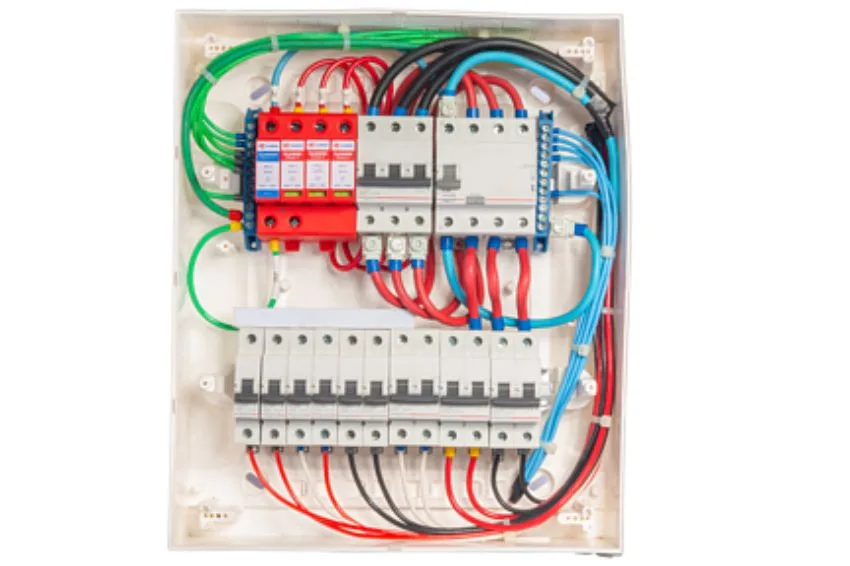
Several criteria are fundamental for selecting surge protection devices (SPDs), such as: maximum continuous operating voltage (Uc), protection voltage level (Up), withstand capability to temporary overvoltages (UT), and impulse currents (In and Iimp).
These are essential parameters for the proper specification of surge protection devices (SPDs). However, even when correctly selected, the performance of the SPD can be seriously compromised if the effects of high frequencies associated with impulse currents in the connecting conductors are disregarded.
It is important to remember that impulsive currents, originating from atmospheric discharges, are not limited to the industrial frequency (60 Hz), but encompass a wide frequency range that can go from a few kilohertz (kHz) to the megahertz (MHz) range. For this reason, effects such as parasitic inductance or inductive reactance, which are negligible in sinusoidal regimes, can play a significant role in the propagation of surges.
Brazilian standard NBR 5410 explicitly recommends that "the length of conductors intended for connection of surge protection devices (SPDs) should be as short as possible, without bends or loops," and establishes a maximum limit of 50 cm. This guideline reflects the concern of ABNT's working groups, composed of engineers and specialists, regarding the relevant inductive effects at high frequencies. The objective of this article is precisely to deepen the understanding of these effects and their practical consequences.
Inductance of conductors
Inductive behavior is present in any conductor that carries time-varying current, as is the case with the cables that connect the surge protection device (SPD) to the system. Inductance is the property of a conductor that opposes the change in electric current, and its magnitude depends directly on the length of the cable and inversely on the distance between the conductors. The greater the length and the further apart the cables, the greater the resulting inductance.
Inductive reactance (XL) represents this opposition to changing current, and is given by the formula:
- XL = 2πfL,
where f is the frequency of the current and L is the inductance of the conductor. This equation makes it clear that inductive effects increase proportionally with frequency.
Connection conductors for the surge protection device (SPD).
A critical aspect in the installation of surge protection devices (SPDs) is the length of the connecting cables. When subjected to an impulse current, these cables can generate significant induced voltages, which add to the residual voltage of the SPD. Figure 1 illustrates the situation where the voltage generated in the conductors is also applied to the terminals of the equipment to be protected.

- Figure 1 – Voltage drop in the connecting conductors of the SPD (Surge Protective Device).
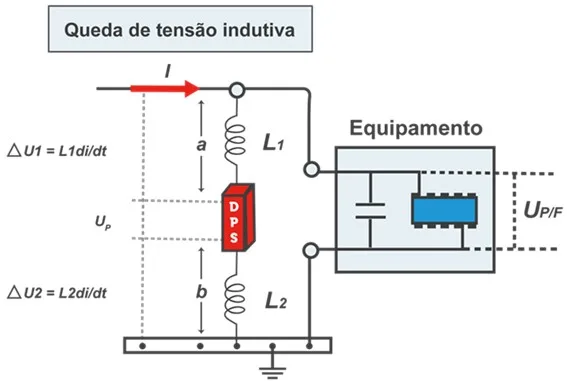
The resulting total voltage (Up/f) is the sum of ΔU₁ + ΔU₂ + Up, and in some cases, it may exceed the equipment's withstand voltage to the impulse (Uw). This effect is so significant that NBR 5419 considers an induced overvoltage of 1 kV per meter of cable when the surge protection device (SPD) is installed at the line entrance. When the total conductor length is less than or equal to 0,5 m, the following can be considered:
- Up/f = 1,2 × Up.
Another important factor is the distance between the surge protection device (SPD) and the equipment. When this distance exceeds 10 meters, wave reflection occurs at the equipment terminals, which can cause voltage fluctuations with an amplitude of up to 2 × Up/f. This phenomenon, known as line resonance, compromises the protection of the end devices. To better understand this aspect, it is recommended to read the article: The importance of DPS coordination.
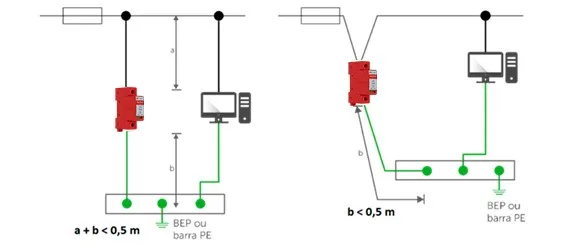
Therefore, the length of the conductors connected to the SPD should be as short as possible, without bends or loops, and limited to a maximum of 50 cm. Figure 2 shows two different ways of connecting SPDs. If the sum of the distances a + b cannot be less than 0,5 m, it is recommended to adopt the alternative configuration, where b < 0,5 m, to minimize inductive effects.

- Figure 2 – Maximum length of the SPD connection conductors
Conclusion
The effectiveness of the protection provided by the surge protection device (SPD) depends not only on its correct specification, but also on how it is installed. Inductive effects in the connecting conductors, although negligible at low frequencies, become critical in the presence of surges with high-frequency components, such as those caused by lightning strikes.
The additional voltage induced by undersized cables can negatively affect the protection offered by the surge protection device (SPD), exposing equipment to risks that could be avoided with proper installation. Therefore, it is always recommended to observe the limits defined by the standards and adopt good installation practices, such as reducing cable length, "twisting" cables, and minimizing loops.
Ensuring that connecting cables are short, straight, and properly positioned is just as important as selecting the correct surge protection device (SPD). After all, effective protection results from the combination of the right device and correct installation.
The opinions and information expressed are the sole responsibility of the author and do not necessarily represent the official position of the author. Canal Solar.



Comments
Comments are moderated before publication.Comments should be respectful and contribute to a healthy debate. Offensive comments may be removed. The opinions expressed here are those of the authors and do not necessarily reflect the views of the author. Canal Solar.