
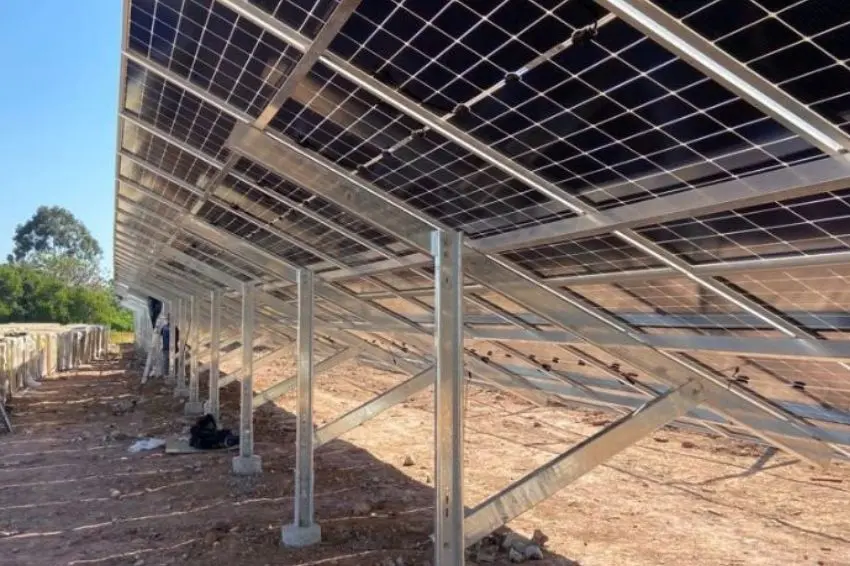
The assembly of ground-mounted structures is, in a way, simple, but dependent on precision and attention to detail. It is precisely these details that account for the majority of errors committed by installers, ranging from poorly executed foundations, execution outside of project specifications, incorrect installations, poorly done grounding/equipotential bonding, uncalibrated tools, lack of installation procedures, and lack of installer training.
Piles are the foundation of any structure, and during the driving process, one of the most critical errors is the lack of proper pile alignment, causing misalignment of the flanges and, in more severe cases, making assembly impossible.
It is essential to perform the alignment, always using a reference line or laser, respecting the terrain roughness limits that correspond to variations in ground height along the structure, as well as the tolerances for ground slope and the positioning of each stake.
Another common mistake is failing to check the angle of solar incidence in the region, leading to a loss of efficiency in generation. The latitude of the installation site directly impacts this perpendicularity.
The inclination of the structure is defined from the horizontal plane, using the Equator as the 0° mark; that is, the further south in the country, the greater this angle becomes. In Brazil, the latitude reaches up to 33°, and Metal Light Solar Estruturas' equipment is capable of adapting to all situations.
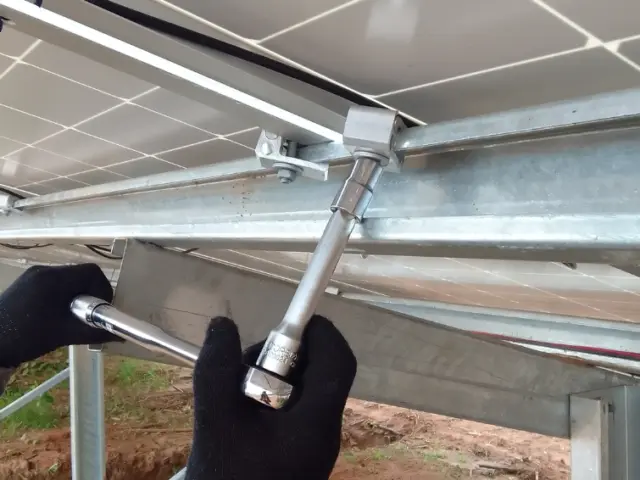
Bolt torque is one of the most critical factors for structural integrity, frequently associated with failures and collapses of structures. This is because the correct torque is essential to ensure the fastening of parts; torque values must follow normative recommendations, such as the DIN (Deutsches Institut für Normung) standard, which is the most widely used in the world.
Metal Light structures utilize, in addition to DIN 125 flat washers, DIN 127 spring washers which, through their helical spring shape, create constant pressure between the nut and bolt, preventing them from loosening due to vibration. Torque should always be applied using a... torquemeter certified and calibrated digital or snap-type.
Photovoltaic power plant structures are constantly exposed to the elements, and therefore it is essential that they undergo post-hot-dip galvanizing according to ABNT NBR 6323. After this process, this type of structure should not be welded, cut, or drilled after its galvanizing treatment, as this compromises the protection.
In many plants, we have identified cases where the structure is altered in the field, resulting in the protection of the galvanization and the warranty being voided. The recommended course of action when this alteration is necessary is to contact the manufacturer and apply cold galvanizing, which has an average warranty of 2 years and should always be reapplied.
To mitigate these errors, Metal Light Solar Estruturas now provides, in addition to assembly manuals, pile driving layouts and structural detailing, training for all our clients and offers a warranty that establishes guidelines for necessary maintenance to ensure the performance and lifespan of the system. This is the experience of 1 GWp of installed power with fixed structures at the client's disposal.
You may also be interested
The opinions and information expressed are the sole responsibility of the author and do not necessarily represent the official position of the author. Canal Solar.

Comments
Comments are moderated before publication.Comments should be respectful and contribute to a healthy debate. Offensive comments may be removed. The opinions expressed here are those of the authors and do not necessarily reflect the views of the author. Canal Solar.