
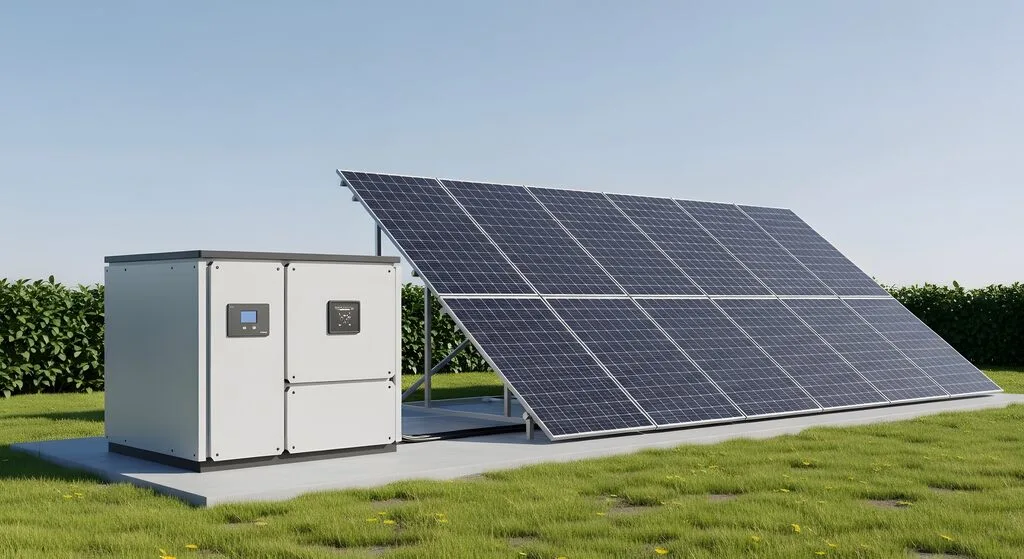
Have you ever imagined generating and storing your own energy, without depending on the utility company? This is possible with an off-grid system.
Also called an autonomous system, this model's main characteristic is its independent operation from the electrical grid.
Therefore, it has been gaining ground in the photovoltaic market, offering consumers a technology capable of storing surplus solar energy and ensuring a continuous supply.
In this article, we explain what an off-grid system is and how it works, its main advantages and disadvantages, and how much it costs to invest in this technology.
We also showcase a real-life success story of someone who replaced diesel generators with solar power and achieved a return on investment in a short time.
Good reading!
take the opportunity to Download the Magazine Canal Solar and stay up-to-date with the latest news, studies, and analyses on the solar energy market in Brazil.
What is an off-grid system?
An off-grid system is a set of photovoltaic equipment that generates and stores energy without any connection to the public grid.
Also called an isolated or autonomous system, this type of installation is designed to serve locations where there is no connection to the utility company or where total electrical independence is desired.
In this model, the energy captured by the solar modules is used locally, and the surplus is stored in batteries.
Thus, consumption is guaranteed even at night or during periods of low solar irradiance. The entire supply is independent, without the need for metering or credit compensation by the distributor.
The adoption of off-grid solar systems has been growing globally.
According to one report According to the Global Off-Grid Lighting Association (GOGLA), 9,3 million units were sold. solar kits in 2024 by companies in the off-grid solar sector. This is the second largest volume in the historical series.
The companies associated with the institution already provide energy to more than 137 million people, 3,6 million of whom are entrepreneurs who use these kits to generate income.
How does an off-grid system work?
The operation of an off-grid system is based on the capture of sunlight by photovoltaic modules and the conversion of this energy into usable electricity.
During the day, the panels generate direct current (DC), which is directed to a charge controller. This equipment regulates the voltage and current sent to the batteries, preventing overcharging and extending their lifespan.
The energy stored in the batteries is used when solar generation is insufficient, such as at night or on cloudy days.
At this stage, the inverter comes into play, transforming the direct current from the batteries into alternating current (AC), the standard for electrical outlets and equipment.
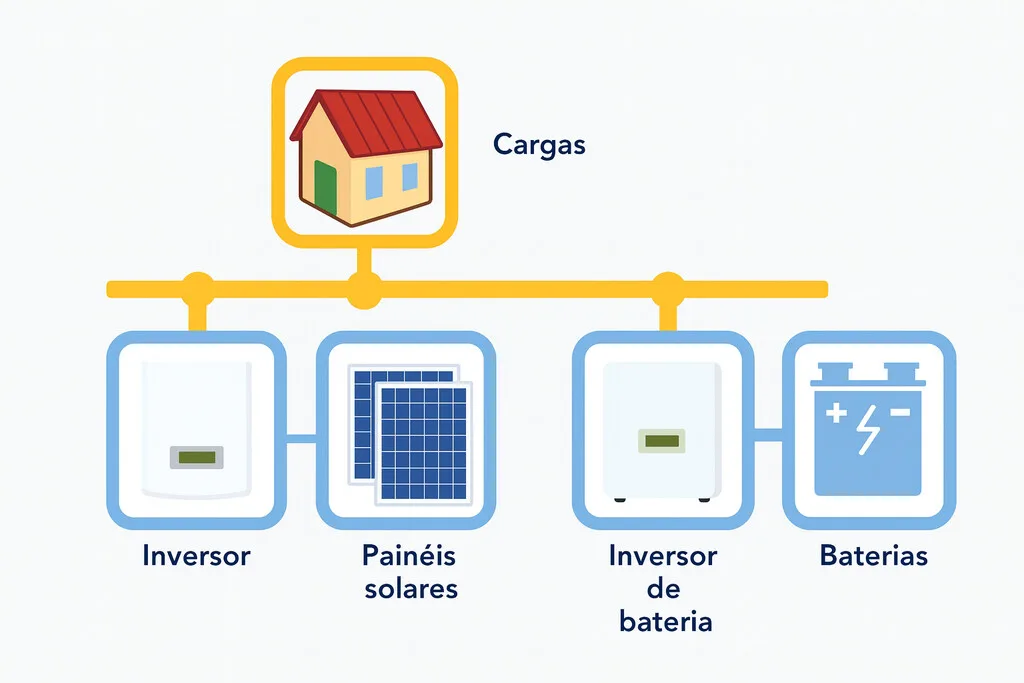
In simplified terms, the flow of energy follows this order:
Solar panels → charge controller → batteries → inverter → electrical equipment.
Each component has a specific function:
- Photovoltaic modules: capture solar radiation.
- Charge controller: manages the input and output of energy from the batteries.
- Batteries: store the generated energy.
- Inverter: converts and distributes energy for immediate use.
The system's performance depends on the correct sizing of all these elements, according to the consumption profile and the desired level of autonomy.
See also: On-grid and off-grid solar energy: differences and which one to choose
Advantages of the off-grid system
The main advantage of this type of system is energy independence. After all, the consumer generates and stores their own electricity, maintaining supply even in locations without a public grid or in situations of supply failure from the utility company.
In addition to autonomy, off-grid solar systems have other significant benefits:
- Application in remote areas: a viable solution for rural regions, isolated communities, islands, and areas without electrical infrastructure.
- Long-term savings: reduced spending on fossil fuels and generator maintenance.
- Continuous supply: guaranteed operation even in locations with power outages or failures from the utility company.
- Sustainability: generating clean energy with less environmental impact and no CO2 emissions.
- Flexibility for expansion: possibility of increasing capacity with new modules and batteries as consumption increases.
- Noise and pollution reduction: replaces diesel generators, eliminating noise and odors.
One of the advantages that sparks the most interest, and also some doubt, among those considering installing an autonomous system is the return on investment. Does the savings compensate in practice?
Next, see a real-world example of a business that adopted this solution and proved its financial results.
Case Study – Ilhabela (SP): Solar energy replaces diesel.
At Praia de Castelhanos, in Ilhabela (SP), Quiosque do Alemão adopted a 4,36 kWp off-grid solar system, equipped with a Growatt SPF5000ES inverter and two 4,8 kWh Dyness lithium batteries.
Before the installation, the kiosk consumed 243 liters of diesel per month, with a total cost of R$ 1.951, including maintenance and fuel transportation.
After the implementation of the off-grid project, consumption dropped to 22 liters of diesel per month, equivalent to R$ 329.
The total investment was R$ 50.785, and the financial return (payback) occurred in 2 years and 9 months.
Read more: Off-grid systems guarantee energy independence for establishments in Ilhabela
Disadvantages of the off-grid system
Despite offering complete autonomy, off-grid solar systems have their challenges, which should be considered before investing. The main limitations are related to the initial cost and long-term operation.
- High initial cost: the investment is usually higher than that of grid-connected systems, mainly due to the use of batteries and charge controllers.
- Dependence on weather conditions: prolonged periods of rain or low solar irradiance reduce generation and require greater storage capacity.
- Maintenance and component replacement: batteries and controllers require constant monitoring and replacement after a few years of use.
- Waste generation: Improper disposal of batteries can cause environmental impacts, requiring proper disposal and specialized recycling.
It is important to highlight that these factors do not preclude the use of this technology. In fact, they reinforce the importance of a well-designed project, executed by qualified professionals, to ensure the efficiency and durability of the system.
Another good idea is to invest in solar energy training and courses to better understand the options available and make more informed decisions about the use of these technologies.
For whom is an off-grid system recommended?
Off-grid systems are suitable for locations where there is no reliable access to the electrical grid or where the cost of extending the grid would be prohibitive.
Here are some ideal profiles:
- Farms, ranches and rural properties located away from the power grid;
- Isolated communities and villages in hard-to-reach regions;
- Islands and coastal regions without electrical infrastructure;
- Mobile units (trailers and motorhomes) that require autonomy during travel;
- Mobile commercial applications without access to the electrical grid (stands, kiosks, and food carts);
- Tourism or accommodation projects in natural environments without internet access.
Are you enjoying the text? Then check out the video to learn about the main myths surrounding solar energy!
Can I use an off-grid solar system in Brazil?
Yes. Off-grid solar systems are permitted and regulated in Brazil.
Because these installations are isolated from the public network, these projects do not fall under the rules of... distributed generation defined by Normative Resolution No. 1.059/2023 from the National Electric Energy Agency (ANEEL).
In practice, this means that there is no need for approval or authorization for small systems that operate independently, since they do not inject energy into the utility company's grid.
Herself - Host ANEEL It recognizes so-called "zero grid" systems, a term used to describe installations that, although connected to the electrical grid, do not inject surplus energy.
However, for larger projects or in areas near existing power lines, it is recommended to notify the local power distributor. This step is important to ensure technical compliance and avoid risks to the safety of the installation.
Learn more: Do zero grid solar energy projects need to be approved?
How much does an off-grid system cost?
The investment in an off-grid solar system varies depending on the power output, battery type, desired autonomy, and project complexity. For residential or small-scale applications, the cost typically ranges from R$15 to R$40.
Larger projects, which require greater generation and storage capacity, can easily exceed R$100. This is especially true when using lithium batteries and higher-power inverters.
What explains this price variation is the set of equipment required for autonomous operation.
In addition to photovoltaic modules, the system includes batteries, charge controllers, inverters, and mounting structures. All of this increases the initial investment compared to grid-connected systems (on-grid).
Also check out: How to calculate energy consumption in kWh/month? Check out the step-by-step guide
Where can I find an off-grid solar system?
To invest in an off-grid solar system, it is essential to have qualified and trustworthy suppliers in your region.
A good professional will know how to correctly size the system, indicate the appropriate equipment, and ensure installation meets the required technical and safety standards.
But before signing the contract, check if the company has proven experience in off-grid projects, if it offers after-sales support, and if it works with certified equipment.
When it comes to solar energy, quality information makes all the difference for a safe and efficient choice. That's why... Canal Solar has established itself as one of the leading portals specializing in photovoltaic energy in Brazil.
Whether you're a consumer looking to reduce your electricity bill or a professional seeking deeper technical knowledge, here you'll find reliable, up-to-date content guided by experts.
Access the portal Canal Solar Explore our content on solar energy, distributed generation, and energy sustainability!
Conclusion
Off-grid systems are becoming a viable alternative for those seeking energy autonomy and independence from the public grid.
Although the initial investment is higher, this system eliminates fuel costs, guarantees a continuous supply, and expands access to energy in remote locations.
In any case, the success of the model depends on a well-designed project, the use of quality components, and planning that considers the consumption profile and the necessary autonomy.
When implemented correctly, the system offers cost savings, stability, and long-term sustainability.
To learn more, visit our website. blog about solar energy And check out content about best practices, innovations, and opportunities to optimize the use of solar energy.

Comments (1)
Comments are moderated before publication.Comments should be respectful and contribute to a healthy debate. Offensive comments may be removed. The opinions expressed here are those of the authors and do not necessarily reflect the views of the author. Canal Solar.
Which company is best for installing this system?