
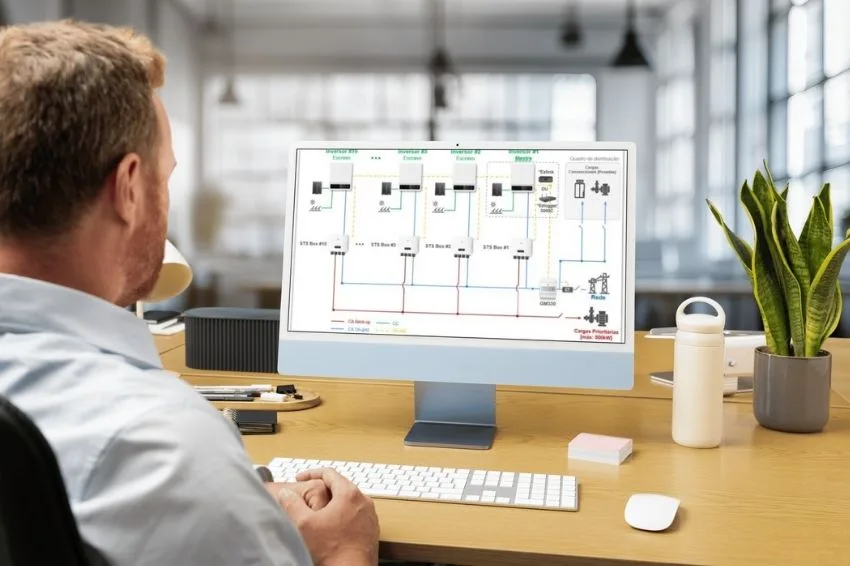
With a favorable scenario, especially for industries, factories, and the agricultural sector, hybrid battery-powered systems are gaining increasing visibility in the market.
These types of consumers have large loads and, consequently, require larger inverters to power them. Therefore, Goodwe has developed a solution to connect up to 10 50 kW hybrid inverters (model ET 50K) in parallel, thus enabling the connection of a load of up to 500 kW.
The biggest benefit of having multiple inverters connected in parallel is reliability. Because, if one of the inverters stops working due to some kind of fault, the others continue operating, as long as the affected inverter is not the master, which controls the others (the slaves).
Therefore, the main components for a system will be presented below. hybrid inverters in parallel.
Static transfer switch
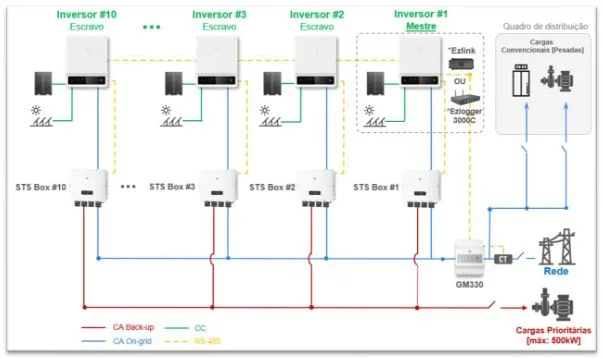
To ensure a smooth transition between connected and disconnected network modes, a static transfer key, the Goodwe STS Box, is essential. In this regard, the STS Box is only necessary when using the backup function.
The STS Box ensures fast and automatic synchronization of phase and frequency, within an interval imperceptible to the naked eye, of less than 10 ms. For motors, typically found in this type of application, it prevents abrupt mechanical torques or current spikes, preserving the load from mechanical or electrical stresses.
-

- Figure 1 – STS Box connection diagram. Source: Goodwe, 2025
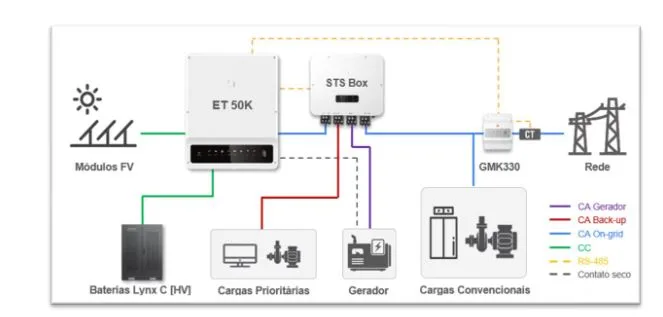
Furthermore, the STS switch can be used to control the start and stop of a diesel generator up to 200A. In this configuration, the generator can power backup loads, charge batteries, and keep the inverter operating in the absence of mains power.
-

- Figure 2 – Example of connection to a diesel generator. Source: Goodwe, 2025
An important point to note is that it is not advisable to connect loads to the backup port if there are no batteries connected to the hybrid inverter. Otherwise, these loads may be disconnected overnight because the backup port is not directly powered by the grid.
Communication module
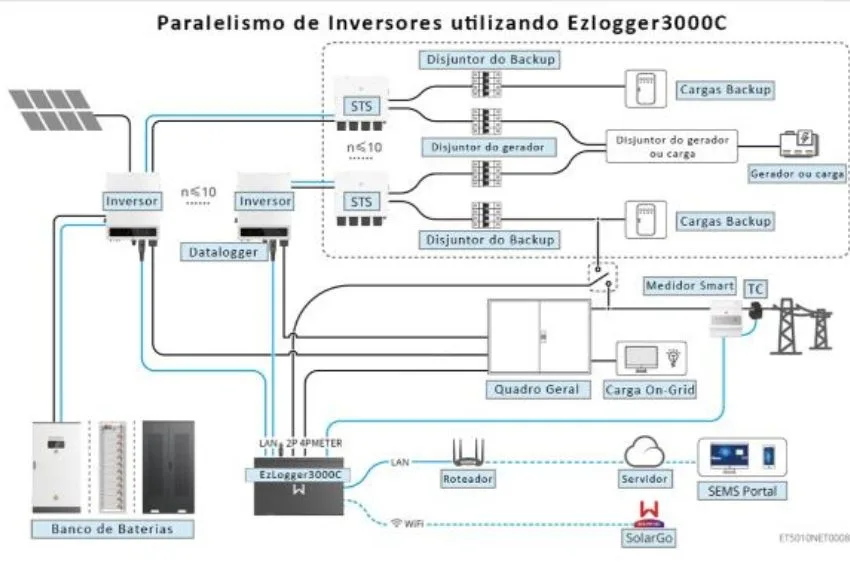
In addition to the STS Box, a communication module is essential. It is usually connected to the same location as the Wi-Fi logger, on the COM2 port. There are two types of modules that differ in the number of inverters in parallel they support.
The Ezlink3000 model supports up to 4 units in parallel, while the Ezlogger3000C supports up to 10. The system allows for load control and even remote shutdown.
Communication cables
All these components must be connected using CAT5E or CAT6 STP cables for distances up to 5 meters, or CAT7 for distances up to 10 meters. The cables are connected in a chain for each inverter, as shown in Figure 3.

- Figure 3 – Cable connection with Ezlogger3000C. Source: Goodwe, 2025
Smart meter
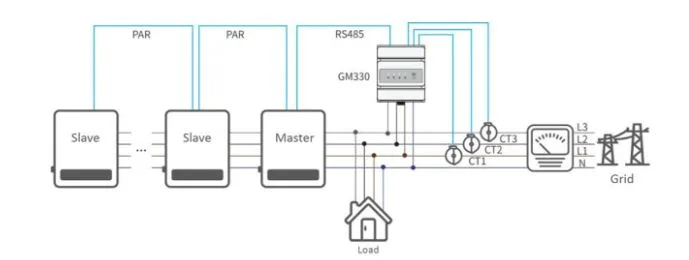
A smart meter must be installed on the master inverter. The models supplied by Goodwe are the Smart Meter GM330 or GM3000. This meter requires the installation of 3 current transformers (CTs), one for each phase, with a 5A nA ratio and an opening suitable for the cable cross-section used in the phases.
It is very important to pay attention to the direction of the current from the current transformer (CT), which must flow from the house to the grid. With the GM330 smart meter, it is possible to implement export power limitation for multiple inverters in parallel.

- Figure 4 – Smart Meter Connection. Source: Goodwe, 2025
An interesting feature of this inverter is the ability to control load shutdown in case of overload of the backup port or battery discharge depth exceeding the permitted limit.
What is needed to install a parallel hybrid inverter system?
In summary, to install a parallel system of Goodwe hybrid inverters, you need:
- One STS Box per inverter, if the backup function is used;
- A communication module, Ezlink3000 (up to 4 inverters) or Ezlogger3000C (up to 10 inverters);
- A SmartMeter GM330 or GM3000, sold separately by Goodwe;
- STP CAT5E or CAT6 cables for lengths up to 5 meters, or CAT7 cables for lengths up to 10 meters.
- Current transformers (CTs) with a potential difference of 5A per phase (not supplied by the manufacturer);
- All inverter software must be up to date (consult Goodwe technical support to verify or update it);
Conclusion
With the increasing use of hybrid inverters for demand reduction, energy arbitrage, microgrid, and off-grid systems for larger consumers with higher loads, parallel hybrid inverter solutions will become increasingly common and necessary. Therefore, understanding how to install them is fundamental.
The opinions and information expressed are the sole responsibility of the author and do not necessarily represent the official position of the author. Canal Solar.



Comments
Comments are moderated before publication.Comments should be respectful and contribute to a healthy debate. Offensive comments may be removed. The opinions expressed here are those of the authors and do not necessarily reflect the views of the author. Canal Solar.