

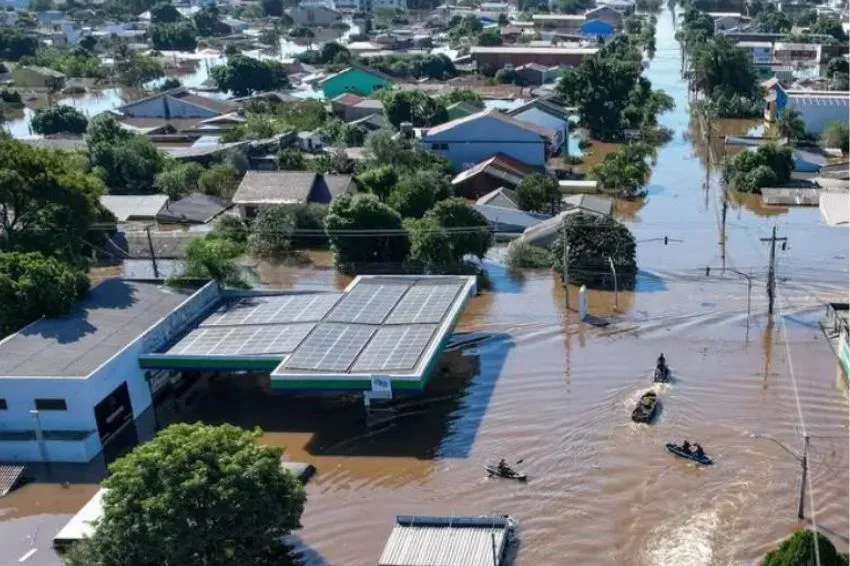
The floods that have affected almost 90% of the cities in Rio Grande do Sul since the beginning of May have caused additional concern for residents of Rio Grande do Sul who have solar energy systems installed in their homes and/or businesses.
So, what should be done with technology if properties are or are at risk of being submerged by rainwater? Are there any recommendations consumers should follow in this type of extreme situation?
Ao Canal Solar, some of the world's leading inverter manufacturers have reported that there is a standard recommendation that must be applied to avoid damage to the system as a whole and the risk of accidents due to electric shocks.
The companies were unanimous in saying that in cases like the one occurring in Rio Grande do Sul, the correct thing to do is to turn off the photovoltaic system under the supervision of a technical engineer and turn it back on only after it has completely dried.
Check out the guidelines from each of the companies interviewed for this report.
ChintPower
The manufacturer first emphasized that isolated consumers should stay away from the area of photovoltaic modules, as even in this type of situation, voltage may remain. "After the floodwaters recede, it's important not to reconnect your system without specialized technical support," emphasizes Christine Gomes, electrical engineer and product manager at Chint Power.
According to the professional, if a property hasn't yet been flooded, it's important for consumers to seek specialized technical support to shut down the entire system—including the inverter, circuit breaker, AC switch, and DC switch. "This way, you can ensure the safety of the photovoltaic system as a whole, as the inverter isn't designed to be submerged in water," Christine emphasized.
Solis
In a statement, the company said that photovoltaic inverters that may have been completely or partially submerged, or exposed to heavy rain, must be kept switched off. According to the multinational, this must be done until the system dries completely for safety reasons, avoiding "short circuits, damage to internal components, and ensuring everyone's safety," Solis emphasized.
Kehua Tech
A Kehua Tech reinforced that the inverters were not made to work submerged, as there is no protection for that. “Operating in this manner damages the equipment,” the company stressed.
“It is recommended that temporary deactivation be carried out until the equipment and system are evaluated, as the customer may also have other problems after flooding”, informed the manufacturer. The water is also mixed with clay that can be deposited inside the equipment.”
Sunrow
A Sunrow, like other companies, also recommends that inverters be kept switched off until a complete assessment is carried out by a qualified professional.
“We emphasize that any cabling disconnection procedures and operations on interruption and sectioning devices in photovoltaic systems must be carried out exclusively by specialized technicians, strictly observing all current safety standards and, imperatively, in conditions of absence of solar irradiance to prevent occurrences accidental.”
Sungrow also emphasizes that such devices, once deactivated, should not be reactivated under any circumstances until a complete assessment of the compromised equipment is completed.
Livoltek
A Livolone drew attention to the fact that when the inverter is subjected to high amounts of water – whether due to flooding, high volume of direct rain or submerged for any other reason – the correct thing to do is to call the professional responsible for the installation.
“Request an inspection of the switchgear, the electrical network, to make sure there has not been a short or something similar. After three days without water for drying, the technician must go to the installation site, turn off the inverter (if it is not already turned off), and carry out a complete review of the entire installation of the home or business.”
Growatt
Guilherme Peterlini, service manager at Growatt Brazil, in turn, explained what installers need to do when they receive a call from a customer in extreme flooding cases. According to the executive, professionals will have to, in addition to shutting down the photovoltaic system, essentially perform a commissioning process from scratch.
“It will be necessary to measure the voltages of the strings and check the quality of the grounding, checking the voltage between the polarities (positive and negative) and the insulation resistance of the photovoltaic system. It's like checking the equipment again from scratch before turning it on and correcting it if you find anything strange. This first measurement is important, and the next step is to analyze the condition of the inverter” he commented.
In this sense, Paterlini instructed professionals to dry the inverter externally and open the equipment (as it will have lost its warranty) to check whether it is also dry inside.
If it is also dry internally, the professional advises professionals to only connect the equipment to DC, turning only the equipment's switch-disconnector switch and leaving the AC circuit breaker open.
“See if the inverter turns on, the LCD display lights up and shows an AC connection error. Then, close the circuit with the AC circuit breaker and see if the inverter can synchronize with the grid and increase its power”, concluded the Growatt professional.
all the content of Canal Solar is protected by copyright law, and partial or total reproduction of this site in any medium is expressly prohibited. If you are interested in collaborating or reusing part of our material, please contact us by email: redacao@canalsolar.com.br.





Answers of 2
The manufacturers did not answer the question in the article, did not provide procedures or clarify the risks of submerged inverters. Considering that 90% of rescues were carried out by civilians/volunteers and could not be different due to the size of the event, what is the safe procedure, what should be done to rescue people on roofs with panels? Can a submerged inverter with DC power short out spontaneously? The water becomes electrified near the inverter or it burns the circuits and the event ends. These were the doubts that circulated
In my opinion, the answer was what to do after the water goes down…”call the technician”
Possibly the people who participated in the rescues did not assess the risks, but questions arose.
Good evening. This article is very good for flooding cases. But here in the southwest of São Paulo, we had very strong winds and some panels were badly damaged. It seems that the wind brought particles, branches, and put a lot of stress on the panels. People who had home insurance were reimbursed, and they didn't have to spend money to buy what the rain and wind damaged. After that, I updated the value of my home insurance, where I have panels. I think it's a good tip, after all, the Solar System is not cheap, if it is completely lost.