
83% of integrators have already received abandoned clients. 70% of expansions go to another professional. Post-installation abandonment doesn't show up on the balance sheet—but it's destroying your business's greatest asset.
There's a type of problem that doesn't appear in any integrator's report: the customer who paid, received the system, was left with a question that no one answered—and silently ceased to exist for you. In 2025, with the new installation market shrinking by 29%, this cost has become even higher. Every customer who slips away due to lack of relationship represents lost revenue—and in the vast majority of cases, goes directly to the competitor who decided to provide real after-sales service.
The phenomenon that became a given: the "orphaned client" of solar
For years, the phenomenon of customers being abandoned after installation was treated as an impression—something that the most experienced in the sector sensed, but which didn't appear in any research. In 2024, Greener presented the data with disturbing clarity: 83% of Brazilian integrators stated that they had received abandoned customers that year. In 2025, the scenario didn't improve—it worsened.
The Strategic Study on Distributed Generation (DG) for the first half of 2025, published by Greener based on 1.188 responses from integrators, showed that 80% of integrators received orphan clients in the first half of 2025 — with 35% receiving more than six clients in this profile, a higher rate than that recorded in 2024. The problem is growing.
The data is disturbing for two simultaneous reasons. First, because the market was in recession: fewer new projects, fewer new clients. Second, because even in this hostile scenario, the volume of orphaned clients received... increased proportionally — proof that post-installation abandonment is not due to overwork, but rather a lack of process.
And the statistic that completes the argument: 94% of integrators say they intend to continue serving orphaned customers—meaning that this growth channel is being noticed by the market. Those who don't offer after-sales service will be feeding the customer base of their competitors who do.
80% of Brazilian integrators received orphan clients in the first half of 2025 — up from 83% recorded annually in 2024, confirming an acceleration of the phenomenon. Distribution: 65% received up to 5 clients with this profile in the semester; 35% received 6 or more — a higher proportion than in 2024.
The most strategic data point: 94% intend to continue serving this type of client. The services most sought after by those "orphaned by solar energy" are preventive maintenance and expansion of the installed system. Those who structure O&M and after-sales service are capturing the customer base that others have abandoned.
The logic is straightforward and uncomfortable: if you're receiving the orphaned customers of your competitors, your competitors are receiving yours. With a market contracting by 29% in new installations by 2025 and more than 20 integrators vying for the same customer base, post-installation churn is no longer just a relationship failure—it's a strategic survival error. The integrator who doesn't take care of their own customer base is literally financing the growth of the competitor who does.
Distribution of orphaned customers received by integrator – H1 2025 vs. 2024
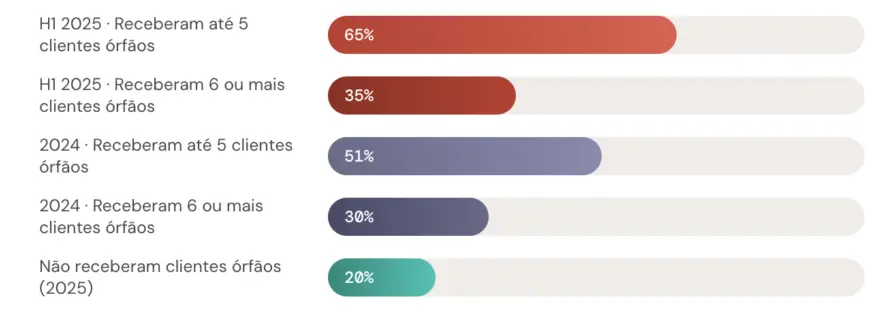
Solar) · 2024: Greener, Strategic Study GD 2024 (3.055 integrators)
There's a second dimension to this data that goes beyond maintenance. Customers who are left without service and seek out another company don't do so solely out of technical necessity. They do so because they have no reason to return to the company that installed their system.
There was no relationship. There was no presence. There was no emotional reason for loyalty. The integrator who serves them now will — naturally — be the reference for the next purchase, for the recommendation to the neighbor, for expansion.
The silent detractor: why most people never complain
One of the most cited studies in customer experience management, conducted by the TARP institute (Technical Assistance Research ProgramsA study conducted by the American government revealed something that continues to surprise managers decades later: only 1 in 26 dissatisfied customers files a formal complaint. The other 25 say nothing. They simply stop buying—and tell others.
In the context of solar energy, this fact takes on an even more acute dimension. A photovoltaic system is not an everyday consumer product. It's a high-value investment—often financed, frequently the family's largest purchase after the house.
When a client becomes dissatisfied, silence is not a relief for the integrator. It's a warning that they will share their experience with their circle of trust—precisely where the most valuable referrals happen.
Behavior of dissatisfied customers in high-ticket services. Most don't complain, but they also don't stay and don't recommend the service.
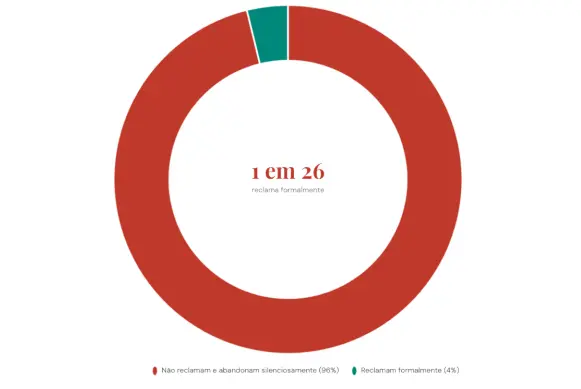
A dissatisfied customer doesn't announce they're leaving. They simply leave, taking their negative experiences with them. Further research in the customer experience sector shows that a dissatisfied customer shares their negative experience with an average of 9 to 15 people in their close circle.
In the solar ecosystem, where purchasing decisions are heavily influenced by condominium WhatsApp groups, neighborhood conversations, and family recommendations, this number carries disproportionate weight. A single poorly served customer can potentially deactivate 3 to 5 future referrals that you'll never even know you lost.



The practical consequence is that the problem of post-installation abandonment doesn't appear as a "problem" for most integrators—because there's no visible complaint. The system is working, the client hasn't called. From the integrator's perspective, everything is fine.
In reality, with 80% of Brazilian integrators actively taking on clients abandoned by competitors by 2025, the chances that their own clients are now being served by another integrator are real—and growing.
70% of expansions go to another professional — the actual cost calculated.
In June 2025, Solfácil released a study with 187 partner companies that revealed the financial impact of post-installation abandonment in very concrete terms: 70% of photovoltaic expansions in Brazil are carried out by professionals different from those who performed the original installation. The client grew, increased consumption, wanted more solar—and called another company.
The data is both alarming and hopeful. Alarming because it means that the integrator who installed the system is missing 7 out of 10 opportunities to expand their own customer base. Hopeful because it demonstrates that the demand for expansion exists—and whoever has a presence in the customer's life will capture it.
Nut Soleasy • 187 companies • June 2025
70% of photovoltaic expansions in Brazil are carried out by professionals other than the original installers. The study showed that 12% of current sales already correspond to expansions or second systems.
The main drivers of expansion in 2025: increased consumption of new air conditioners (45%) — the air conditioning market grew 33% in 2024 according to ABRAVA — and the acquisition of electric vehicles (7%) — sales of electric cars advanced 89% in 2024 according to ABVE. These numbers are only expected to grow in 2026.
The integrator who doesn't maintain an active presence in the client's life will continue to be excluded from these opportunities. Let's translate this data into monetary terms using Q1 2026 assumptions.
An integrator with 200 systems installed in the last three years, where demand for expansion is confirmed in at least 15% of the base (conservative estimate), has 30 potential expansion projects. If 70% of these go to another company — according to Solfácil's data — that's 21 lost projects.
With kits costing 35% more in 2026 and an average expansion ticket of around R$16 to R$18, that's over R$350 in revenue that simply didn't exist for you. And this value only grows as home electrification advances.
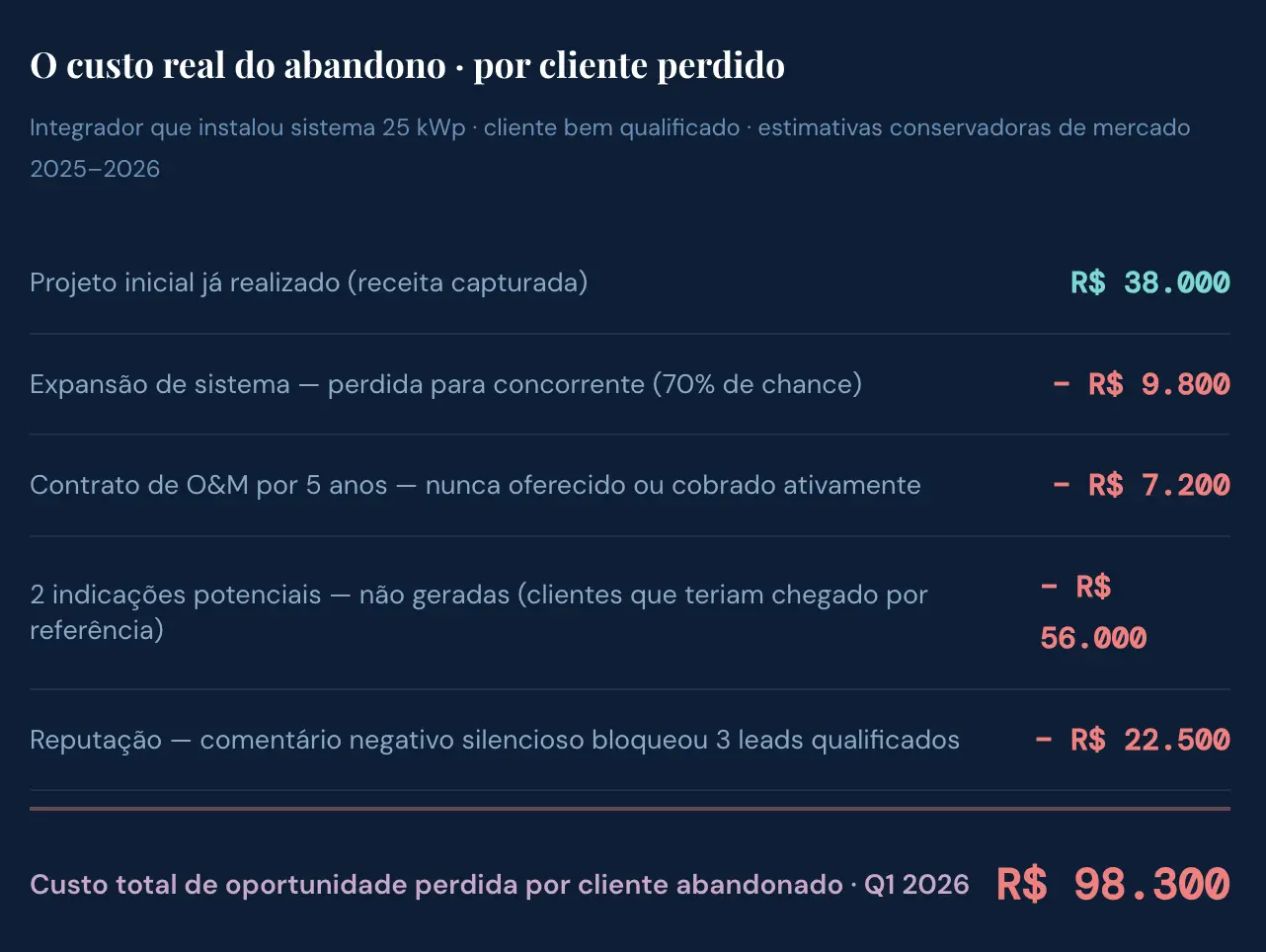
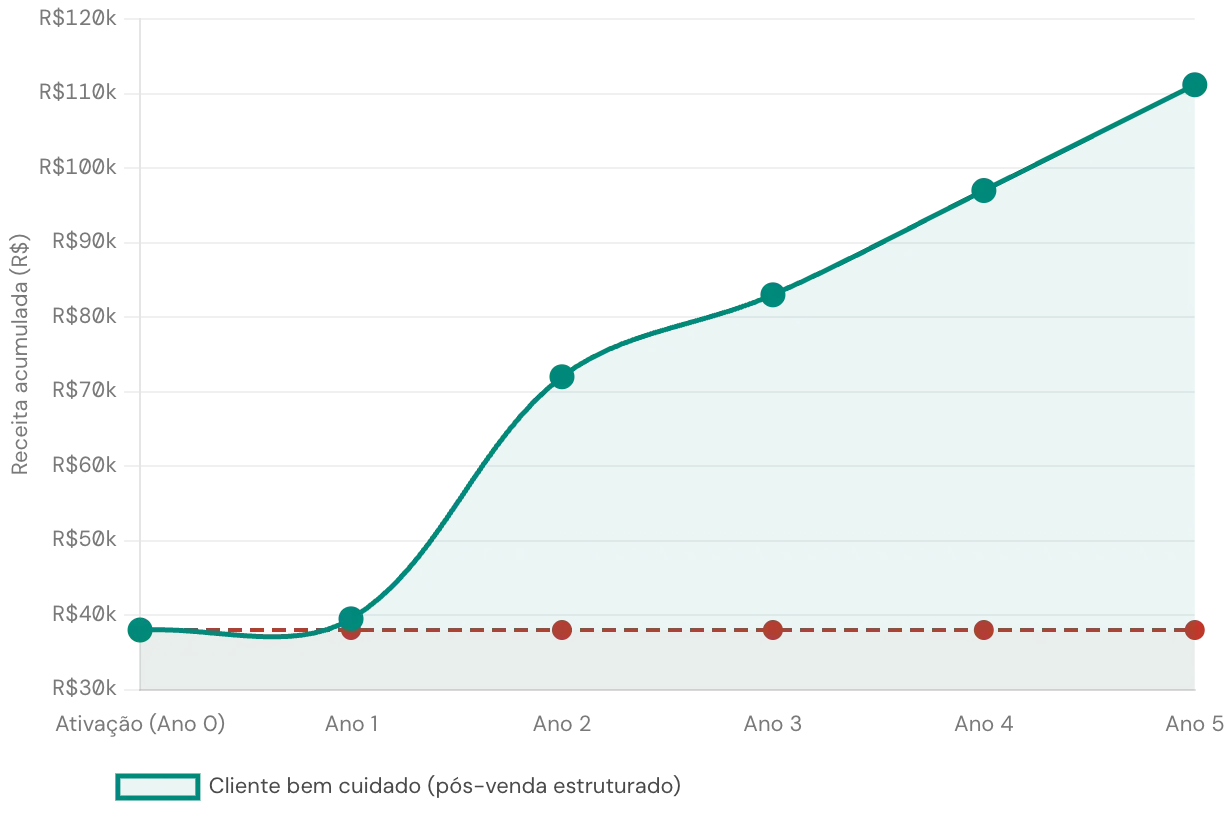
This calculation is not utopian. Each line represents a documented revenue stream as possible according to industry literature and Brazilian solar market data. The sum is not what you "failed to profit in an ideal scenario"—it's what well-served clients actually generate for integrators with structured relationship processes. Abandonment is not free. It has a price. And the price is almost three times the value of the original project.
Cumulative revenue per customer over 5 years: abandoned vs. well-cared for
Base: 25 kWp residential system · estimated values with conservative assumptions · Brazilian solar market 2025–2026
The four moments where abandonment happens
Abandonment is rarely a deliberate decision by the integrator. It's the absence of process at a critical moment. There are four specific time windows in which most solar customers begin to feel "helpless"—and where a simple action could completely change the trajectory of the relationship.
Critical moment 01
Immediate post-approval
The initial activation euphoria is short-lived. In the first two weeks, the client starts looking at the app and comparing it to what they expected. If there is no proactive contact from the integrator during this period, the first instance of doubt goes unanswered—and the relationship begins to cool.
Risk: high
Critical moment 02
First invoice after the system
The first electricity bill after activation is a moment of great anxiety. Any discrepancy with what was promised—even if justifiable due to seasonality—can generate silent dissatisfaction if the integrator is not present to provide context. This is the main source of detractors in solar energy.
Risk: critical
Critical moment 03
First technical failure or warning
When the inverter shuts down, the app loses signal, or generation drops abruptly, the customer panics. If the integrator's response takes more than 48 hours—or worse, doesn't come at all—this moment permanently shapes the customer's perception of the value of the contracted service.
Risk: very high
Critical moment 04
The silence after the 6th month.
After six months without contact, the solar customer enters a zone of indifference. They are not dissatisfied—they are simply disconnected. It is precisely at this point that the competitor who actively prospects within the installed base begins to appear. Indifference is the most dangerous state in the relationship.
Risk: silent
Signs that a customer may be becoming orphaned — and what to do in each case.
| Warning sign | What does this mean | Recommended Action | ideal window |
| The monitoring app hasn't been opened in 30 days. | Disengagement — the customer stopped monitoring the system. | Send a proactive report with cost savings data. Rekindle interest with concrete data. | Immediate |
| He did not respond to the last contact. | Passive silence — it's not hostility, it's distance. | Change channel (WhatsApp → phone) and customize the approach with data from their system. | Within 15 days |
| Ticket opened but not resolved within 48 hours. | Active frustration — customer waiting and receiving no response. | Immediate contact from the manager, not the technician. Specific scheduling and deadlines should be established. | Urgent (24h) |
| Last bill exceeded expectations without warning. | Silent negative experience — disappointed customer | Proactively call before he calls. Provide context for the bill and reaffirm the accumulated savings. | Urgent |
| More than 6 months without any contact from the integrator. | Frozen relationship — client in a state of indifference. | Birthday link with performance report. Regain market share before the competitor. | Programmed |
| Generation 15% below projection for 2+ months. | Performance below expectations — customer may be comparing | Proactive technical visit. Free diagnosis. Communicate before he notices. | Urgent |
When the orphan comes to you — and how to use this moment to your advantage.
Here's the fact that completes the reasoning: most integrators who receive orphaned clients serve them reactively—they solve the immediate problem and don't create any relationship process with that client. The result is that they build a new base of orphaned clients, this time from the "orphans" they received.
The integrator who understands the model correctly acts differently. When an orphaned client comes to them, it's not just a maintenance call—it's an opportunity to build the relationship that the previous installer didn't build. This client already knows what solar is, has seen the return on investment of the system, and is ready for the next step. They just need someone to take care of them.
First contact
Free, non-judgmental diagnosis
When a customer arrives with a problem, the first move isn't to sell—it's to listen. Perform a complete, free technical diagnosis of the system. This establishes technical credibility and creates an emotional debt of gratitude. Don't mention the previous installer. Focus entirely on what the customer needs now.
30 days
Presentation of the history and realistic expectations.
Thirty days after the initial service call, send a report detailing the system's current performance, comparing it to the original projection (if possible), and forecasting generation for the coming months. This report transforms a technical visit into a relationship—and positions you as the go-to person for everything that follows.
60–90 days
Offer of an O&M plan and expansion discussion.
After two months of building a relationship, the orphaned client is ready for a deeper conversation. Present the preventive maintenance contract options and, if the profile indicates it, initiate the conversation about expansion or supplementation with batteries. The approach is consultative: "Based on what I see of your system and consumption, here's what makes sense for you."
Given that it validates the strategy · greener 2025
Referrals from satisfied customers remain the main sales channel for Brazilian integrators, accounting for 89% of new sales, according to the Greener 2025 Study (referring to 2024). Furthermore, 75% of integrators already generate revenue through after-sales services—expansion, retrofitting, batteries, maintenance, or cleaning.
With 94% of integrators stating they intend to continue serving orphaned clients, the post-installation services market is consolidating itself as a business vertical in its own right. Whoever gets there first and has the process will stay.
The minimum protocol for not creating orphans — starting now.
Most clients don't become orphans because of the integrator's ill will. They do so because there's no process. There's no contact schedule, no designated person, no milestone that triggers action. The client simply slips through the gap between "the system working" and "the next project to close."
The solution doesn't need to be expensive or complex. The minimum viable protocol for avoiding orphaned customers can be achieved through five actions, all executable with tools any integrator already has:
Dance anti-abandonmentThe 5 checkpoints that determine whether a customer stays or becomes an orphan.
| # | Checkpoint | When | Canal | Actual objective |
| 1 | Activation link | 7 to 15 days post-activation | Phone | Confirm expectations, teach the app, open a channel of trust. |
| 2 | Pre-invoice alert | Before the first post-solar bill arrives | Anticipate the comparison, contextualize seasonality, avoid disappointment. | |
| 3 | 90-day check-in | 3 months after activation | WhatsApp or email | Send performance reports, strengthen relationships, collect informal NPS data. |
| 4 | Monitoring alert | Whenever the system deviates >15% from the projection for 48 hours or more. | Phone | Show that you're keeping an eye on things — before he even notices the problem. |
| 5 | System anniversary | 12 months after activation (and annually) | Customized report + link | Celebrate the savings generated, initiate conversations about expansion, and request referrals. |
Five checkpoints. None of them require an expensive system or a dedicated team at the start. They require what most integrators already have: a phone, WhatsApp, a monitoring platform, and a control spreadsheet. What's lacking isn't tools—it's intention transformed into process.
Strategic context Q1 2026
With over 20 active integrators in Brazil, a market contracting for the second consecutive year in 2026, and photovoltaic kits projected to increase by 35% — a customer who has already installed and is well-served is worth more than two new prospective customers. Greener identified that integrators who invested in training and relationship building had an average of 95 annual sales versus 45 for those who did not invest. The arithmetic of post-sales service is simple: each percentage point of retention recovered is margin that does not depend on exchange rates, credit, or price wars.
Conclusion
In 2025, with the market contracting, budgets falling by 46%, and competition fiercer than ever, 80% of Brazilian integrators will have received the clients abandoned by the competition. This is not an anomaly—it's the market punishing those who don't provide after-sales service. The question that remains is simple and uncomfortable: who is receiving your clients?
The opinions and information expressed are the sole responsibility of the author and do not necessarily represent the official position of the author. Canal Solar.

Comments (1)
Comments are moderated before publication.Comments should be respectful and contribute to a healthy debate. Offensive comments may be removed. The opinions expressed here are those of the authors and do not necessarily reflect the views of the author. Canal Solar.
This also demonstrates the profound lack of professionalism in the sector. If 83% received dissatisfied customers, it means that the majority do not provide a decent service, and caused the customer to seek out another company, which will also cause frustration. And unfortunately, most will cause frustration.