
• Mon, January 19, 2026
Facebook X-twitter Instagram Youtube LinkedIn Spotify
  • GC Solar: 17,95 GW
  • GD Solar: 41,3 GW
  • TOPCon Modules: $0,088/W
  • P-Type Cells: $0,034/W
  • N-Type Cells: $0,032/W
  • HJT Modules: $0,10/W
  • N-Type Wafer: US$0,128/pc
  • Polysilicon: US$ 19,00/kg
  • GC Solar: 17,95 GW
  • GD Solar: 41,3 GW
  • TOPCon Modules: $0,088/W
  • P-Type Cells: $0,034/W
  • N-Type Cells: $0,032/W
  • HJT Modules: $0,10/W
  • N-Type Wafer: US$0,128/pc
  • Polysilicon: US$ 19,00/kg
  • advertise here
  • About us
  • Expedient
logo site solar channel
  • News
    • energy storage
    • Market and Prices
    • Investments & Business
    • Policy and Regulation
  • Articles
    • Batteries
    • Opinion Article
  • Renewable
  • Latam
  • Blog
  • Solar Energy Companies
  • Integrators
  • Magazine
    • Magazine Canal Solar
    • Conecta Magazine
  • Events
  • Videos
  • Electric Vehicles
  • Consultancy
  • Academics
  • News
    • energy storage
    • Market and Prices
    • Investments & Business
    • Policy and Regulation
  • Articles
    • Batteries
    • Opinion Article
  • Renewable
  • Latam
  • Blog
  • Solar Energy Companies
  • Integrators
  • Magazine
    • Magazine Canal Solar
    • Conecta Magazine
  • Events
  • Videos
  • Electric Vehicles
  • Consultancy
  • Academics
  • News
    • Brazil
    • World
    • Technology and inovation
  • Articles
    • technicians
    • Opinion
  • Renewable
  • Latam
  • Blog
  • Solar Energy Companies
  • Integrators
  • Magazine
    • Conecta Magazine
  • Events
  • Videos
  • About Us
  • Advertise Here
  • CS Consulting
  • Canal VE
  • Academics
  • News
    • Brazil
    • World
    • Technology and inovation
  • Articles
    • technicians
    • Opinion
  • Renewable
  • Latam
  • Blog
  • Solar Energy Companies
  • Integrators
  • Magazine
    • Conecta Magazine
  • Events
  • Videos
  • About Us
  • Advertise Here
  • CS Consulting
  • Canal VE
  • Academics
logo site solar channel
Home / Articles / Technical Article / Tracker protection system in strong wind conditions

Tracker protection system in strong wind conditions

Horizontal position is not the most suitable for collecting trackers in strong winds, as previously thought
Follow on Whatsapp
  • Photo by Lucas Andrade Lucas Andrade
  • December 15, 2021, at 08:48 AM
4 min 30 sec read
Tracker protection system in strong wind conditions
Solar trackers have a protection system that is activated when the wind reaches a certain speed. Photo: Stinorlandbrasil/Disclosure

One of the biggest issues when sizing structures and solar trackers is the stress they receive from the wind.

As the tracker and modules are susceptible to various angles, various forces from winds can affect them during the day.

It is worth noting that strong winds are not necessarily typhoons, but also dynamic winds of moderate strength.

Aligning communication technology and real-time measurements, solar trackers have a protection system that is activated when the wind reaches a certain safe speed determined by the project or the manufacturer.

When the system is activated, an angular position is defined and the panels are relocated to a safe position where they better receive wind impacts without causing material damage to the structure, trackers and, consequently, modules.

Winds in regions of Brazil

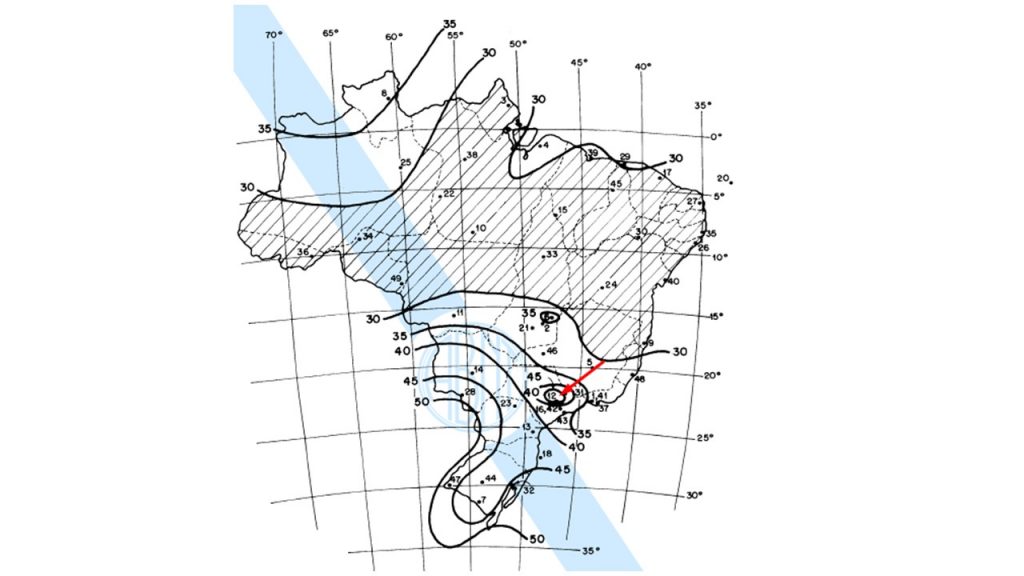
According to the standard NBR 6123 – Forces due to wind in buildings, the basic winds are defined by regions, considering a gust of 3 seconds, occurring on average once every 50 years, 10 meters above the ground, in an open and flat field, and can be in any direction.

The NBR 6123 standard defines the isopleths (lines of equal basic wind speed) for the Brazilian territory. The isopleths define 5 ranges of wind speeds recorded in the territory. On the map below we can see the regions and basic winds defined by the standard.

The isopleths define 5 wind regions in Brazilian territory:

  • I – Winds up to 30 m/s
  • II – Winds of 30 m/s to 35 m/s
  • III – Winds of 35 m/s to 40 m/s
  • IV – Winds of 40 m/s to 45 m/s
  • V – Winds of 45 m/s to 50 m/s
Isopleths of Brazilian territory
Isopletes of Brazilian territory. Photo: NBR 6123

The figure below illustrates the territory of the State of São Paulo, where we can verify the presence of different wind regions, defined according to the isopleths of the national territory.

The city of Campinas (SP), for example, is located in region IV, from 40 m/s to 45 m/s. In the same city, however, winds of up to 162 km/h have been recorded.
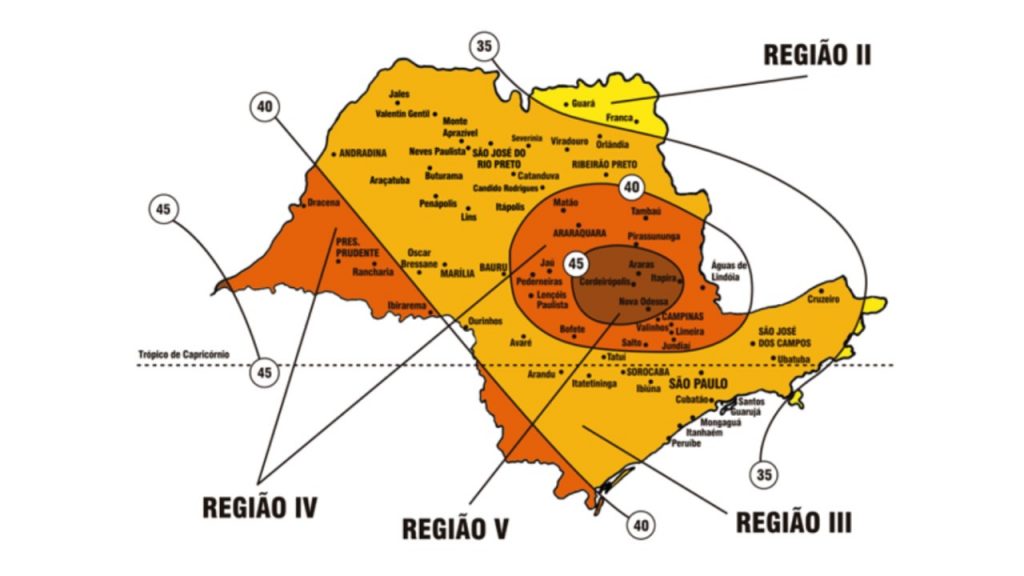
Isopleths and wind regions present in the territory of the State of São Paulo
Isopleths and wind regions present in the territory of the State of São Paulo. Photo: Lock/cl

Field wind records

Tracking solar systems necessarily have an anemometric station to measure wind speed. Anemometers can be rotating, equipped with cup-shaped blades, or ultrasonic, which do not have moving parts.

For the trackers to receive the information obtained by the anemometers, there must be communication between them. A control station present at the solar plant must be responsible for collecting the anemometer data and commanding the withdrawal of the trackers in the event of wind speeds above a pre-determined limit.

The control systems are activated according to the risk situation and can be regulated based on the location's history, making the action parameters personalized for each region and type of weather, such as hail and floods.

Dynamic wind effects

Tracker manufacturers do not consider wind as a static load, as the incidences of tracker and module breakages mostly come from dynamic phenomena, according to the Nextracker study “Mitigating Extreme Weather Risk”.

A resonant structure, which is the case of tracker structures, and with dynamic wind loads, can suffer six times more loads than a non-resonant structure, showing that a study with only static loads is not enough to mitigate claim risks.

Security position

For each type of weather, it is necessary to study a different angle for retracting the tracker to the safety position. In the case of hail, for example, the module must be adjusted to a position with a high angular inclination. Floods, however, require a low slope angle.

In the case of winds, the completely retracted position of 0º is not the most suitable as previously thought. Modules retracted to this position are more susceptible to dynamic wind loads. Therefore, experts recommend a safety position of 30º to 60º degrees with the module face in the direction of the wind. For this, it is important that the anemometric station also has a device for determining the wind direction.

Command and control

Commands can be activated manually or automatically by operators when they deem it necessary. Once the retraction mode is activated, the entire plant can reach the indicated position within three minutes. Below we can check the interface of Nextracker's navigation system, NX Navigator.
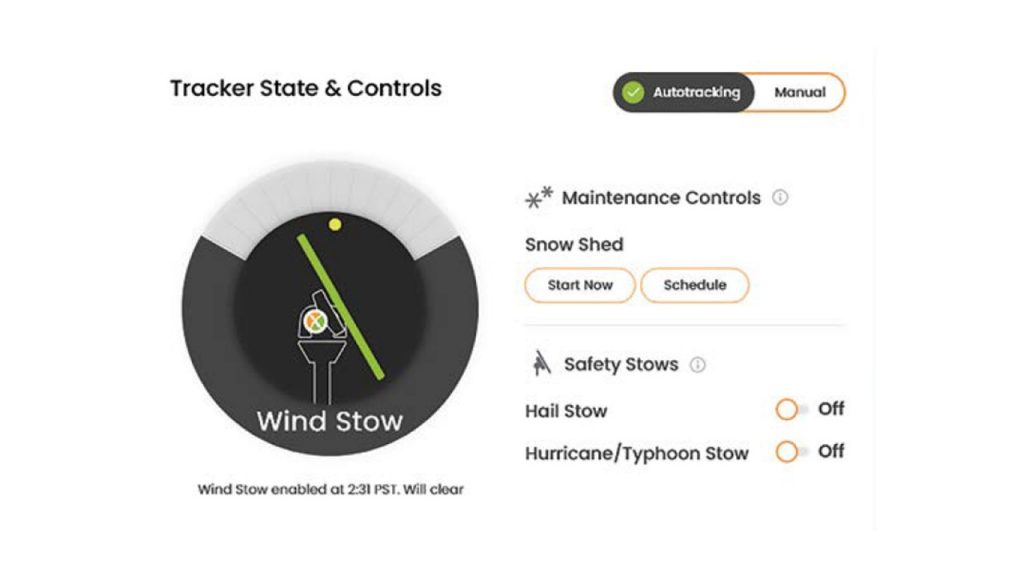

Solar tracker automatic retraction system adjustment screen. NX Navigator Interface
Solar tracker automatic retraction system adjustment screen. NX Navigator interface. Photo: Nextracker
Power Plant Course
Photo by Lucas Andrade
Lucas Andrade
Graduated in Electrical/Electronic Engineering from the University of Taubaté (UNITAU) with a specialization in solar energy from UNICAMP and studying a Lato Sensu Postgraduate course in solar energy from the Federal University of Viçosa - UFV.
PreviousPrevious
NextNext

Answers of 2

  1. Avatar Ruan Candido said:
    December 15 from 2021 to 10: 22

    “The city of Campinas-SP, for example, is located in region IV, from 40 m/s to 45 m/s. In that same city, however, winds of up to 162 km/h have been recorded.”

    162 km/h is equivalent to 45 m/s. If winds of up to 162 km/h were recorded, it is within the range for the region.

    Reply
    1. Ericka Araújo Ericka Araújo said:
      1 February 2022 to 10: 21

      Exactly, our intention was to show that the winds recorded in the region can indeed reach the limit indicated in the isopleth.

      Reply

Leave a comment Cancel reply

Your email address will not be published. Required fields are marked with *

Comments should be respectful and contribute to a healthy debate. Offensive comments may be removed. The opinions expressed here are those of the authors and do not necessarily reflect the views of the author. Canal Solar.

News from Canal Solar in your Email

Posts

And how long will the grounding system at your power plant hold up?

And how long will the grounding system at your power plant hold up?

Hot-dip galvanizing: technical parameters, applicable standards and implications

Hot-dip galvanizing: technical parameters, applicable standards and implications

More news

Read More
Canal Solar - Consumers will be responsible for 60% of the B Wire cost starting in 2026.
  • January 2, 2026
Photo by Ericka Araújo
Ericka Araújo

Consumers will be responsible for 60% of Fio B costs starting in 2026.

Canal Solar - ArcelorMittal begins operation of 315 MW solar power plant.
  • December 10, 2025
Photo by Wagner Freire
Wagner Freire

ArcelorMittal begins operation of 315 MW solar power plant.

Canal Solar - APsystems is the world's most profitable microinverter manufacturer, according to Sinovoltaics
  • September 3, 2025
Photo by Caique Amorim
Caique Amorim

APsystems is the world's most profitable microinverter manufacturer, according to Sinovoltaics.

It is a news and information channel about the photovoltaic solar energy sector. Channel content is protected by copyright law. Partial or total reproduction of this website in any medium is prohibited.

Facebook X-twitter Instagram Youtube LinkedIn Spotify

Site Map

Categories

  • News
  • Articles
  • Interviews
  • Consumer Guide
  • Authors
  • Projects
  • Brazil
  • World
  • Technical Articles
  • Opinion Articles
  • Manufacturer Items
  • Electrical Sector
  • Biddings
  • Products

Channels

  • About Us
  • Contact
  • We’re hiring!
  • Privacy
  • Expedient
  • advertise here

Membership and certifications

Copyright © 2025 Canal Solar, all rights reserved. CNPJ: 29.768.006/0001-95 Address: José Maurício Building – Mackenzie Avenue, 1835 – Floor 3, – Vila Brandina, Campinas – SP, 13092-523

We use cookies to make your experience on this site better Find out more about the cookies we use or turn them off in your .

Receive the latest news

Subscribe to our weekly newsletter

Canal Solar
Powered by  GDPR Cookie Compliance
Privacy

This website uses cookies so that we can provide you with the best user experience possible. Cookie information is stored in your browser and performs functions such as recognizing you when you return to our website and helping our team to understand which sections of the website you find most interesting and useful.

Cookies strictly required

Strictly Necessary Cookie should be at all times so that we can save your preferences for cookie settings.

Cookies for third parties

This website uses Google Analytics to collect anonymous information such as the number of visitors to the site, and the most popular pages.

Keeping this cookie enabled helps us to improve our website.