
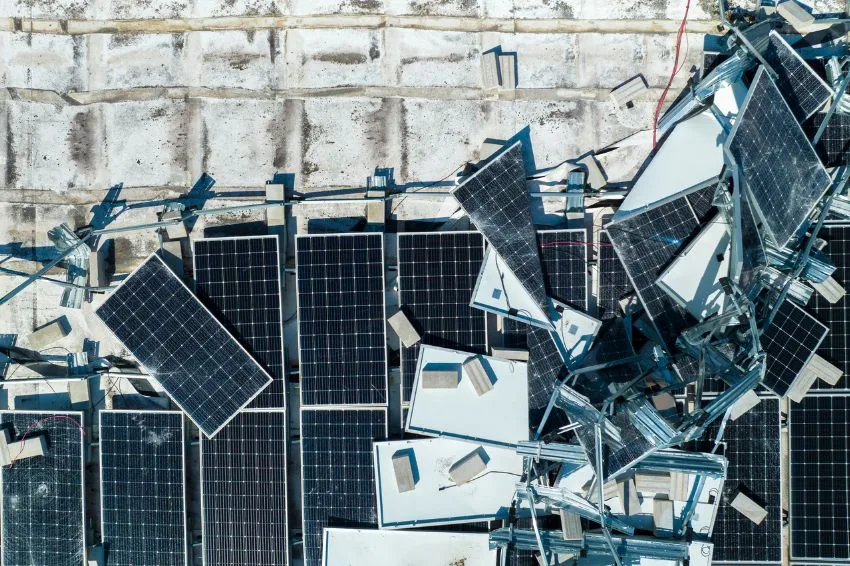
The collapse of a roof with solar panels during a storm at a supermarket in northwest Paraná, last Monday (22), reignited the debate about the risks of poorly dimensioned installations.
The incident, which left no one injured, comes amid a series of extreme weather events recorded in different regions of Brazil.
In recent months, cities such as Campo Grande (MS), Curitiba (PR) and Porto Alegre (RS) have faced strong winds with gusts exceeding 80 km/h, accompanied by heavy rain and damage to the electrical grid.
In October 2022, for example, a solar panel broke off a roof and fell onto a car in Campo Grande, where two women were fortunately spared injury. Incidents like these illustrate how much mounting structures need to be prepared to withstand high wind pressure.
Currently, the NBR 6123 standard, from ABNT (Brazilian Association of Technical Standards), is the main technical reference for the dimensioning of these structures.
It uses so-called wind isopleths—lines that indicate average speeds by region—as a basis for calculating the forces that must be supported by roofs and coverings with solar systems. Values range from 30 m/s to 50 m/s across the country and should be considered during the design phase.
According to Laís Andrade, an engineer at CS Consultoria, the main problems encountered in the field are the use of parts from different manufacturers, incorrect torque on fastening clamps, and even improvised structures, such as low-quality wood. "Some installers reuse materials or ignore manuals, completely compromising safety," she warns.
Industry engineers also point out the low qualifications of some of the market. Raphael Vaz, a product engineer at 2P, states that manufacturers' installation manuals should be followed strictly.
"Each structure has its own specific behavior. Ignoring these guidelines puts the facility at risk, even with winds below 80 km/h," he says.
The standard also stipulates that the project must be carried out with the support of specialized engineers and based on laboratory simulations.
In addition to NBR 6123, standards such as NBR 8800 (metal structures) and NBR 14762 (cold-formed steel) also contribute to a safe and efficient design.
What they all have in common is that they all require careful consideration of the installation environment, the quality of materials, and, above all, technical responsibility. After all, a solar structure should last more than 25 years, provided it is properly designed for the climate where it will be installed.
all the content of Canal Solar is protected by copyright law, and partial or total reproduction of this site in any medium is expressly prohibited. If you are interested in collaborating or reusing part of our material, please contact us by email: redacao@canalsolar.com.br.


Comments
Comments are moderated before publication.Comments should be respectful and contribute to a healthy debate. Offensive comments may be removed. The opinions expressed here are those of the authors and do not necessarily reflect the views of the author. Canal Solar.