
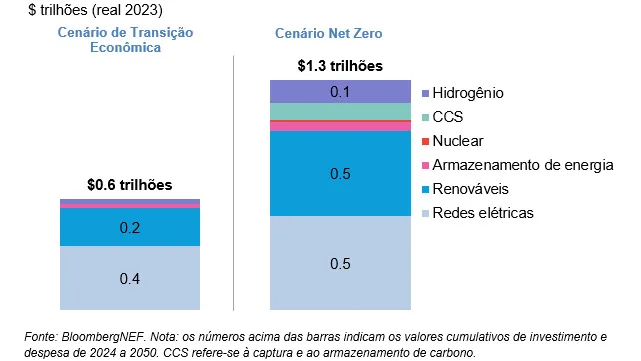
For Brazil leads the global energy transition, the country will need to iinvest more than $1,3 trillion in its low-carbon energy supply over the period 2024 to 2050, including US$0,5 trillion in renewable energy.
This value represents a great opportunity for private sector investment and includes the capacity needed to provide clean energy for the electrification of end-use sectors such as transportation, construction and industry.
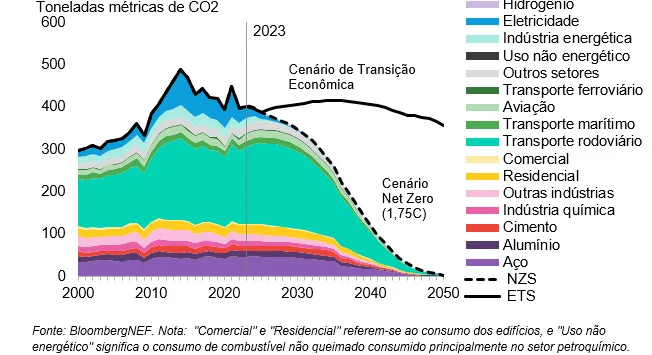
The data was presented by BNEF (BloombergNEF) in its first Brazil Transition Factbook. According to the study, such electrification plays an important role in the decarbonization trajectory of the country, representing 53% of emissions avoided between now and 2050, compared to a no-transition scenario in which there is no additional decarbonization action.
In addition, expenditures and investments for energy demand reach US$ 4,3 trillion in the Net Zero Scenario, led mainly by purchases of electric vehicles.
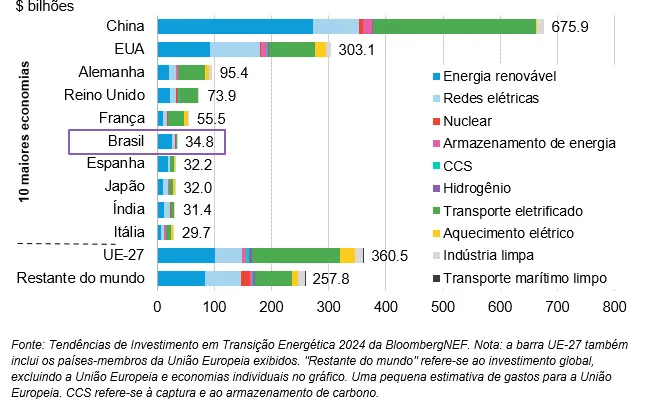
O Brazil is already one of the top world destinations for investment in energy transition, attracting almost $ 35 billion in 2023 – sixth largest value in the world and the largest among emerging markets, except China.
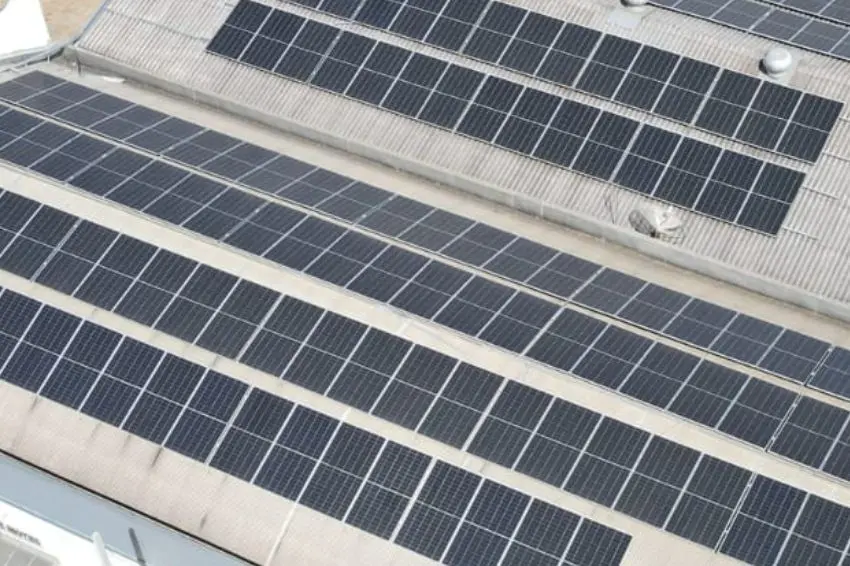
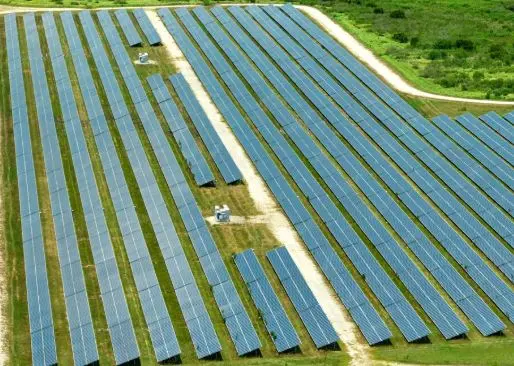
The country is also the third largest market all with wind energy and photovoltaics, with a record of 5 GW of wind projects e 16 GW of installed solar power coming into operation in 2023.
However, for the Brazil to stay on track towards net zero, the country's energy-related emissions need to fall 14% by 2030 compared to 2023 levels e plummet 70% by 2040, so that they are aligned with BNEF’s Net Zero Scenario, which charts a path to net zero carbon emissions by 2050, keeping global warming well below 2°C.
Other highlights
Below are other analyses of the Brazil's Energy Transition Manual.
Brazil is an important source of transition metals
The country ranks third in the world according to BloombergNEF's assessment of energy transition metal reserves. It also holds more than 15% of the world's reserves of five strategic minerals: graphite, iron ore, rare earths, nickel and manganese;
Brazil is a potential market for low-carbon hydrogen production
In August 2024, the country passed its green hydrogen law, and BNEF estimates that the country could produce the cheapest green hydrogen in the world;
Biomass creates an opportunity for a cleaner steel industry
Brazil could have the world’s cheapest net-zero carbon steel by 2030, thanks to abundant biomass availability and very low electricity prices;
Biofuels play an important role in the energy transition
The adoption of electric vehicles is expected to grow in the country, but biofuels are essential in the short term. Both technologies are possible ways to reduce emissions from one of the largest passenger vehicle markets in the world;
Brazil realizes the importance of the sustainable finance taxonomy
The country already has a voluntary, industry-led taxonomy. Brazil and the UK are the only jurisdictions outside the EU that plan to make data disclosure mandatory once their frameworks green are available. Brazil is the leader in sustainable finance policies in the region, with up to 34 policies aimed at companies and banks;
Brazil’s top companies set ambitious emissions targets
The ten largest Brazilian companies with net zero carbon emissions targets will need to reduce their emissions by 177 million metric tons of CO2 equivalent per year;
Brazil can be a model country when it comes to climate change mitigation
Between 2024 and 2050, the country could collectively create natural carbon offsets for up to 30,5 gigatons of CO2 equivalent. That’s more than the next three largest countries combined.
Brazil's supply dominance means any change in the country's fundamentals could have ramifications for global demand and carbon credit prices.
Compliant Luiza Demoro, global head of energy transitions at BloombergNEF, Brazil, who holds the presidency of the G-20 this year and will host COP30 in 2025, is in the spotlight.
“With abundant natural resources and immense potential in the clean energy, climate and nature sectors, the country is uniquely positioned to help drive global decarbonization efforts.”
“However, to seize this opportunity and unlock capital flows at scale, Brazil needs to urgently develop, approve and implement robust policies and regulations, while addressing market barriers,” the executive concluded.
Read also
- DG and hybridization: unlocking solar potential in the energy transition
- Brazil can lead the energy transition, but it will need to go a long way
- Y20: Youth debate fair energy transition in Minas Gerais
Don't miss any news from the electricity sector! Sign up by clicking here and have exclusive access to our content!
all the content of Canal Solar is protected by copyright law, and partial or total reproduction of this site in any medium is expressly prohibited. If you are interested in collaborating or reusing part of our material, please contact us by email: redacao@canalsolar.com.br.