

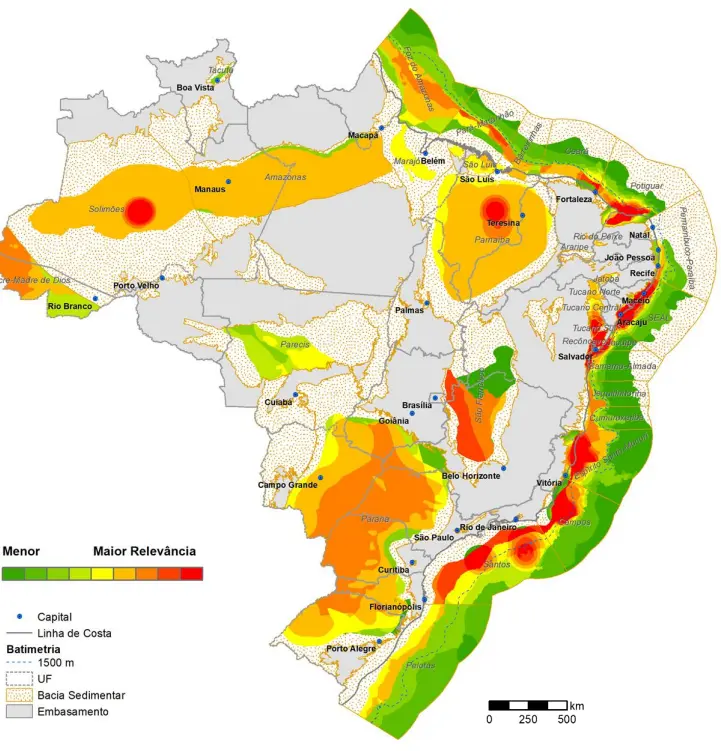
EPE (Energy Research Company) has expanded its national mapping of areas with potential for carbon capture, transport, use, and storage – a move that reinforces the role of technology in Brazilian energy transition and industrial decarbonization strategies.
The new edition of the technical report released by the state-owned company linked to the Ministry of Mines and Energy updates previous analyses and incorporates new methodological criteria to identify regions with greater suitability for the development of projects related to the geological storage of CO₂.
According to EPE, the objective is to offer technical support for national energy planning and for the formulation of public policies aimed at a low-carbon economy. The study also seeks to support the territorial planning of future CO₂-related activities in the country.
A publication It highlights that carbon capture and storage technologies are gaining international relevance, especially in sectors considered difficult to decarbonize, such as steelmaking, cement, refining, fertilizers, and heavy industry.
Logistics and geology
One of the main points of the study is the identification of areas where geological factors and logistical conditions align most favorably for the implementation of CCUS projects.
According to EPE's findings, the historical concentration of Brazilian logistics infrastructure in the coastal regions of the Southeast and Northeast favors the development of large-scale carbon capture and transport hubs, especially through pipelines and port facilities.
The study indicates that the combination of industrial emitting centers, existing infrastructure, and areas with suitable geological potential increases the likelihood of the economic viability of the projects.
At the same time, the state-owned company warns that expanding this infrastructure into the interior of the country will require robust investments, as well as the consolidation of a clearer regulatory framework and instruments capable of reducing financial risks for entrepreneurs.
According to the document, the challenges observed in Brazil are similar to those faced internationally, where geological transport and storage often represent the main bottlenecks in the CCUS supply chain due to high CAPEX and regulatory complexity.
Bioenergy is a Brazilian differentiator.
Among the most relevant conclusions of the study, EPE highlights the strategic potential of the bioenergy sector for the development of so-called negative emissions.
The document points out that Brazil has particularly favorable conditions for expanding BECCS projects — a technology that combines bioenergy with carbon capture and storage.
According to the state-owned company, the availability of sustainable biomass, the technological maturity of the sugarcane energy sector, and the historical integration of bioenergy with climate policies place the country in a privileged position to develop this technological route.
The study also notes that emissions from so-called "hard-to-slaughter" sectors – those difficult to decarbonize – remain highly concentrated in southeastern Brazil, while the Northeast and South appear as secondary industrial emission hubs. This territorial design reinforces the logic of creating regional hubs close to large industrial clusters.
next stage
EPE states that the methodological advancements implemented have increased the discriminatory power of the national CCUS map, expanding its usefulness in guiding investment and planning decisions.
The study concludes that Brazil has favorable conditions for advancing carbon capture and storage pathways applied to both the energy and industrial sectors, as well as synergies with other decarbonization strategies.
Despite this, the document emphasizes that the consolidation of this market will depend on the coordinated acceleration of public policies, risk mitigation mechanisms, and incentives for pioneering projects.
As a next step, the state-owned company intends to move towards more detailed quantitative assessments of storage capacity and capture potential, deepening its technical knowledge on the subject and strengthening Brazil's position in the global market for climate solutions.
all the content of Canal Solar is protected by copyright law, and partial or total reproduction of this site in any medium is expressly prohibited. If you are interested in collaborating or reusing part of our material, please contact us by email: redacao@canalsolar.com.br.