

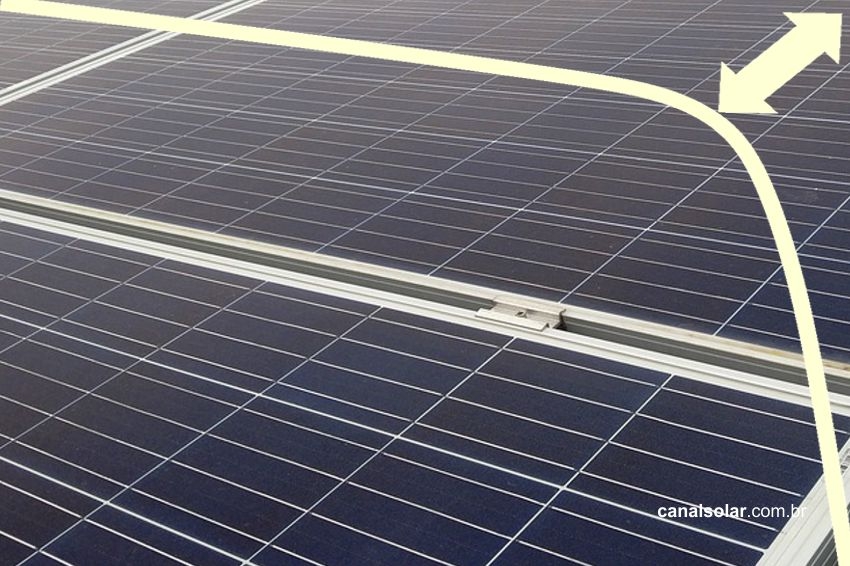
Have you heard about the FF (form factor) of photovoltaic modules? Probably never. This is information never shown in the datasheet from manufacturers.
Do you know why? Because the form factor is of no use in evaluating the characteristics of a commercial photovoltaic module.
The form factor as the quality score is of absolutely no use. My statement seems a bit strong, but let's look at some information below.
The form factor is a quality index of photovoltaic cells. This parameter, which measures how close a cell approaches ideality, is widely used by researchers in the field of semiconductors.
A cell with a small form factor is almost always a bad cell. Manufacturers always aim to produce cells with a high form factor, which in this case is an index of quality.
The FF of a photovoltaic cell is mainly affected by parameters such as series and parallel resistances (shunted) of photovoltaic devices, which in turn are influenced by several factors such as carrier recombination rate (something we study in semiconductor physics), ohmic contact resistances and other things.
When we talk about commercial photovoltaic modules, FF loses its usefulness, as there are other more important figures of merit. Obviously, a module built with cells that have a very small form factor will be a bad module.
In other words, it is difficult to produce a high-power, high-efficiency photovoltaic module with cells that have a low form factor. On the other hand, when we analyze a photovoltaic module that is known to have good electrical characteristics, such as peak power and efficiency, the form factor is no longer an important number.
After all, what is form factor?
In the figure below we find the IV curve of a photovoltaic module. I already wrote about the IV curve in the article Understanding the IV and PV curves of photovoltaic modules.
The photovoltaic module has a maximum current called short-circuit current (ISC circuit shorts) and a maximum voltage known as open circuit voltage (VOC open circuit).
This means that if you short-circuit the terminals of a photovoltaic module, a current equal to I will flow through the cables.SC. The current ISC, which is the maximum current that a module can supply, depends on the intensity of the incident light.
In the catalogs the current ISC is specified with an irradiance (sunlight power per area) of 1000 W/m2. The open circuit voltage is specified with the same irradiance value, but the main variable that affects the module voltage is temperature. In the catalogs the voltage VOC is specified at a temperature of 25 oC.
It would be wonderful if a module could supply a power equal to the product I at its terminalsSC x VOC. But this is simply impossible due to the very nature of photovoltaic cells.
The electrical output characteristic of the photovoltaic cells (and consequently the photovoltaic module) will always have the shape we see in the figure. The curve will always have an approximately horizontal straight feature at the beginning, a knee of curvature and then an approximately vertical straight feature.
The shape factor measures how far the IV curve is from a rectangular shape. If the curve were rectangular, we would have an output power PMAX=VOC x ISC.
In real life, the IV curve is not a rectangle, so the maximum power output of the module is equal to PMP =VMP x IMP, where VMP and IMP the voltage and current at the maximum power point, whose values are specified in the manufacturers' catalogues.
The shape factor is defined as the ratio between PMP and PMAX, as we see in the figure below. How PMAX will always be greater than PMP, the form factor will always be a number less than 1.

In Figure 2 we observe IV curves with different shape factors. It is possible to note that the shape factor is closely related to the inclination of the straight parts (horizontal and vertical) of curve IV.

The more horizontal and more vertical these parts are, the greater the form factor. The slopes of the straight lines are directly related to the internal electrical resistances of the module, which include resistances of the cells themselves and other components of the module (cables, connectors, ribbons, welding etc.).
Important parameters when choosing PV modules
The parameters that the consumer must observe in the data sheets are:
- peak power;
- efficiency and;
- thermal coefficients.
We won't delve into that now. I recommend reading the article Effect of temperature on mono and polycrystalline modules, where I talk about the thermal coefficients of photovoltaic modules.
In summary, I explain below how each parameter affects the quality of the final product that the consumer will purchase.
Peak power (Wp)
It is the maximum power of the module. Corresponds to the nominal power specified in the catalog in STC (standard test conditions: 1000 W/m2 and 25 oW). Examples: 290 Wp, 300 Wp, 430 Wp, 450 Wp, 500 Wp.
Obviously, a module with higher power will generate more energy than one with lower power. This is a very easy criterion to understand;
Efficiency (%)
It is the percentage of sunlight energy that the module can convert into electrical energy. The efficiency specified in the catalog is valid for STC conditions.
In practice, modules operate with reduced efficiencies due to several factors, especially thermal losses. Considering only the STC condition, the module with higher efficiency is always better, but not always. Like this?
Let's compare a module A (with a power of 400W and an efficiency of 18,5%) and a module B (with a power of 390W and an efficiency of 19%). These values are just examples for teaching purposes. Which would be the best module, A or B? For you to think.
Temperature coefficients
There are three coefficients that are typically specified in photovoltaic module data sheets – short-circuit current coefficient, open-circuit voltage coefficient and power coefficient.
These three coefficients show how these variables (current, voltage and power) are influenced by the operating temperature of the photovoltaic cells.
The most important coefficient is power, which reveals the reduction in module power (and consequently energy generation) with increasing temperature. Modules with reduced power coefficients are better. A high power/temperature coefficient reveals a module that will suffer when operating in aggressive weather conditions.
Let's make a comparison again: module A (with power of 400W and power/temperature coefficient = -0,35%/oC) or module B (also 400 W and power/temperature coefficient = -0,4 %/oW). Between A and B, which would be the best option for maximum energy generation in a solar plant?
See that we are comparing equal powers and different temperature coefficients. Shouldn't efficiency come into this comparison? No, as both modules have the same power.
What matters about the product is its peak power. And if there is any other parameter that we should analyze after power, it would be precisely the thermal coefficient – the lower, the better.
Form factor (%)
The form factor can be a pure number or can be expressed as a percentage, just like the module efficiency. Faced with so many variables to analyze (power, efficiency and three thermal coefficients), the FF is the least relevant thing that can exist in the set of characteristics of a photovoltaic module.
Let's make one last comparison: module A (with a power of 400W, efficiency of 19% and FF = 0,78) and module B (with a power of 400 W, efficiency of 18,5% and FF = 0,80). What would be the best choice?
It shouldn't be difficult to imagine that the form factor doesn't make the slightest difference in this choice. The form factor is not a matter that the photovoltaic module user should worry about.
Scientific analysis of the influence of form factor
In search of more solid evidence for my analyses, I searched the scientific literature for information regarding the form factor of photovoltaic modules.
Publications on this subject are very rare. Little is said about the modules and there is not much data, perhaps because the market has never been concerned with this before.
There are many scientific works and many discussions about the form factor of photovoltaic cells, but little or nothing is said about commercially available photovoltaic modules.
At work "A single procedure for helping PV designers to select silicon PV modules and evaluate the loss resistances“, by authors Carrejo, Amador and Arnaltes, published in Elsevier's Renewable Energy magazine in 2007, we found a comparative analysis of several photovoltaic modules, with different characteristics and form factors. In this article we find, among other things, the following conclusions:
- In several experimental analyzes carried out, the authors discovered that the form factor (FF) of the modules changes depending on the operating conditions (irradiance, temperature). This was already expected. The interesting observation that the authors made is that modules with higher FF in STC conditions (standard test conditions – 1000 W/m2, 25 oC) do not always continue to have the highest FF under other conditions. Words from the authors themselves about the form factor: “Analyzing other similar cases, same results were obtained, and this leads to think that the values of this parameter should perhaps not be used as an ''a priori'' indication of the module quality.";
- At the conclusion of the research, the authors state: “Fill factor by its own should not be considered as an indicator of PV module quality as examples studied here have shown. For comparing PV modules and for providing information in relation to their loss resistances, pu values of VMP and IMP must also be considered.” Translation: The form factor (FF) should not be considered an indicator of photovoltaic module quality.
The form factor in commercial modules
For the end user of a commercial photovoltaic module, the form factor does not reveal important information. This number is never shown on manufacturers' data sheets, but can be calculated with the expression shown in Figure 1.
Manufacturers are committed to providing the market with high-power, high-efficiency photovoltaic modules, whatever the form factor.
Commercial photovoltaic modules typically have form factors between 0,75 and 0,8. There are high-power modules with a reduced form factor, while older, lower-power modules have a slightly larger form factor.
If you could choose two photovoltaic modules for your project, which would you choose? A high-power module with a form factor of 0,7 or a low-power module with a form factor of 0,8? The question remains as an exercise for thinking.
There are infinite models of photovoltaic modules on the market, with infinite combinations of cell types and formats, number of bus bars and metallization formats, among other things, which affect the form factor of the final product.
Before looking at the form factor of any photovoltaic module as a possible quality index, one should look at other more relevant parameters such as peak power, efficiency and thermal coefficients.
The form factor is the last thing that should be looked at when evaluating a module. The importance of this information is so low that manufacturers don't even deign to show it in their catalogs.
Let's look in the tables below at some data on photovoltaic modules available on the world market, including in Brazil.
I tried to get modules of the same power so we could do more interesting analyses, to avoid comparing “bananas with oranges”.
The first table shows the characteristics of the modules in STC (standard test conditions – 1000 W/m2, 25 oC in the cell) and the second shows the characteristics in NOCT (nominal operating cell temperature – 800 W/m2, 20 oC environment).
Table 1: Characteristics of commercial photovoltaic modules under STC conditions
 In Table 1 we will observe, for example, that the 440 W modules from manufacturers JA, Risen and GCL have the same power and the same efficiency.
The JA module has a form factor of 77%, while Risen and GCL, respectively, have form factors of 78,5% and 81,7%. Among these modules, which one would you choose based on the form factor criteria? And what would this represent, in practical terms, for the performance of the solar plant?
Now observe, still looking at the same modules, the power/temperature coefficients: -0,35 %/oC (JA), -0,37 %/oC (Risen) and -0,38 %/oC (GCL).
The module with the largest form factor, strangely and contrary to common sense, is the one with the worst thermal coefficient.
In practice, if we rigorously analyze this fact, the GCL module is the one that will produce the least energy among the three. On the other hand, the JA module, which has the smallest form factor, has the best thermal coefficient among the three.
Lastly, still looking at Table 1, let's look at the data for the 450W Jinko module. It is the most powerful module among all shown in the table. And strangely, it is the module that has the smallest form factor among all (77,2%).
It is also worth highlighting that this module has the lowest power/temperature coefficient in the table, comparable to that of the 440W JA.
This only confirms what we have been saying since the beginning of this article: the form factor (FF) is not an indicator of the quality of photovoltaic modules. Calculating the form factor of commercial modules and making comparisons based on that number only means one thing: nothing.
Table 2: Characteristics of commercial photovoltaic modules under NOCT conditions

Now let's look at the data in Table 2, which correspond to the characteristics of the modules in NOCT, which are operating conditions closer to reality, while the STC parameters are just laboratory conditions. We have important revelations in this table.
Comparing the 440W JA (first line) and 450W Jinko (last line) modules, we see that the JA module presents similar performance.
The first provides 334 W in NOCT (versus 445 W in STC), while the second provides 335 W in NOCT (versus 450 W in STC). Both have approximately the same form factor in STC (77,7% and 77,2%), but in NOCT the form factors are 77,7% and 75,3%.
We observe here, perhaps, an indication that the form factor may signal some difference between the modules, but before analyzing the form factor (in STC) we analyze: power in STC, power in NOCT, efficiency in STC, power factor shape in STC, thermal coefficients and lastly, very lastly, we can dare to look at the shape factor.
And we are talking about the form factor in NOCT (which no one simply reports or calculates) and not the form factor in STC – which no one also reports or calculates, but would be the first thing we would look at if we were interested in the form factor.
Conclusion
We can say that the form factor is not a relevant data for photovoltaic modules. When comparing performance between commercial modules, FF is the last parameter we could use.
In my opinion, corroborated by the analysis of the data in Tables 1 and 2 and also by the conclusions of the article “A single procedure for helping PV designers to select silicon PV modules and evaluate the loss resistances“, by authors Carrejo, Amador and Arnaltes, published in Elsevier's Renewable Energy magazine in 2007, the form factor should not be used as an indicator of the quality of photovoltaic modules. commercial photovoltaic modules: peak power, efficiency and temperature coefficients.


Answers of 2
Goodnight!!! I would like to know if photovoltaic modules for micro converters are suitable for the off grid system?
Yes, photovoltaic modules are for all types of systems, both on grid and off grid.