

Updated October 14, 2025
What's the correct angle for tilting photovoltaic modules? This is a simple question, yet a mystery that permeates the world of solar energy.
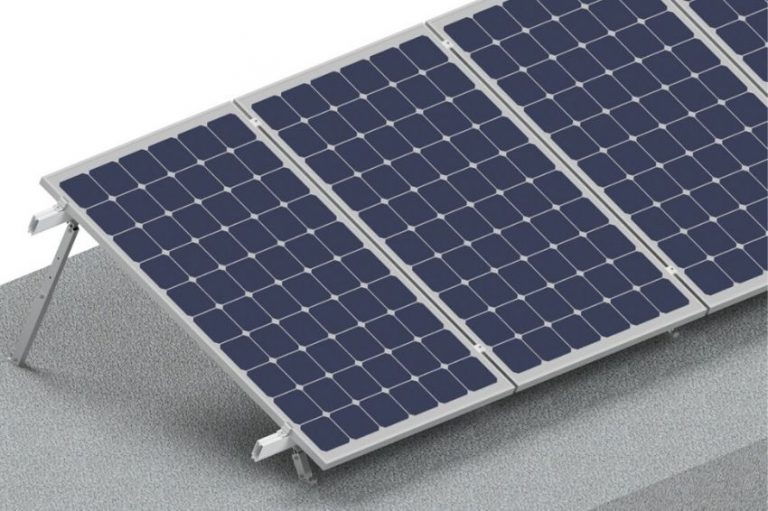
If you have a roof, the answer couldn't be more straightforward: the slope angle is the same as your roof. If you're unhappy with your roof or are planning a solar installation on a slab or on the ground, then you'll have to keep searching for the answer.
So, what's the best tilt angle for a photovoltaic module? How do you calculate it?
What is the tilt angle of photovoltaic modules?
First, let's keep one thing in mind: we would like the front surface of the solar panel could always face the sun's rays (i.e., perpendicular to the direction of the rays).
Obviously, this requires a tracking system, as the Sun's position and trajectory in the sky change throughout the hours, days, and months of the year. But in this case, we're talking about fixed systems, in which we must choose a fixed tilt angle that cannot be changed.
Want to better understand how it works? solar energy approvalRead our blog and get all your questions answered on the subject, with clear and practical explanations for those who want to regularize their system.
How does the ideal angle vary with the season?
Let's use some basic geometry in the figure below. The illustrated situation shows what happens on the summer solstice in the southern hemisphere (21/12). On this day, solar declination is maximum and the Sun describes its highest trajectory in the sky.
At any point at latitude L, the solar module needs to be tilted at an angle of L-23,45°. Following similar reasoning, we can conclude that on the winter solstice (21/06) the module must be tilted at an angle L+23,45°.
The angle of 23,45° corresponds to the declination of the Earth's axis of rotation (North-South axis) in relation to the axis of its translational movement around the Sun. This declination is responsible for the seasons and also results in variations in the height of the sun's trajectory on different days of the year.
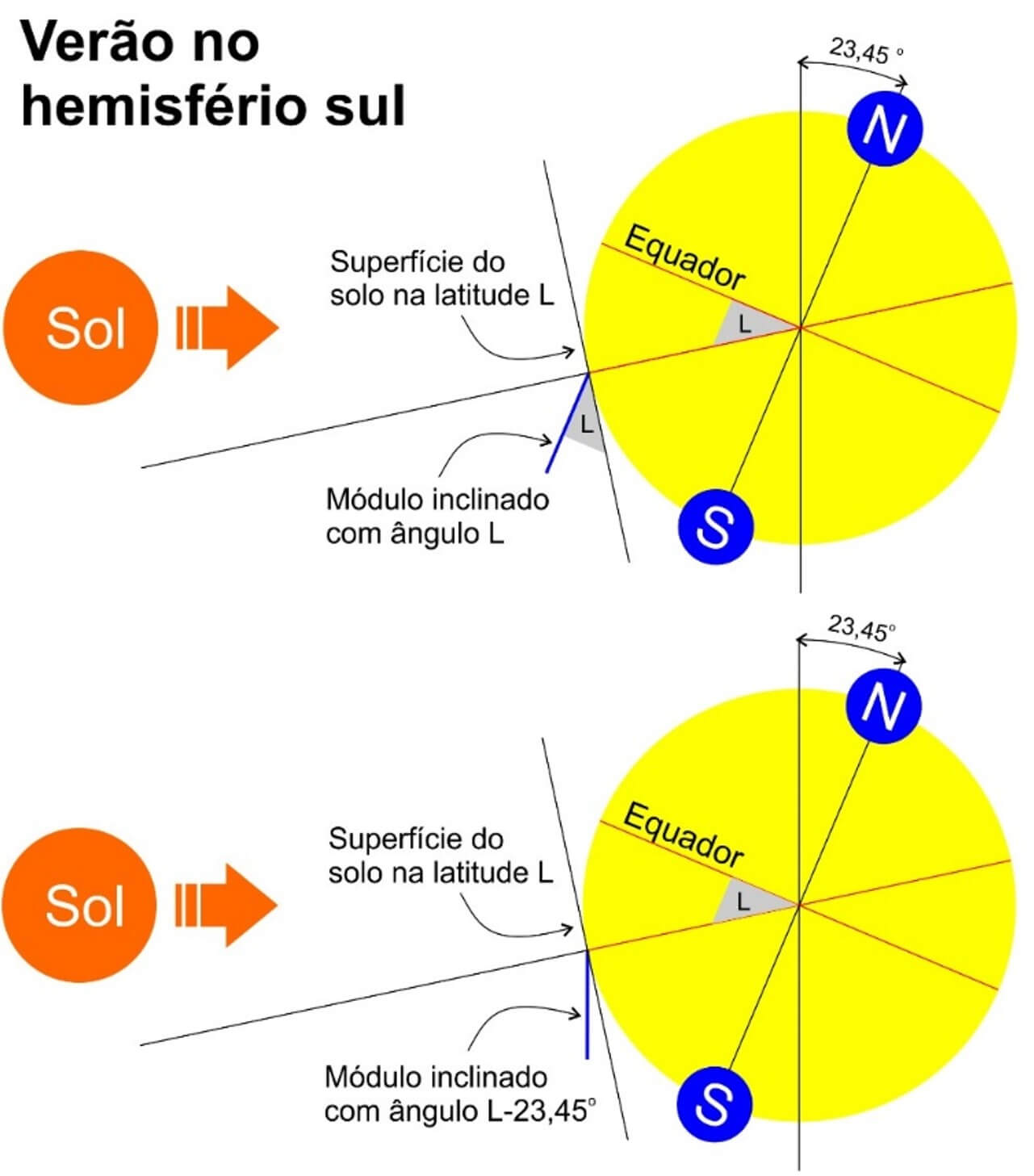
In summary, for a given latitude L, the best tilt angle at the summer solstice (when the sun's height is maximum) would be L-23,45°. At the winter solstice (when the sun's height is minimum), the angle should be L+23,45°. To prioritize power generation throughout the summer (and not just at the solstice), the recommended tilt angle is L-15°, while in winter it is L+15°.
The number 15°, added to or subtracted from the latitude angle L, is recommended by many authors because it is approximately the average value between the minimum and maximum solar declination angles, between the equinoxes and solstices. In fixed systems, to avoid favoring any given day, month, or season, the general rule is to tilt the modules by the latitude angle L itself.
This rule, however, does not replace generation analysis performed using software like PVSyst based on historical solarimetric data. Climatic factors, not just geometric ones, affect the correct choice of tilt angle in photovoltaic systems.
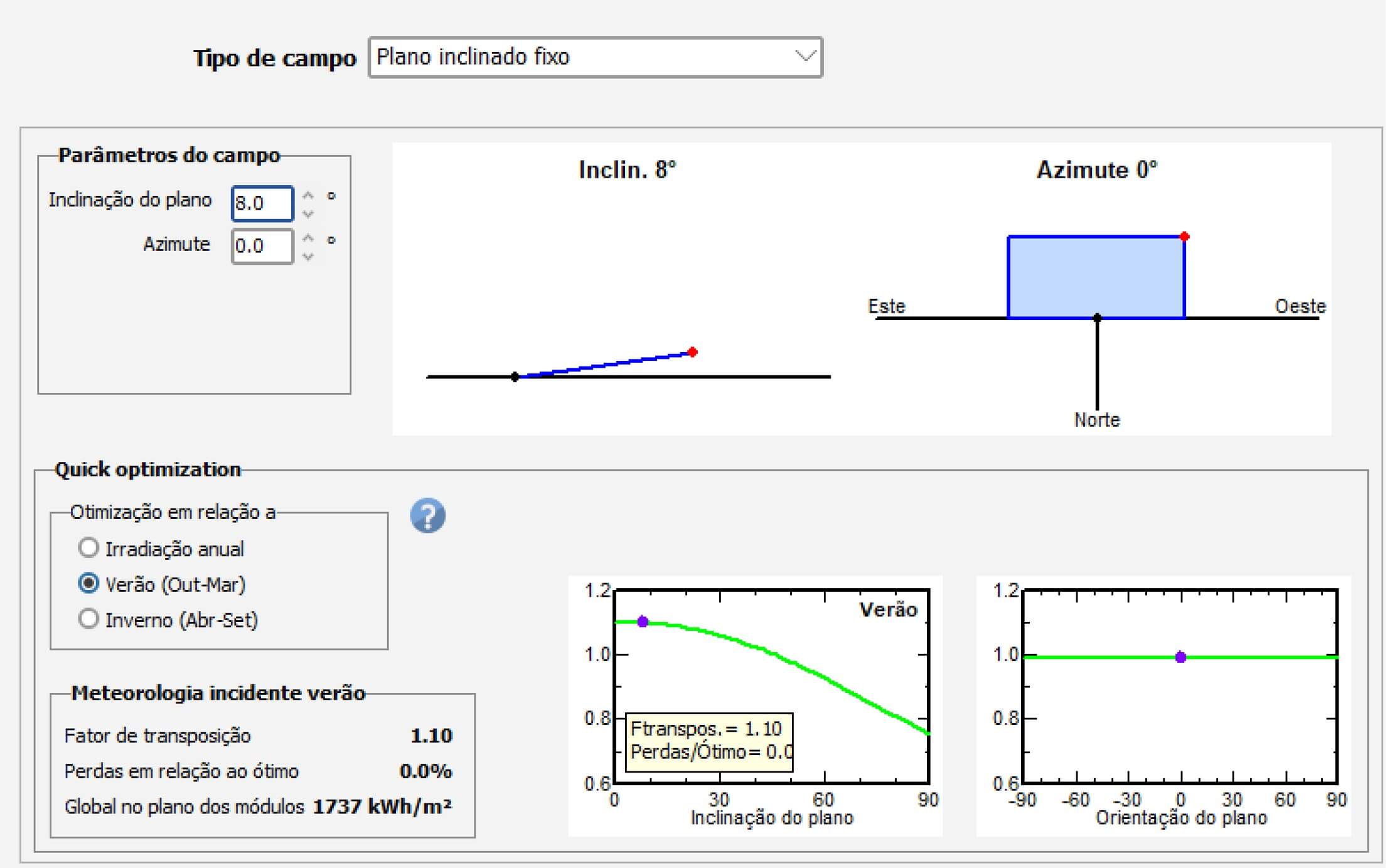
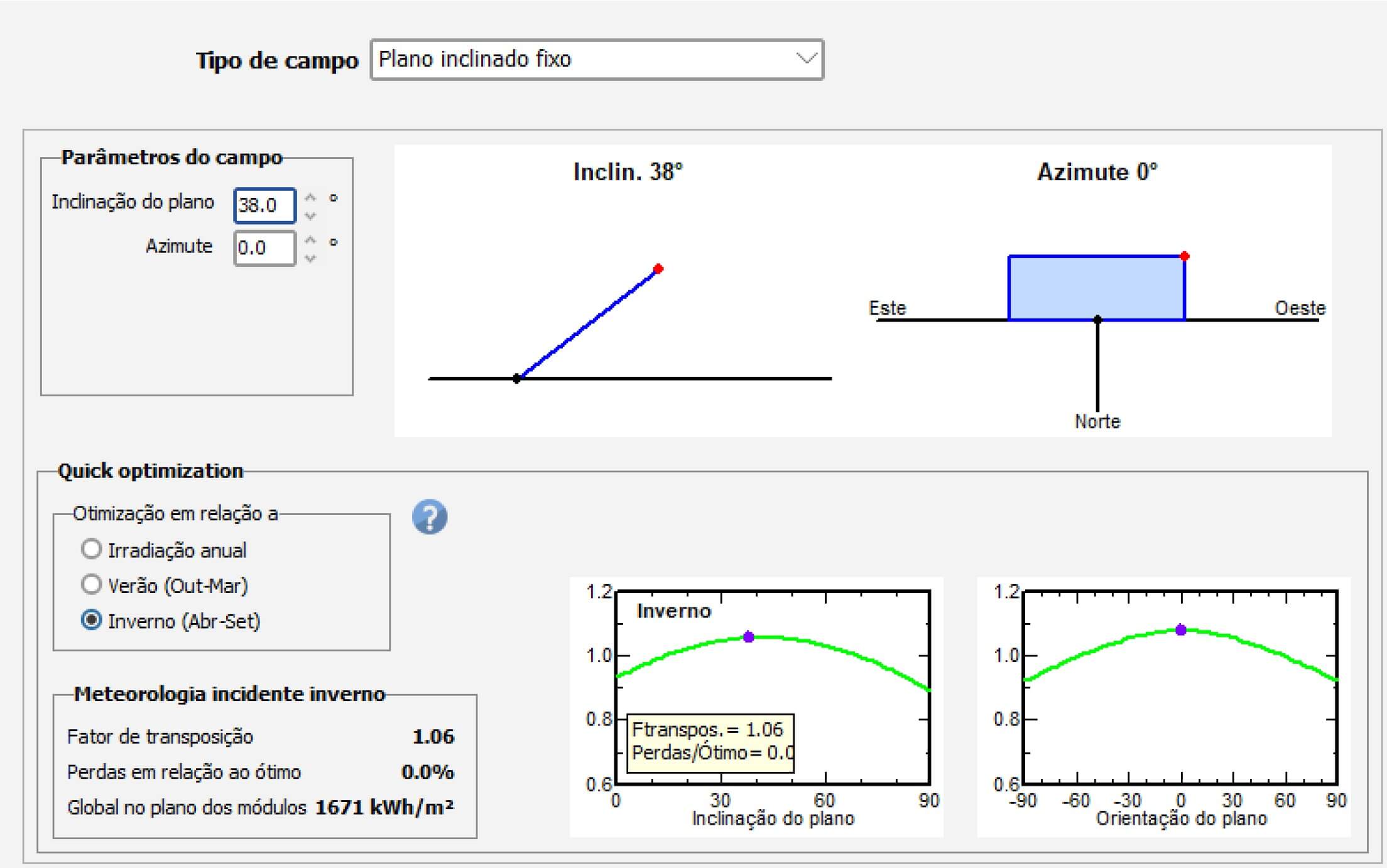
The following figures show inclination angles suggested by the PVSyst software in the city of Campinas-SP, with a South latitude of approximately 23°.
The following situations were considered: constant energy generation throughout the year (slope = 23°), higher generation in summer (slope = 23°-15°) and higher generation in winter (slope = 23°+15°).
Read also Learn all about solar energy..
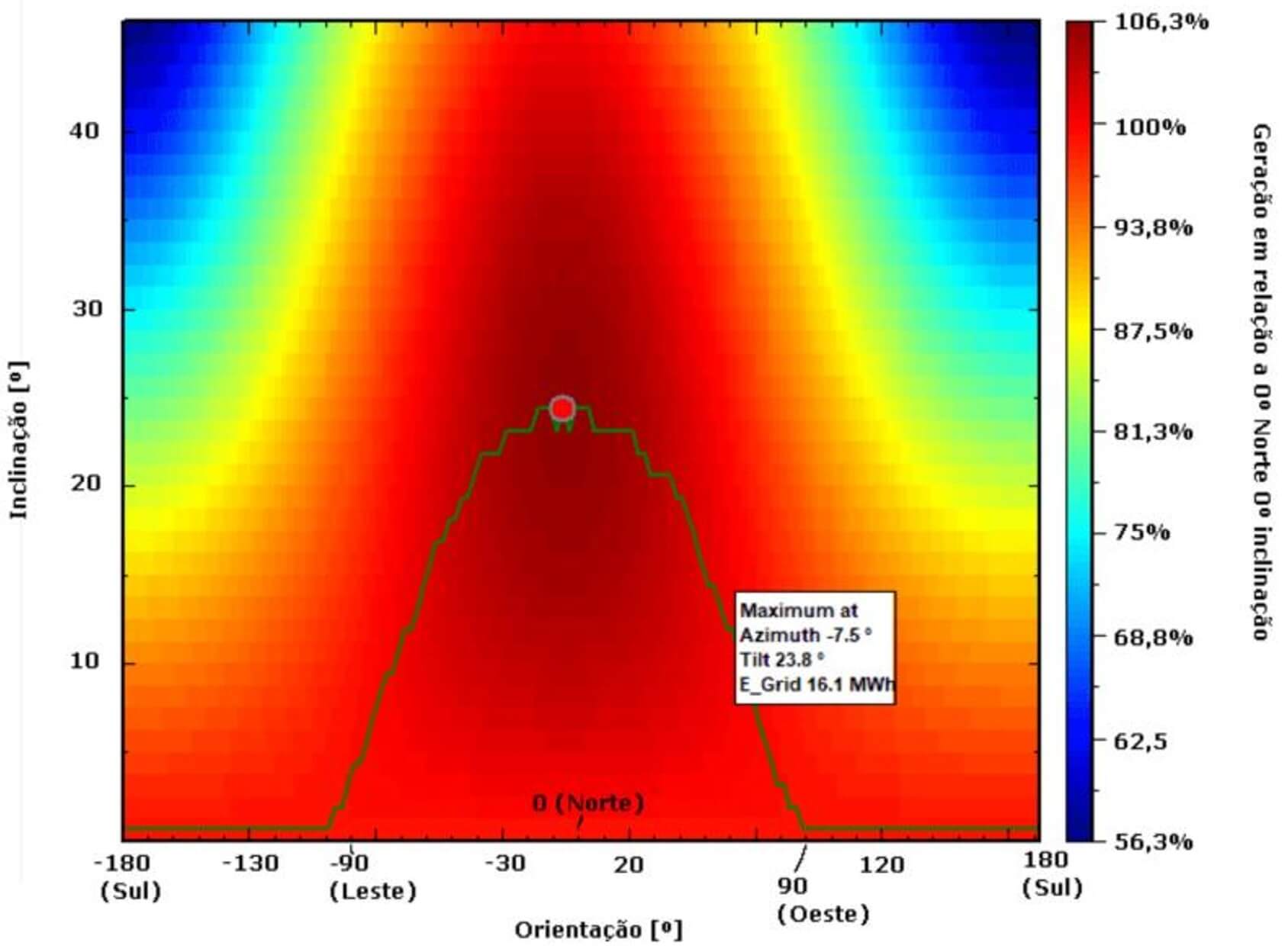
A general rule is to always orient the modules to the North (in the Southern Hemisphere) and tilt with the latitude angle, but the general rule does not always apply and graphs like the one shown below can be obtained with an advanced optimization analysis in PVSyst for the location where the solar plant is intended to be installed.
The ideal installation angles for a photovoltaic module can vary depending on the local climate and terrain. The following graph, created with PVSyst's advanced optimization tool, correlates inclination, azimuth, and energy production. The third dimension of the graph is represented by the color map.
The graph shows that the best way to install a photovoltaic module in this location is with an azimuth of 7,5° (East) and inclination of 23,8°. The suggested tilt angle is very close to the latitude angle.
An interesting fact in this graph is that the suggested azimuthal orientation is not zero, that is, the solar panels should not be facing exactly the geographic North in Campinas.
Conclusion
A good rule of thumb is to tilt the modules at the same latitude as the location to ensure the best performance of the photovoltaic system, with approximately constant energy production throughout the year, without prioritizing any particular time of year.
In other words, if your city has a latitude angle of 23°, a good idea is to tilt the photovoltaic module at this same angle in relation to the horizontal plane.
Don't worry about precision: a few degrees more or less won't make a difference. It's not always possible to tilt the modules to the exact desired angle, depending on the tilt solution you use.
If you want to produce more energy in the summer, a good idea is to subtract 15 degrees from your latitude. For example, in Campinas (latitude = 23°), it would be recommended to tilt the modules at 8°. If you want to produce more energy in the winter, one option would be to add 15 degrees to your latitude (i.e., a tilt of 38° in Campinas).
But the rule is not always valid, as the correct tilt angle for solar modules depends on climatic and geographical factors. Furthermore, the rule does not apply to modules that are not oriented towards the geographic North.
The general rule is also not valid for solar plants with modules arranged in very close rows, as in this case the mutual shading factor of the rows must be considered.
The best performance of the solar plant depends not only on the angle of inclination of the modules, but also on the spacing between them.
Regardless of any rule followed, the correct installation angle of the photovoltaic modules of a photovoltaic system can only be accurately determined from an advanced simulation in software such as PVSyst.
Want to know more? Be sure to participate in events in the solar energy sectorThey can provide valuable insights and updates on best practices and the latest technologies, helping you make more informed and effective decisions.
If you want to explore further the technical details and performance optimization of photovoltaic systems, consider investing in solar energy courses and training.
These programs provide more in-depth insights into module tilt, as well as addressing other issues relevant to efficiency and maximizing solar energy production.
Take the opportunity to discover how renewable energy can transform the future! Visit our articles about solar energy exclusive.
Deepen your knowledge


Answers of 7
Congratulations Marcelo, “Excellent explanation. Very rich in details.”
I'm a layman and was looking for an answer on this matter. I find it strange that the signs on my house were placed with zero inclination…..the dirt from dust and leaves gradually accumulates.
I would like an opinion on this
Hello!
Ms. Cleusa, the correct thing to do would be to check with the engineer or technician who did the project and installation for you. If you can't find one, there must be professionals in your region who work with systems today. In the past, there were very few companies.
Several calculations and site verifications are carried out in order to arrive at a system that can meet the client's needs.
But there must be a solution to your problem, there are excellent professionals in this area.
Professor, Marcelo Villalva, what would be the loss of performance, in relation to the ideal inclination, modules in Juazeiro/Ba, fixed to a Kalhetão roof, almost horizontal, two waters, opposite inclinations of only 3%? The major axis of the roof, approximately in the East/West direction.
Great material, clear, direct, simple. The type of material that I make a point of copying/pasting, whenever I need it. Thank you very much!
Very good article.
We must emphasize the climate, imagining that in summer there are much more clouds and rain, where we must tend the final choice towards the winter angle.
Finally, these impediments to the sun's rays also occur due to dry fog in pollution in large cities or burning regions, as we see in winter. But these are still less restrictive than summer clouds.
Similarly, there are fogs associated with humidity and temperature, proportional to the local altitude. They occur in greater density at dawn, mainly in winter but also during the rainy season. these can be worse in certain places than summer clouds.
Ultimately, the choice is complex.
Thank you for the tips.
I really enjoyed
Simple and direct language without fluff.