

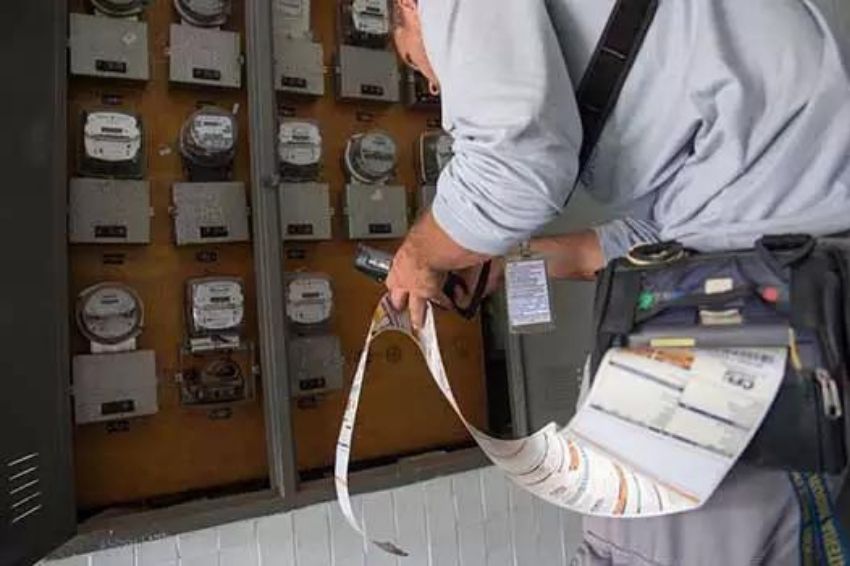
The white tariff is a tariff modality for low voltage consumers, called group B, which includes, for example, homes and small businesses. It was created by the National Electric Energy Agency (ANEEL) to alleviate electricity consumption during peak hours, shifting the load on the electrical system during the day.
Before the creation of this modality, there was only one tariff for group B, called the conventional tariff. Regardless of the time of day, the cost of electricity was the same. This is the big difference with the white tariff: depending on the time of day, the cost of electricity will be cheaper or more expensive than with conventional charging.
If the consumer is able to use equipment that consumes more electricity during off-peak hours, they may have some savings at the end of the month. However, if you decide to adhere to the white tariff and continue with the same habits, your electricity bill will probably be higher than with the conventional tariff. Therefore, an assessment is necessary before joining.
Consumers who subscribe to the white tariff will have three different tariff values during business days:
- Tip: higher fare;
- Intermediate: rate with a small increase in relation to the conventional rate;
- Off-peak: lower fare.
There is a fourth tariff station, called the reserved period, which is applied only to consumers in the rural irrigating or agricultural subclass. For all tariff models, weekends and national holidays are considered off-peak. Each electricity distributor defines the start and end times of tariff stations according to their needs.
Table 1 shows the white tariff schedules for distributors that supplied more than 10.000.000 MWh in 2020. The others can be found on the ANEEL.
Table 1 – Hours of tariff stations of different distributors
| Distributor | Intermediate 1 | Peak Time | Intermediate 2 |
| Amazonas Energy | 19:00 – 20:00 | 20:00 – 23:00 | 23:00 – 0:00 |
| Celesc-D | 17:30 – 18:30 | 18:30 – 21:30 | 21:30 – 22:30 |
| Equatorial PA | 17:30 – 18:30 | 18:30 – 21:30 | 21:30 – 22:30 |
| Celpe | 16:30 – 17:30 | 17:30 – 20:30 | 20:30 – 21:30 |
| Cemig-D | 16:00 – 17:00 | 17:00 – 20:00 | 20:00 – 21:00 |
| coelba | 16:00 – 18:00 | 18:00 – 21:00 | - |
| Copel-DIS | 17:00 – 18:00 | 18:00 – 21:00 | 21:00 – 22:00 |
| CPFL Paulista | 16:00 – 18:00 | 18:00 – 21:00 | 21:00 – 22:00 |
| CPFL Piratininga | 17:00 – 18:00 | 18:00 – 21:00 | 21:00 – 22:00 |
| EDP ES | 17:00 – 18:00 | 18:00 – 21:00 | 21:00 – 22:00 |
| EDP SP | 16:30 – 17:30 | 17:30 – 20:30 | 20:30 – 21:30 |
| electric | 16:30 – 17:30 | 17:30 – 20:30 | 20:30 – 21:30 |
| Energisa MT | 15:30 – 17:30 | 17:30 – 20:30 | 20:30 – 21:30 |
| ENEL CE | 16:30 – 17:30 | 17:30 – 20:30 | 20:30 – 21:30 |
| ENEL GO | 16:00 – 18:00 | 18:00 – 21:00 | 21:00 – 22:00 |
| ENEL RJ | 16:00 – 18:00 | 18:00 – 21:00 | 21:00 – 22:00 |
| ENEL SP | 16:30 – 17:30 | 17:30 – 20:30 | 20:30 – 21:30 |
| Light | - | 17:30 – 20:30 | 20:30 – 22:30 |
| RGE | 16:00 – 18:00 | 18:00 – 21:00 | 21:00 – 22:00 |
Table 2 presents the costs of conventional electricity and the white tariff of these distributors, making it possible to compare them and assess whether adherence will be advantageous.
Table 2 – Values of tariff stations from different distributors
| Distributor | Conventional Tariff [R$/kWh] | White Tariff [R$/kWh] | ||
| Tip | Intermediate | Out Ponta | ||
| Amazonas Energy | 0,693 | 1,356 | 0,892 | 0,587 |
| Celesc-D | 0,506 | 0,884 | 0,576 | 0,430 |
| Equatorial PA | 0,766 | 1,752 | 1,111 | 0,598 |
| Celpe | 0,619 | 1,308 | 0,833 | 0,522 |
| Cemig-D | 0,618 | 1,170 | 0,765 | 0,509 |
| coelba | 0,620 | 1,392 | 0,874 | 0,491 |
| Copel-DIS | 0,559 | 1,000 | 0,656 | 0,474 |
| CPFL Paulista | 0,596 | 1,026 | 0,672 | 0,490 |
| CPFL Piratininga | 0,534 | 0,933 | 0,606 | 0,441 |
| EDP ES | 0,611 | 1,150 | 0,739 | 0,498 |
| EDP SP | 0,546 | 0,955 | 0,623 | 0,437 |
| electric | 0,555 | 1,063 | 0,688 | 0,460 |
| Energisa MT | 0,684 | 1,399 | 0,901 | 0,562 |
| ENEL CE | 0,589 | 1,268 | 0,802 | 0,488 |
| ENEL GO | 0,547 | 1,001 | 0,651 | 0,449 |
| ENEL RJ | 0,714 | 1,333 | 0,880 | 0,571 |
| ENEL SP | 0,594 | 1,115 | 0,724 | 0,499 |
| Light | 0,694 | 1,268 | 0,854 | 0,612 |
| RGE | 0,643 | 1,164 | 0,752 | 0,507 |
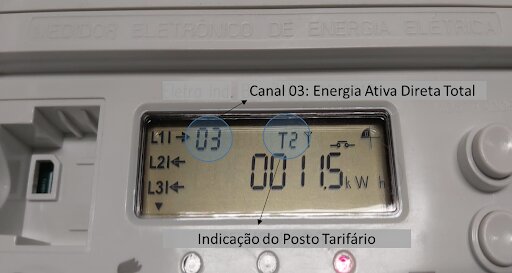
Choosing the white tariff will cause the distributor to replace the electricity meter with an electronic model with multiple pricing, if the consumer does not already have one. Thus, depending on the time of day, the electricity will be increased at the desired tariff level. Below are the standard codes according to ABNT NBR 14522, which will be displayed on the electricity meter display, as shown in Figure 1.
- Code 03: Total direct active energy;
- Code 04: Direct active energy at the tip;
- Code 06: Intermediate direct active energy;
- Code 08: Direct active energy outside the tip.
Multi-tariff electricity meters undergo additional tests to those mentioned in Annex A (Technical model assessment tests) of INMETRO Ordinance No. 587 of 2012, which are minimum requirements for a model to be marketed. Models that will be used in the white tariff must also comply with the tests prescribed by INMETRO Ordinance No. 520 of 2014. What is intended to be verified, in this case, is the guarantee that the meter's time base meets the minimum requirements for being marketed.
Multiple-billing models differ from others due to the accuracy of their clock based on time. Under normal conditions, they can have a maximum error of 5,78 µs/s, that is, 1/2 second every 24 hours. To perform tests on multiple-billing models, it is necessary to put them in “clock mode”. This operation is usually performed using a command via software provided by the manufacturer. This mode causes the meter to display only code 02 (current time) and emit periodic optical or electrical synchronization pulses, which must be less than 5 minutes.
With this pulse it is possible to synchronize it and compare it to a standard time base, which is at least 10 times better than the accuracy of the meter's time base. This procedure is not available to users, only to those who carry out the technical approval of the model, which are INMETRO itself or accredited laboratories.
Notes
- The white tariff does not apply to residential consumers classified as low income, beneficiaries of discounts provided by law, and to public lighting;
- The white tariff values (Table 2) are the costs of electricity without taxes;
- The data in tables 1 and 2 were collected on 16/08/2021.
Sources
- https://www.aneel.gov.br/tarifa-branca
- Inmetro Ordinance No. 587, of November 05, 2012
- Inmetro Ordinance No. 520, of November 28, 2014


Answers of 2
Hello, how do the utilities control whether this meter measures off-peak energy on weekends and holidays? Does it have a calendar or should an average be calculated? I was going to sign up for the white tariff this month but I was wondering how the weekends and holidays would be calculated...
Hello, Victoria. Sorry for the delay in responding, it's an old article and the prices in this publication are no longer in force.
That's right, the smart meters used in the white tariff have a highly accurate calendar and clock. It is not calculated by the average! Weekends and holidays are charged outside the tip. Hugs