
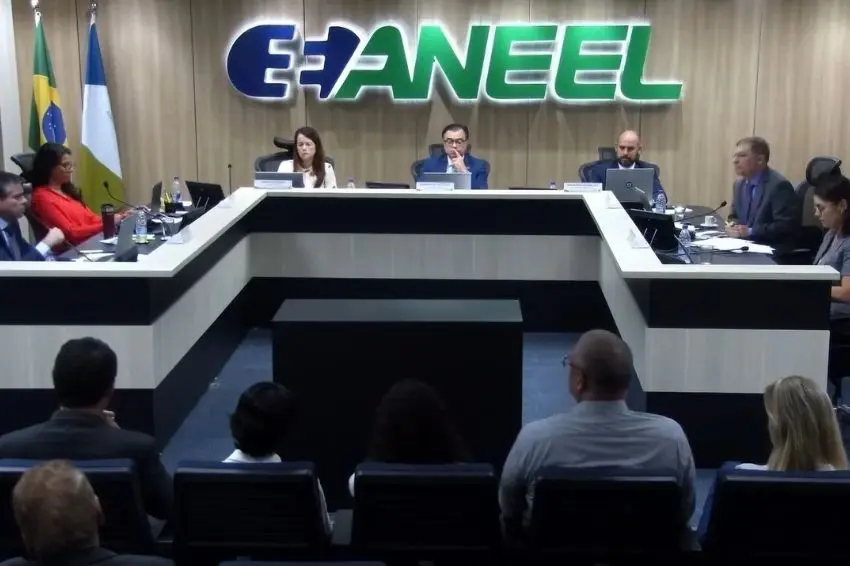
The board of ANEEL (National Electric Energy Agency) approved this Tuesday (17) the opening of two public consultations focused on DG (distributed generation), Public Consultation No. 043/2026 and the
The main one discusses new rules that could restrict shared generation models marketed through "subscription," with a deadline for submitting contributions between November 19 and January 27, 2027.
The objective of the regulation is to discipline Article 28 of the Legal Framework for Distributed Generation (Law No. 14.300 / 2022), which defines micro and mini-generation systems as production intended for self-consumption.
According to the regulatory body, some of the shared generation projects are operating in practice as indirect sales of energy, deviating from the purpose intended by law.
The debate follows a warning issued by the TCU (Federal Court of Accounts) in a 2024 ruling, which pointed to evidence of distortion in the modality and the risk that subsidies paid for by other consumers are supporting irregular business models.
To support the proposal, the technical area of ANEEL The study analyzed the behavior of 13 distributors and identified significant movement in the customer base of these businesses.
In the concession area of Cemig (Companhia Energética de Minas Gerais), for example, the turnover of consumer units reached approximately 400%, which, according to the technical note, indicates structures specifically designed to allow the frequent entry and exit of participants.
For more information, visit the page. Public Consultation No. 043/2026.
The sector criticizes the lack of impact analysis and sees legal risks.
As soon as the decision of ANEEL According to a statement released by RED (Brazilian Association of Distributed Energy Resources), formerly ABGD, advocating for a Regulatory Impact Analysis (RIA) before any changes are made to the rules governing shared generation.
According to the organization, measures such as the requirement for a minimum stay of 12 months and new cost-sharing rules create restrictions that are not foreseen in the Legal Framework for Distributed Management.
"Law No. 14.300 consolidated a flexible model that itself..." ANEEL "It helped to build it. It is up to the Agency to regulate this choice, not to replace it. Creating restrictions that the law did not foresee exceeds the Agency's regulatory power and generates legal uncertainty," said Rose Santos, CEO of RED.
The association also emphasizes that banks, investors, and entrepreneurs financed power plants under a stable legal framework and recalls that the preliminary version of the PDE 2036 (Ten-Year Energy Expansion Plan) projects 91,7 GW of distributed generation capacity by 2036, with R$ 95,9 billion in new investments and 13,5 million consumers.
Although it acknowledges the Agency's oversight role and states that it does not advocate for the irregular sale of energy, the entity argues that any adjustments should be preceded by economic, legal, and social studies.
“Billions were invested because the country offered a clear rule. Changing legislation approved by the National Congress through regulation, without measuring the impacts, breaks the trust of those who believed in Brazil and closes the door to clean and renewable energy for those who cannot invest in their own system,” concluded Rose Santos.
Liquidation of surpluses is also subject to public consultation.
At the same meeting, the board of directors of ANEEL It also authorized the opening of a second public consultation, lasting 45 days (from November 19 to January 4, 2027), to assess the possibility of distributors liquidating the surplus of distributed solar generation from their networks in the MCP (Short-Term Market).
According to the proposal, the transaction would be valued at the PLD (Price of Settlement of Differences), and the resources obtained from the sale would be used to reduce consumer tariffs.
The measure seeks to correct accounting distortions caused by the absence of MMGD surpluses in the accounting of CCEE (Chamber of Electric Energy Commercialization), an asymmetry that would have generated an estimated financial impact of R$ 225 million in 2025, according to a survey by the chamber itself.
To resolve the impasse, the agency is studying two approaches: a simpler model, restricted to accounting records, and a broader one that allows for the transfer of tariff gains to the consumer. The technical recommendation is to implement the more restrictive option provisionally starting in January 2027.
For more information, visit the page. Public Consultation nº 042/2026.
all the content of Canal Solar is protected by copyright law, and partial or total reproduction of this site in any medium is expressly prohibited. If you are interested in collaborating or reusing part of our material, please contact us by email: redacao@canalsolar.com.br.

Comments
Comments are moderated before publication.Comments should be respectful and contribute to a healthy debate. Offensive comments may be removed. The opinions expressed here are those of the authors and do not necessarily reflect the views of the author. Canal Solar.