• Mon, June 1, 2026
Facebook X-twitter Social media coordinator Youtube LinkedIn Spotify
  • GC Solar: 22,33 GW
  • GD Solar: 47,97 GW
  • advertise here
  • About us
  • Expedient
logo site solar channel
  • News
    • Market & Investments
    • International market
    • Politics & Regulation
    • Projects & Applications
    • Renewable
    • Sustainability & ESG
    • Technology & Innovation
    • Electric Vehicles
  • Articles
    • Opinion Article
    • Manufacturer's Article
    • Technical Article
  • Latam
  • Batteries
  • Blog
  • Solar Energy Companies
    • Integrators
  • Magazine
    • Magazine Canal Solar
    • Conecta Magazine
  • Consultancy
  • Courses
  • News
    • Market & Investments
    • International market
    • Politics & Regulation
    • Projects & Applications
    • Renewable
    • Sustainability & ESG
    • Technology & Innovation
    • Electric Vehicles
  • Articles
    • Opinion Article
    • Manufacturer's Article
    • Technical Article
  • Latam
  • Batteries
  • Blog
  • Solar Energy Companies
    • Integrators
  • Magazine
    • Magazine Canal Solar
    • Conecta Magazine
  • Consultancy
  • Courses
  • News
    • Market & Investments
    • International market
    • Politics & Regulation
    • Projects & Applications
    • Renewable
    • Sustainability & ESG
    • Technology & Innovation
    • Electric vehicles
  • Articles
    • Opinion
    • technicians
    • Manufacturer Items
  • Latam
  • Blog
  • Solar Energy Companies
  • Integrators
  • Magazine
    • Conecta Magazine
  • About Us
  • Advertise Here
  • CS Consulting
  • Courses
  • International market
  • News
    • Market & Investments
    • International market
    • Politics & Regulation
    • Projects & Applications
    • Renewable
    • Sustainability & ESG
    • Technology & Innovation
    • Electric vehicles
  • Articles
    • Opinion
    • technicians
    • Manufacturer Items
  • Latam
  • Blog
  • Solar Energy Companies
  • Integrators
  • Magazine
    • Conecta Magazine
  • About Us
  • Advertise Here
  • CS Consulting
  • Courses
  • International market
logo site solar channel
Home / Articles / Technical Article / Saving cables with leap-frog connection of photovoltaic modules

Saving cables with leap-frog connection of photovoltaic modules

Understand the leap-frog strategy and learn how it allows you to reduce the cost of electrical cables in facilities
Follow on Whatsapp
  • Photo by Marcelo Villalva Marcelo Villalva
  • March 3, 2019, at 02:22 AM
2 min 38 sec read
Saving cables with leap-frog connection of photovoltaic modules
Technique allows you to reduce the cost of electrical cables in facilities

An efficient way to make string connections of photovoltaic modules is the strategy known as leapfrog.

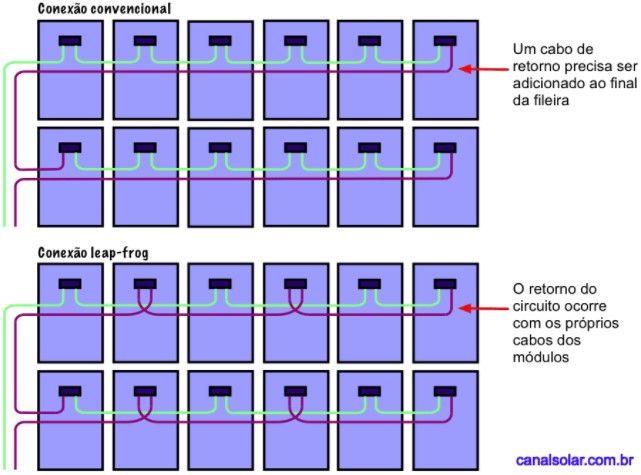
This connection mode, illustrated in the figure below, allows you to reduce the cost of electrical cables in installations.

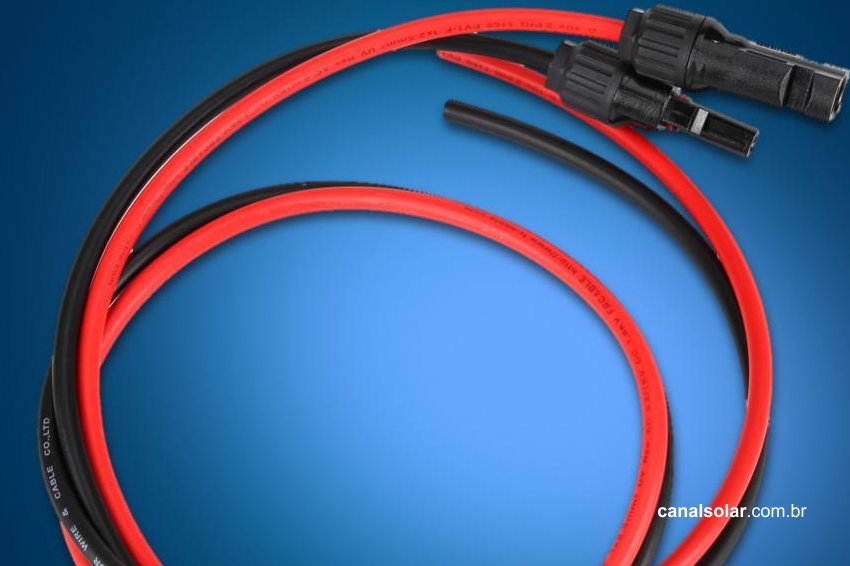
The return and return connections are made with the photovoltaic modules' own cables, both on the return and onward journeys, avoiding the use of return cables.

In addition to providing savings, the connection leapfrog It also improves the circuit's immunity against electromagnetic induction, as this strategy forces the cables to always be close to each other, making it easier to reduce the loop areas of the circuits, which makes the photovoltaic installation less susceptible to electromagnetic surges.
 

How to do the leapfrog?

There's not much of a secret. Instead of connecting the modules in sequence, which is the conventional way, we connect the modules by jumping, always skipping one module. We do this on the way there and back. At the end of the connection, we return to the same point and the series circuit terminations are close together, eliminating the need to add a return cable to the circuit, as shown in the figure above.

O leapfrog Is it always possible? Yes, almost always. Typically the strategy leapfrog It is possible in the vast majority of projects, as manufacturers recommend that the mechanical fixation of the module be done on the largest edge. Therefore, the mechanical arrangement shown in the figure below is always the most commonly found in any type of installation.
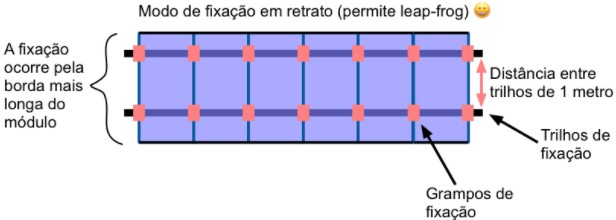
The actual orientation of the modules on the roof will depend on the positioning of the aluminum profiles, which can be vertical (if they are supported on the purlins) or horizontal (if they are supported on the corrugations of the tiles) – in general, that is it. However, with horizontal or vertical rails, the modules will always be flanked by the longest edge, as we see in the previous figure.

In ground-floor plants, portrait positioning (standing modules) is more common, as this eliminates the use of aluminum profiles, with the modules being supported directly on galvanized steel beams. The call leapfrog It is almost a rule today in installations, as it is uncommon to find modules flanked by the shortest edge.

What would be the impediment to making the call? leapfrog with modules flanked by the shortest edge? If you can't see this, imagine in the previous figure the modules lying on the same rails, which are in a horizontal position.

It would be difficult to interconnect the modules by skipping a module, as the distances between the modules would be longer. In the figure, while the distance between two modules is approximately 1 meter (which is the width of a module), in landscape position the distance between two modules would be 2 meters, making it unfeasible to connect modules with their own cables.

cabling Study with the Canal PV installations leapfrog Photovoltaic systems
Photo by Marcelo Villalva
Marcelo Villalva
Specialist in photovoltaic systems. Professor and researcher at the Faculty of Electrical and Computer Engineering (FEEC) at UNICAMP. Coordinator of LESF - Energy and Photovoltaic Systems Laboratory at UNICAMP. Author of the book "Photovoltaic Solar Energy - Concepts and Applications".
PreviousPrevious
NextNext

Leave a comment Cancel reply

Your email address will not be published. Required fields are marked with *

Comments should be respectful and contribute to a healthy debate. Offensive comments may be removed. The opinions expressed here are those of the authors and do not necessarily reflect the views of the author. Canal Solar.

News from Canal Solar in your Email

Posts

Understand in practice how to size hybrid battery-powered systems.

Understand in practice how to size hybrid battery-powered systems.

ESG in Brazilian Solar Photovoltaic Energy: Governance, Regulation, and Project Engineering

ESG in Brazilian solar photovoltaic energy: governance, regulation and project engineering.

More news

Read More
https://docs.google.com/document/d/1kZb4aUu_w7RFJvqvFKp9Ljy2zb4C12zUAzMPmSAz4KI/edit?tab=t.0

Bill to reinstate Redata gains new momentum.

Sister Dorothy Settlement to Receive Solar Energy Kits in Rio de Janeiro

Sister Dorothy Settlement to Receive Solar Energy Kits in Rio de Janeiro

Canal Solar - World Bank predicts a 24% increase in energy prices by 2026

World Bank predicts a 24% increase in energy prices by 2026.

It is a news and information channel about the photovoltaic solar energy sector. Channel content is protected by copyright law. Partial or total reproduction of this website in any medium is prohibited.

Facebook X-twitter Social media coordinator Youtube LinkedIn Spotify

Site Map

Categories

  • News
  • Articles
  • Interviews
  • Consumer Guide
  • Authors
  • Videos
  • Projects
  • Magazine
  • Electric Vehicles

Channels

  • About Us
  • Contact
  • Privacy
  • Quality Policy
  • Work with us
  • Expedient
  • advertise here

Membership and certifications

Copyright © 2026 Canal Solar, all rights reserved. CNPJ: 29.768.006/0001-95 Address: José Maurício Building – Mackenzie Avenue, 1835 – Floor 3, – Vila Brandina, Campinas – SP, 13092-523
Receive the latest news

Subscribe to our weekly newsletter

Fill in the information above and receive your free copy of Canal Solar magazine.