
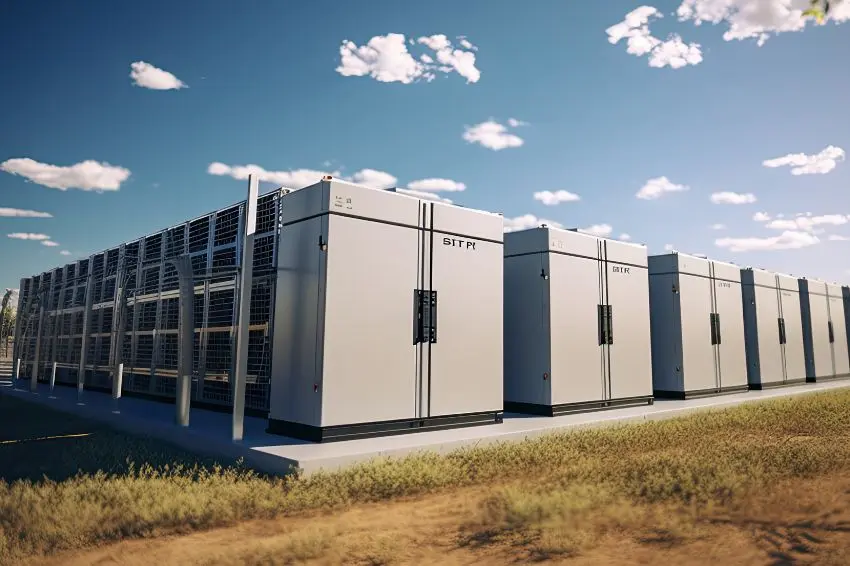
The advancement of distributed generation and the consolidation of hourly tariff structures have placed battery energy storage systems (BESS) at the center of cost management strategies for consumer units served at medium voltage. One application stands out: load displacement (load shifting), which shifts consumption from expensive tariff periods to cheaper periods.
In this context, it is noted that one variable that often receives less attention than it deserves in project modeling is: the full cycle efficiency Round-Trip Efficiency (RTE). This article presents a case study that quantifies the impact of RTE on the return on investment of a project. load shift.
What is Round-Trip Efficiency (RTE)?
Full-cycle efficiency is defined as the ratio between the energy effectively delivered during discharge and the energy absorbed during charging, considering todas internal system losses:

This metric aggregates the losses from various subsystems:
- Bidirectional power converters (PCS)
- Step-up or step-down transformers (where applicable)
- Internal resistive losses of electrochemical cells
- Thermal management system (HVAC)
- Auxiliary consumption of the battery management system (BMS)
- Cable and connection losses
In systems based on lithium-ion batteries, typical RTE values range between 82% and 92%, varying according to the system topology, operating regime, and ambient temperature.
The economy of load shift
No load shiftThe battery stores energy during off-peak hours and discharges during peak hours. The economic gain comes from the tariff spread—the difference between the cost of storing energy during the cheapest hours and the cost avoided by shifting consumption from the most expensive hours.
It is precisely in this mechanism that RTE becomes relevant, since the volume of energy required for charging is inversely proportional to RTE; the lower the efficiency, the greater the amount of energy purchased that is not converted into useful energy during discharge—and, consequently, the narrower the margin of arbitrage that sustains the viability of the project.
Capacity total airBESS storage
The BESS capacity will be given by equation (2)

where,
DoD (depth of discharge)Maximum depth of discharge of the battery. Which for lithium is 90%;
SoH (state of health)The level of battery degradation compared to its initial condition can generally be considered to be 20%-30%.
EloadEnergy to be stored in the battery in kWh, which in this article will be the energy consumed during peak hours.
Since RTE is in the denominator of Equation (2), less efficient systems require greater installed capacity to deliver the same useful energy, which is directly reflected in a higher initial investment (CAPEX).
Download the full magazine and get free access to this article by clicking [here]. here.
The opinions and information expressed are the sole responsibility of the author and do not necessarily represent the official position of the author. Canal Solar.




Comments (1)
Comments are moderated before publication.Comments should be respectful and contribute to a healthy debate. Offensive comments may be removed. The opinions expressed here are those of the authors and do not necessarily reflect the views of the author. Canal Solar.
For my residential photovoltaic installation, I want to install a battery and export energy during peak hours. Will this meter record consumption and energy injection during peak hours? Does it have sufficient code to account for consumption and production during all peak, off-peak, and intermediate hours?