
Brazil's electricity matrix is expected to undergo one of the biggest transformations in its history over the next decade. This is what the final version of the PDE (Ten-Year Energy Expansion Plan) 2035, published in the DOU (Official Gazette of the Union) this Thursday (2), indicates.
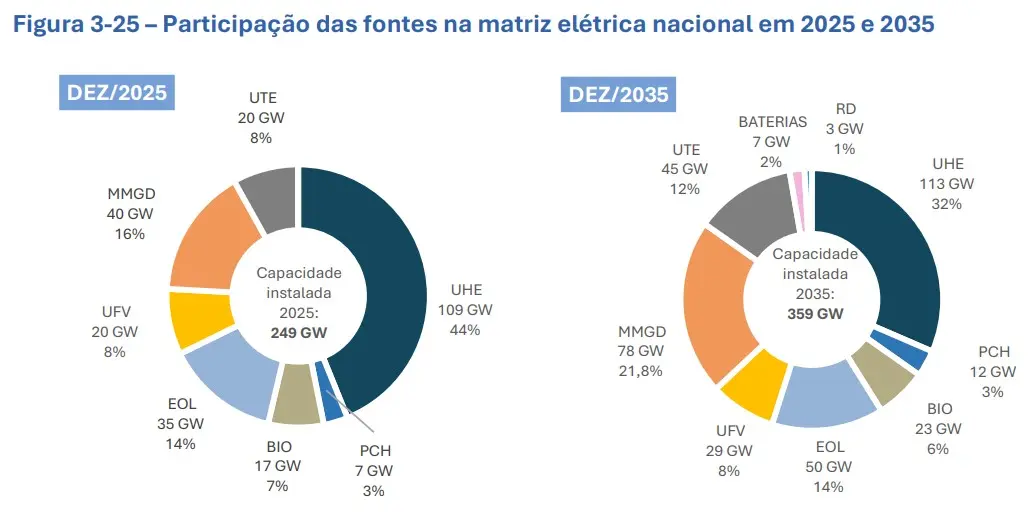
Prepared annually by EPE (Energy Research Company) to guide the planning of the expansion of the national energy sector, the document projects the addition of 110 GW of installed capacity by 2035, raising the country's total power from the current 249 GW to 359 GW.
According to the document, growth will continue to be primarily driven by renewable sources, but with significant changes in the profile of expansion.
While solar distributed generation is expected to accelerate its share of the energy mix, the growth of large photovoltaic plants tends to slow down due to increasing cuts in renewable generation, a phenomenon known as curtailment.
At the same time, Brazilian energy planning is beginning to incorporate technologies such as battery storage and demand response in a more structured way, which are considered fundamental to ensuring the security and operational flexibility of the national electricity system.
To make this entire structural transformation viable, the government document estimates that the Brazilian energy sector will require investments of around R$ 3,5 trillion by 2035, distributed among the generation, transmission, and distribution of electricity.
Hydropower plants are expected to lose relative ground in the electricity mix.
Despite remaining the country's main source of power generation, hydroelectric plants are expected to continue losing share in the Brazilian electricity matrix in the coming years.
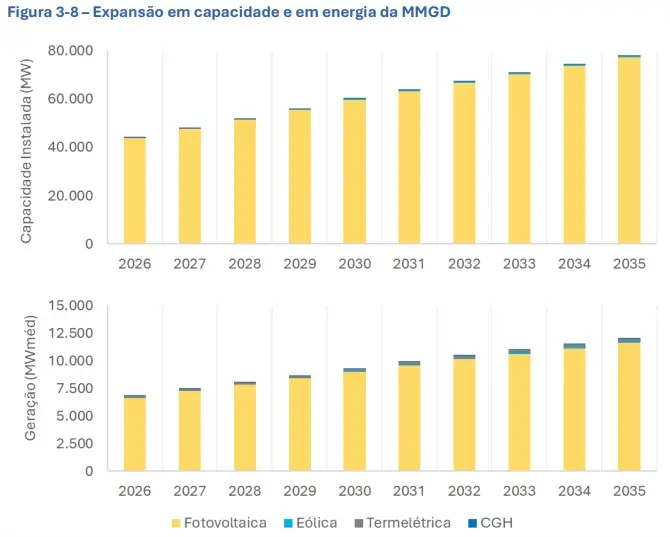
In 2025, hydroelectric power plants will represent approximately 44% of the national installed capacity, with around 109 GW. By 2035, although the installed capacity will increase to approximately 113 GW, its relative share is expected to fall to 32%.
According to EPE, this reduction does not mean a loss of relevance for hydroelectric plants, but rather the accelerated growth of other renewable technologies and new flexibility solutions for the electrical system.
The projected expansion of hydropower over the next ten years totals 7,5 GW, including new hydroelectric plants, small hydroelectric plants (SHPs), and modernization projects for existing plants.
Solar energy will surpass 100 GW of installed capacity.
The main focus of Brazil's electricity expansion will continue to be solar energy. Projections from the PDE (Energy Development Plan) indicate that Brazil should reach approximately 107 GW of installed solar capacity by 2035, considering both centralized generation and micro and mini-distributed generation.
Most of this growth, however, will occur outside of large power plants. According to the document, distributed generation (DG) is expected to reach 78 GW of installed capacity, increasing its share of the national electricity matrix from approximately 16% in 2025 to almost 22% in 2035.
Meanwhile, centralized solar generation is expected to reach around 29 GW, maintaining a share close to the current 8% of the installed capacity of the SIN (National Interconnected System).
The numbers reflect an important structural change in the Brazilian solar sector: expansion will continue at an accelerated pace, but will be driven mainly by systems installed close to consumption centers.
Curtailment reduces the competitiveness of centralized solar.
One of the most relevant points of the PDE 2035 is the official recognition that the current scenario of excess renewable energy supply already directly influences the expansion prospects of large solar power plants.
The document states that, in the current context of energy curtailment (a situation where generation cuts are necessary due to excess supply relative to demand or transmission limitations), further expansion of centralized solar generation becomes economically and operationally less attractive for the system.
In practice, this means that the government projects the addition of only 5,6 GW of new centralized solar capacity between 2026 and 2035, a volume significantly lower than the expected growth for distributed generation (DG).
The assessment reinforces the growing perception in the market that the future of Brazilian solar energy will depend not only on expanding installed capacity, but also on developing new solutions for flexibility, storage, and modernization of the electrical infrastructure.
Batteries are definitively entering energy planning.
Another highlight of the PDE 2035 is the growing role assigned to energy storage systems. For the first time, national energy planning incorporates a significant expansion of batteries connected to the electrical grid.
Projections indicate an initial input of approximately 600 MW of storage in 2028, reaching about 6,6 GW by 2035, equivalent to approximately 2% of the total installed capacity of the SIN (National Interconnected System).
In addition to storage, the PDE also projects the expansion of so-called demand response, a mechanism by which consumers voluntarily adjust their energy consumption to contribute to the balance of the electrical system. According to the study, this resource could reach approximately 3,3 GW by 2035, representing about 1% of the national installed capacity.
Taken together, storage and demand response capabilities could add approximately 10 GW of flexibility to the Brazilian electricity system by 2035, signaling a significant shift in national energy planning, which has historically relied predominantly on expanding conventional generation to ensure security of supply.
Wind and thermal power plants should also increase their share.
Wind energy will continue to play a significant role in Brazil's electricity expansion. The PDE (Energy Development Plan) projects the addition of 13,6 GW of new wind capacity over the next decade, increasing the installed capacity of this source from the current 35 GW to approximately 50 GW in 2035.
Thermal power plants are expected to increase their share in the national electricity matrix. According to EPE, the share of thermal plants will increase from 8% of installed capacity in 2025 to approximately 12% in 2035, driven both by the plants foreseen in Law No. 14.182/2021 and by the need to guarantee additional capacity and operational safety requirements.
The baseline scenario considers the entry of 18,7 GW of flexible natural gas-fired thermal power plants, in addition to 7,6 GW of inflexible thermal power plants foreseen in legislation, and the start of operations at the Angra 3 nuclear power plant.
all the content of Canal Solar is protected by copyright law, and partial or total reproduction of this site in any medium is expressly prohibited. If you are interested in collaborating or reusing part of our material, please contact us by email: redacao@canalsolar.com.br.