
A survey conducted by PwC Brazil and the Acende Brasil Institute indicated that, in 2024, 44,8% of the gross operating revenue generated from the sale of electricity to the end consumer was allocated to the payment of taxes and sector charges.
Despite the reduction compared to 2023, when this figure was 46,2%, the value still represents almost half of what the consumer pays.
The research analyzed 44 power generation, transmission, and distribution companies based on audited financial data and information from... ANEEL (National Electric Energy Agency), ONS (National Electric System Operator) and MME (Ministry of Mines and Energy).
Taxes and charges analyzed
The analysis took into account various taxes and charges, such as federal, state and municipal taxes (IRPJ, CSLL, PIS/Pasep, Cofins, ICMS, ISS) and labor charges.
In addition, specific charges for the electricity sector were included, such as the CDE (Energy Development Account), CFURH (Financial Compensation for the Use of Water Resources), RGR (Global Reversion Reserve), ESS (System Services Charges) and PROINFA (Incentive Program for Alternative Sources of Electricity).
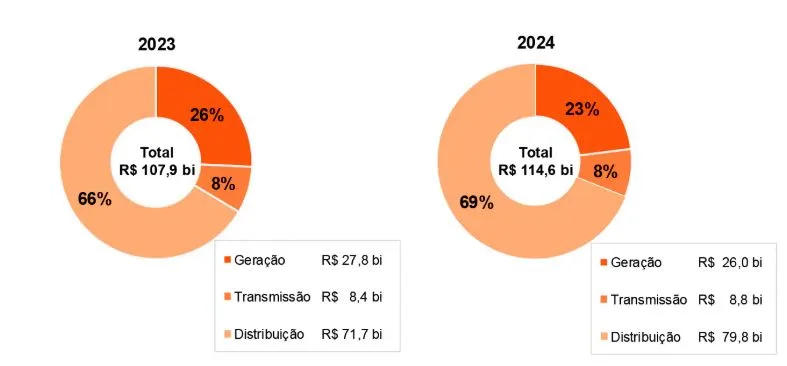
The sector raised R$ 114,6 billion in 2024.
In 2024, the sector collected R$ 114,6 billion in taxes and charges, an increase of 6,2% compared to the R$ 107,9 billion of 2023. Most of the revenue came from energy distribution, which totaled R$ 79,8 billion, representing 69% of the total.
Generation revenue reached R$ 26 billion, a decrease of R$ 2,7 billion, while transmission totaled R$ 8,8 billion, showing an increase of R$ 0,4 billion.
Distribution accounted for the majority of this revenue. In 2024:
- Distribution It accounted for R$ 79,8 billion, equivalent to 69% of the total, with an increase of R$ 8,1 billion and a 3 percentage point increase in participation;
- Generation It raised R$ 26 billion, a decrease of R$ 2,7 billion and a reduction in its market share from 26% to 23%.
- Transmission It totaled R$ 8,8 billion, an increase of R$ 0,4 billion, maintaining an 8% share.
ICMS remains the main tax.
According to the survey, the ICMS It remains the main tax levied on the electricity sector. In 2024, its share rose from 15,1% to 16,7% of revenue, an increase of 0,6% that significantly impacts the composition of the tax burden.
Other consumption taxes showed mixed performance:
- Cofins It fell from 8,1% to 7,7%;
- PIS It decreased from 1,8% to 1,7%;
- ISS remained at 0%.
Regarding income taxes:
- IRPJ It fell from 2,2% to 1,9%;
- CSLL It remained at 0,7%.
Meanwhile, payroll taxes, such as social security contributions and other labor charges, saw their share decrease from 2,1% to 1,3%. In total, the tax burden fell from 31,0% in 2023 to 30% in 2024, a reduction of 1 percentage point.
Sectoral charges decline, but CDE hits record high.
Sectoral charges accounted for 14,8% of revenue in 2024, down from 15,2% in 2023. The main change occurred in the CDE (Energy Development Fund), which increased its share from 12,9% to 13,2%.
In nominal terms, CDE revenue reached R$ 33,853 billion in 2024, the highest level in the historical series. This growth occurred after a period of stability between 2022 and 2023, when revenue had decreased from 15,4% to 12,9%.
Other charges had a smaller share:
- R&D/PEE It remained at 0,7%;
- CFURH remained at 0,4%;
- RGR It fell from 0,2% to 0%;
- PROINFA It fell from 0,5% to 0%;
- Outer cargo They rose slightly from 0,4% to 0,5%.
How was the CDE used in 2024?
In 2024, CDE expenses totaled R$ 37,167 billion, an increase of R$ 2,181 billion compared to 2023. The main destinations were:
- Tariff discounts in distribution: R$10,236 billion;
- CCC – Isolated systems: R$10,742 billion;
- Social Tariff – Low Income: R$6,185 billion;
- Universalization – PLP + installation kit: R$2,503 billion;
- Subsidy for distributed generation (Law 14.300): R$ 1,681 billion;
- CDE Eletrobras (Law 14.182): R$ 1,299 billion.
On the revenue side, the CDE tax reached R$ 33,853 billion, an increase of R$ 3,661 billion compared to 2023.
Structurally high load
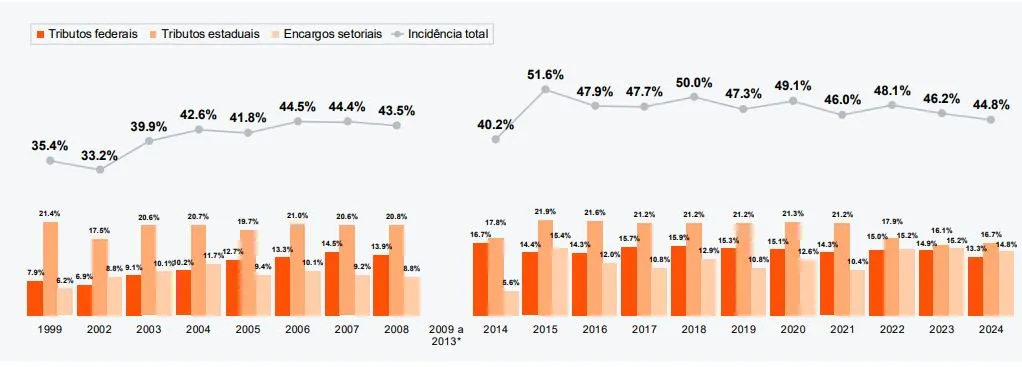
The analysis also presented the historical series from 1999 to 2008 and from 2014 to 2024, which indicates that the total tax and charge burden on the electricity sector has remained high for decades.
The highest point in the series was recorded in 2015, when the total incidence reached 51,6%, reflecting a period of strong pressure due to sector charges and the increase in state load, especially in a context marked by the water crisis and the emergency measures adopted in the electricity sector.
After this peak, the total burden showed a tendency to stabilize, varying between 46% and 50% until 2022. In 2024, the incidence decreased to 44,8%, the lowest level since 2014, although it is still significantly above the rates observed in the early 2000s.
Analyzing the composition of the tax burden, state taxes, mainly led by the ICMS (Tax on Circulation of Goods and Services), continue to be the main component throughout the entire series, with a high and relatively stable share.
Sector-specific charges, in turn, showed greater volatility, with peaks during periods of greater intervention in the sector and a gradual reduction in recent years. Federal taxes, although smaller, maintained a consistent share throughout the period.
ICMS varies between states.
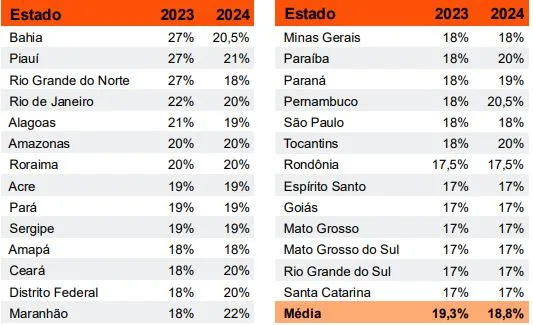
The study also revealed variations in ICMS rates between states. In 2024, the national average was reduced from 19,3% to 18,8%, but some states, such as Maranhão (22%), Piauí (21%) and Bahia (20,5%), still have high rates, while others remained stable.
These regional disparities, coupled with the fact that ICMS (a Brazilian state tax) is levied on a gross base that includes the tax itself, can impact the final price of energy for the consumer.
all the content of Canal Solar is protected by copyright law, and partial or total reproduction of this site in any medium is expressly prohibited. If you are interested in collaborating or reusing part of our material, please contact us by email: redacao@canalsolar.com.br.

Comments
Comments are moderated before publication.Comments should be respectful and contribute to a healthy debate. Offensive comments may be removed. The opinions expressed here are those of the authors and do not necessarily reflect the views of the author. Canal Solar.