
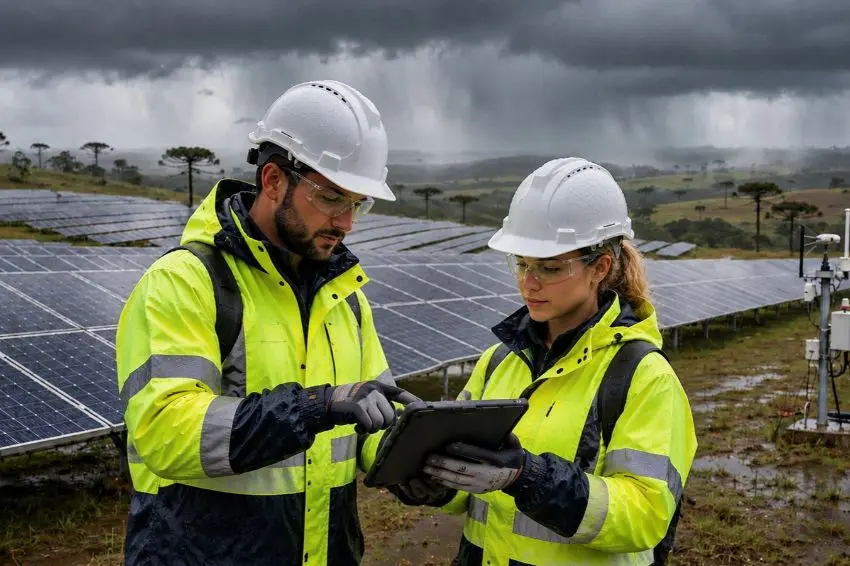
The increasing frequency of severe weather events, driven by climate change, reinforces the need to prepare solar power plants to cope with strong winds, hail, and heavy rain.
In Paraná, for example, a state that has been heavily affected by frequent storms, between June and August of this year, the Civil Defense recorded 228 incidents in 150 municipalities, including 95 windstorms, 62 hail events, and five tornadoes.
To give you an idea, last September, 14 Simepar weather stations recorded the highest rainfall volumes for the month since the beginning of their historical records. This scenario demands attention from operators, both to prevent physical damage and to reduce the time that equipment remains unavailable.
According to L8 Energy, a company specializing in the construction, operation, and maintenance of photovoltaic plants, the combination of robust structures, regular maintenance, and monitoring technologies can reduce risks and make emergency response faster.
The company also draws attention to the intensification of El Niño, a phenomenon that favors increased rainfall in the south of the country. In this context, the planning of facilities and preparation for adverse conditions become important steps to protect assets and maintain operational safety.
Protection begins with the structure.
Prevention should be considered from the project's inception; that is, support structures, foundations, anchors, and fasteners need to be sized according to the expected winds in the region and the characteristics of the terrain.
L8 Energy recommends regular inspections to identify corrosion, gaps, and deformations that could compromise the stability of photovoltaic modules.
Preventive maintenance should also include drainage systems and soil condition assessments, as heavy rainfall can cause erosion, flooding, and instability, affecting foundations, cables, and electrical equipment.
Following a storm, the company advises that inspections be carried out to check for possible damage to structures, panels, and electrical installations before resuming operations. Generation should not resume without the necessary checks.
Remote control
Another recommendation is to expand the use of remote monitoring through SCADA systems, an acronym for Supervisory Control and Data Acquisition systems. This technology allows for real-time monitoring of operational variables, alarms, and the status of equipment.
When an electrical protection system trips during a storm, for example, the operator can identify the affected point and assess the situation without immediately sending a team to the site. This reduces the exposure of professionals to lightning strikes, flooded areas, and potentially hazardous installations.
L8 Energy emphasizes, however, that remote monitoring does not replace on-site inspection when there is suspicion of physical damage or when safety protocols require an on-site assessment.
Thermal cameras
Integrating SCADA with thermal cameras is another measure recommended by the company. The images allow for the detection of temperature variations that may indicate abnormal heating in electrical components or other anomalies that need to be investigated.
In the event of a circuit shutdown, cross-referencing alarms with images and thermal information helps assess whether the equipment should remain isolated and which checks need to be prioritized.
Resumption requires safety.
Rapid damage assessment is important because each period of downtime can represent a loss of generation. With remote monitoring, operators can locate incidents, organize inspections, and decide more quickly which procedures to adopt.
The possibility of remotely restarting equipment, however, depends on the nature of the fault and the safety conditions. In the event of evidence of physical damage, short circuit or fire hazard, the equipment must remain isolated until the checks are completed and it is cleared for operation.
all the content of Canal Solar is protected by copyright law, and partial or total reproduction of this site in any medium is expressly prohibited. If you are interested in collaborating or reusing part of our material, please contact us by email: redacao@canalsolar.com.br.

Comments
Comments are moderated before publication.Comments should be respectful and contribute to a healthy debate. Offensive comments may be removed. The opinions expressed here are those of the authors and do not necessarily reflect the views of the author. Canal Solar.