
What are hybrid photovoltaic systems?
Hybrid photovoltaic systems are those that can operate in on-grid (grid-tie) and off-grid modes.
The main application of hybrid systems is grid-tie installations where a backup resource is required. This feature allows part of the loads to continue to be powered by batteries and photovoltaic modules even in the absence of a power grid.
In hybrid systems, when a power grid failure occurs, the grid-tie mode is turned off and the off-grid mode is activated.
Hybrid systems can be constituted in two ways: with a combination of on-grid and off-grid inverters or with a hybrid inverter (which has on and off/grid operating modes), as shown in Figure 1.
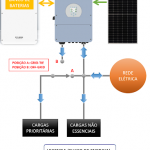
Priority loads
During hybrid system operation in off-grid (backup) mode, it is possible that only part of the loads will be served while the electrical grid is unavailable.
It is typically difficult to size a hybrid system to power all of a facility's loads in backup mode. For example, in an office building we can use off-grid mode to emergency power the computers and lighting circuits, while the air conditioning units will be out of operation.
The same reasoning applies to homes, where we will leave the most consuming or non-essential appliances turned off (air conditioners, showers, washing machines) and only power the lighting, intercom and electronic gate circuits in backup mode, for example. .
The definition of priority loads depends on the customer's needs. If the consumer wishes to keep their air conditioner running in backup mode, they can. It will cost a little more, as a higher power inverter will need to be used, but technically this is possible.
Load selection for off-grid operating mode
In practice, how will hybrid systems distinguish between priority and non-essential loads? To begin, let's exemplify a system based on a hybrid inverter that has two AC ports: one off-grid and one grid-tie – Figure 2.
To understand what hybrid inverter AC ports are, you can read the articles “What is a Hybrid Solar Inverter?” and “Hybrid inverter x inverter-charger”, previously published here on Canal Solar.
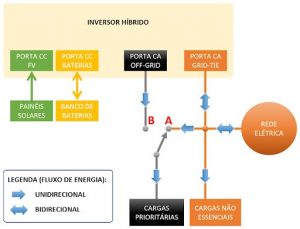
During grid-tie operation, when the system is connected to the electrical grid, the on-grid port is used to connect the inverter to the electrical grid, as shown in Figure 3, with the switch in position A.
In this case, all loads present in the installation are powered by the electrical network. The energy from the solar panels is injected into the installation and can fully or partially supply local consumption. Any excess energy, if any, will be injected into the electrical grid or stored in the batteries (or both, prioritizing charging the batteries).
Assuming the batteries are charged, what we have here is a pure grid-tie system: panels generating energy, local consumption being met and surplus being injected into the grid.
The novelty of the hybrid system (compared to the traditional grid-tie system) is the off-grid operating mode. When the electrical grid fails, the inverter's on-grid port is immediately turned off, ceasing any injection of energy into the electrical grid.
Then, the off-grid port comes into operation, supplying the loads connected to it. It is at this point that load selection takes place. Using a toggle switch, part of the load circuits will be disconnected from point A and connected to point B. The remaining, non-essential loads will remain disconnected during off-grid operation, as illustrated in Figure 4.
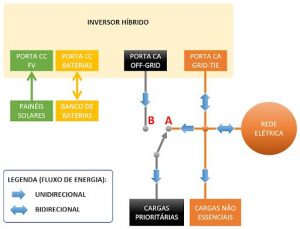
The selection of loads in hybrid systems and the transition from on-grid to off-grid mode requires the presence of a changeover switch. This switch is necessary because the inverter's on-grid and off-grid ports cannot operate simultaneously. The loads are powered by the on-grid port or the off-grid port, depending on the operating mode in which the system is located.
Furthermore, the off-grid circuit needs to be isolated from the grid-tie circuit, as the off-grid port cannot be connected to the power grid. When the latter is restored, the key must return to its original position, keeping the two doors isolated at all times.
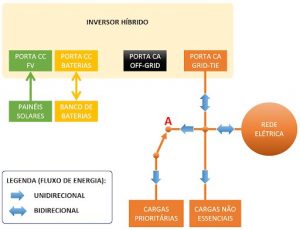
Another situation is illustrated in Figure 5, in which an inverter with a single multifunctional AC port is employed. This is the case, for example, with the GEN 24 inverter from Fronius. Even so, a toggle switch is necessary as the AC port must be disconnected from the electrical grid when the inverter is operating in off-grid mode.
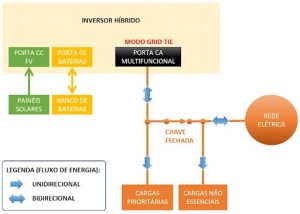
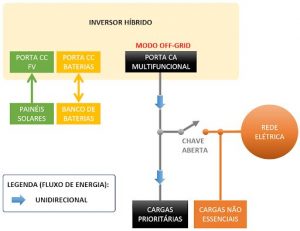
In Figure 6, we see that load selection occurs when the switch is switched. In this case, a simple contactor switch is used, which only has the function of opening or closing the inverter connection to the electrical grid.
When the network fails, the switch opens, disconnecting the connection to the network and at the same time removing part of the loads from the circuit. Only essential (priority) loads remain connected to the AC port, which starts to operate in off-grid mode (voltage source). When the system is in grid-tie mode, the switch remains closed and all consumer loads are connected to the electrical grid.
Conclusion
Hybrid photovoltaic systems, which can be built with a combination of inverters or based on an on/off-grid hybrid inverter, are an evolution of conventional grid-tie systems.
The hybrid system allows the consumer to have a backup system when there is a power grid failure, preventing essential loads from being no longer supplied. In this type of system, it is necessary to select priority loads and use a changeover switch, which isolates the on-grid and off-grid circuits.
There are inverters that have separate on-grid and off-grid AC ports, while others may have a single multi-function AC port (on/off-grid). In either case, a switch is needed to segment non-essential and priority loads. Furthermore, the switch prevents the electrical grid from being inadvertently connected to the AC port during off-grid operation, a situation that could lead to the inverter burning out.



Comments (9)
Comments are moderated before publication.Comments should be respectful and contribute to a healthy debate. Offensive comments may be removed. The opinions expressed here are those of the authors and do not necessarily reflect the views of the author. Canal Solar.
For a customer who already has a string inverter, is an automation system necessary so that the hybrid system does not start the string inverter?
Good morning, I'm starting a solar energy company and I would like all the knowledge I can, that's why I would like to purchase your book
Good afternoon, how are you? Check out our episode of Canal Answers about how to open a solar energy company: https://youtu.be/rfmHGgRIOOM.
I am not aware of a bidirectional hybrid system with the electrical grid. Is there?
Hello, Manoel, how are you? Yes there is!
This article is very important because I have been researching a system that can be used when there is a power outage due to the on-grid system. It is the plant that I have installed and at the moment I need to increase it with an 8kw inverter to meet my demand. So I think a hybrid would be the most convenient. I would really like to purchase your book. E-mail dpopres@gmail.com. thanks
Top.
I loved the way you explained it.
I want to enter this area and with your explanation, I found no difficulties in understanding.
Hello, Fernanda, how are you? We have several courses for you to learn and enter the market. Talk to our consultants: http://whts.co/CanalSolar-cursos
Excellent article. Well explained, very clear. I believe this system is the best for homes. Great teacher Marcelo, always ready to teach.