
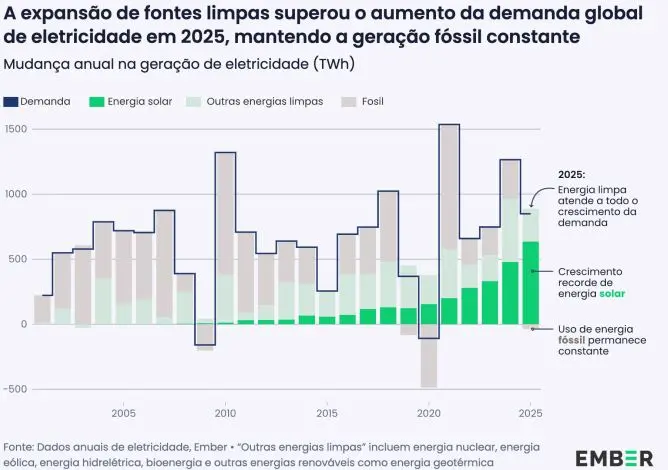
A study published by Ember earlier this week showed that solar energy will account for 75% of the growth in global electricity demand in 2025.
This performance boosted renewable energy sources, which now account for 33,8% of global generation, surpassing coal (which recorded a 0,2% decrease) for the first time in history.
This movement was driven primarily by China and India, which historically are the biggest contributors to the increase in fossil fuel production.
In 2025, both countries recorded a decline in this type of energy, reversing a trend observed over the past few years.
In China, fossil fuel generation fell by 56 TWh (-0,9%), the first reduction since 2015, driven by strong growth in clean energy, mainly solar.
In India, the drop was 52 TWh (-3,3%), a result of the combination of record expansion in solar and wind power, high hydroelectric production, and below-average demand growth.
In both cases, the record expansion of clean energy sources outpaced demand growth, halting the global advance of generation from fossil fuels.
Growth of solar energy sources
In 2025, solar generation reached 2.778 TWh – an increase of 636 TWh compared to 2024, equivalent to a growth of 30%, the largest in the last eight years.
According to the research, this additional volume would be sufficient to replace the gas-generated electricity equivalent to all LNG exports through the Strait of Hormuz in the previous year, estimated at 550 TWh.
Since 2022, when it totaled 1.333 TWh, solar energy has practically doubled and is now more than ten times higher than that recorded in 2015, when it was 256 TWh.
In 2025, this source surpassed global wind power generation for the first time and came close to nuclear power. It is expected that both will surpass nuclear energy as early as 2026.
Exclusive
Ember's analysis considered electricity data from 215 countries, including the most recent information from 2025, with detailed data from 91 countries representing 93% of global demand.
Thirteen geographic and economic groups were also evaluated, including Africa, Asia, Latin America, and the European Union, in addition to a more in-depth analysis of the seven largest consumer markets, which account for 72% of global demand.
To complement the diagnosis, meteorological and installed capacity data were used, allowing the identification of structural trends shaping the global electricity sector.
all the content of Canal Solar is protected by copyright law, and partial or total reproduction of this site in any medium is expressly prohibited. If you are interested in collaborating or reusing part of our material, please contact us by email: redacao@canalsolar.com.br.