
After the boom in subscriptions recorded in 2024, the free energy market shows signs of slowing down in 2025. Data from CCEE (Electric Energy Commercialization Chamber) indicate that, between January and September, 18.378 new consumer units migrated to the free environment – a number practically stable in relation to the same period last year (18.414), when the sector achieved the greatest growth in its history.
Despite the stability in the accumulated total, the monthly pace has been losing strength since the beginning of the year, with successive reductions in migrations, as shown in the graph below.
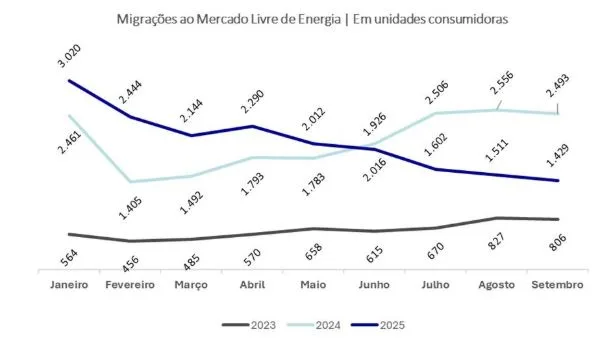
The downturn reflects a combination of regulatory, economic, and structural factors that have been reshaping companies' appetite for the free market. The processing of provisional measures reviewing sectoral subsidies and charges has increased the perception of risk among agents and consumers, prompting caution in migration decisions.
Furthermore, the expectation of a review of yarn discounts and adjustments in contracting costs led traders to adopt a more selective stance, prioritizing contracts with safer margins and less exposure.
Another important element is the natural maturity of the liberalization process. After the 2024 boost (when the free market was extended to all high-voltage consumers), a significant portion of the eligible population has already migrated. The slower pace in 2025, therefore, also reflects a consolidation movement, with a growing base of already established consumers and a reduced contingent of new entrants.
According to Alexandre Ramos, chairman of the CCEE Board of Directors, the result does not indicate a decline, but rather stability at a high level. "What we are observing is a mature market, maintaining significant growth and expanding its regional and sectoral diversification. This demonstrates companies' confidence in the model and the competitiveness of freely traded energy," he assesses.
Services and telecom lead the advance in 2025
Among the segments that grew the most during the year, the services sector stood out, with 6 new units migrated, an increase of 25,6% compared to 2024. Telecommunications (+19,6%) and transportation (+15,7%) also recorded significant results, driven by the search for more efficient management and cost predictability – especially among medium-sized companies and urban operations.
In industry, the wood, paper and pulp (+13,8%) and chemicals (+1,9%) sectors maintained a positive trajectory. Traditional segments, such as textiles (-40,3%), vehicles (-32,1%) and commerce (-17,7%), showed a decline after the strong entry movement observed in the previous cycle.
all the content of Canal Solar is protected by copyright law, and partial or total reproduction of this site in any medium is expressly prohibited. If you are interested in collaborating or reusing part of our material, please contact us by email: redacao@canalsolar.com.br.