
This is the fifth article in the series about the immersion we carried out in the Australian electricity sector in May 2026. In previous texts, I addressed some of the themes that most caught my attention throughout the mission: the need for a systemic view of the energy transition, institutional and regulatory evolution, grid transformation and, more recently, the growing role of distributed energy resources.
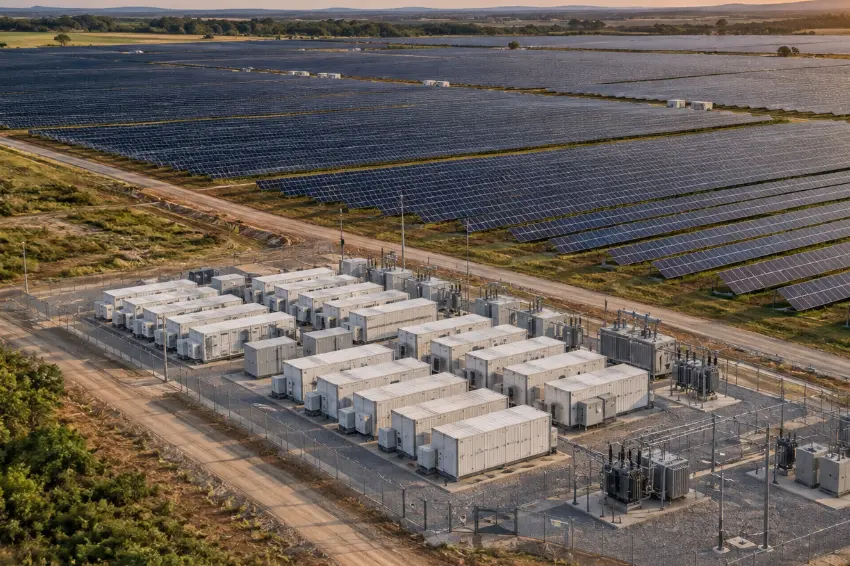
In this article, I move on to another topic that was present in virtually all of our conversations in Australia: battery energy storage. The timing is particularly opportune to bring this discussion to Brazil.
In December 2026, the country will take an important step towards integrating large-scale energy storage into the SIN (National Interconnected System).
The first Brazilian auctions dedicated to contracting battery storage systems are scheduled for December 2nd and 4th. The adopted model is Capacity Reserve in the form of Power: autonomous storage systems will be contracted to provide power to the system, with 15-year contracts and supply starting in August 2028.
The initial market response is noteworthy. According to EPE (Energy Research Company), 6.091 projects were registered, totaling 296.807 MW of power. Obviously, registration does not mean qualification, contracting, or even that all these projects have the same level of maturity. Even so, the scale of the numbers demonstrates the existing interest in the development of this new market in Brazil.
It's a significant step forward. But one of the main conclusions I drew from the Australian experience is that contracting power may only be the beginning of the story.
Throughout meetings with universities, government, energy companies, investors, and market players, it became clear that a battery can play a much broader economic role. More than just a device that stores energy to return it a few hours later, BESS can be an asset capable of responding to different system needs and capturing different sources of value.
This may be one of the discussions that Brazil will need to face after implementing its first large-scale projects.
From battery to active power source
In Australia, our discussion about storage came up at virtually every stage of the mission, but from different perspectives.
At UNSW and CEEM (Centre for Energy and Environmental Markets), the discussion helped to place storage within a broader view of the system. The point is not simply to add batteries to the grid, but to understand what service a given resource can provide and how it interacts with generation, consumption, the grid, and the market. This difference seems conceptual, but it has important economic consequences.
A battery can transfer energy over time. It can charge during periods of abundant power generation and discharge when the system needs energy.
It can respond quickly to frequency variations. It can contribute to the integration of renewable energy sources. It can be associated with a solar or wind power plant. And, depending on existing regulations, it can participate in different markets.
It was precisely this economic dimension that emerged strongly in the conversation with Aurora Energy Research. When discussing the evolution of the Australian market, the importance of price volatility for the economics of energy storage became evident. Periods of very low prices – even negative ones – alternating with periods of high prices create opportunities for assets capable of shifting energy over time.
In this environment, the battery does not necessarily have a single revenue stream. Price arbitrage, ancillary services, and different contractual structures can combine to generate the asset's revenue. This is called revenue stacking: the ability to extract value from different applications using the same infrastructure.
The Australian experience offers concrete examples of this logic. Storage projects in that market combine arbitrage revenues with the provision of FCAS (frequency control and storage) services, showing that the asset's value can derive from different services and not just from the buying and selling of energy. This point is particularly relevant for Brazil.
The price of the battery also depends on the market.
During our meeting with Samsung C&T, storage emerged in connection with the development of energy projects and the challenges created by a grid that needs to keep pace with the accelerated transformation of the Australian energy mix. We also discussed hybrid projects, combining renewable generation and BESS (Build-Storage Energy and Solid Waste).
This combination is important because it changes the way we view the battery. It ceases to be merely an emergency response to a lack of power and becomes an integral part of the development and operation strategy of projects.
In our conversation with Aurora Energy Research, a similar provocation arose: an integrated portfolio of solar generation and storage may have a different monetization capacity than that obtained by the assets analyzed in isolation. This also led us to discuss a problem that is very well known in Brazil today: curtailment.
Batteries, of course, do not eliminate structural transmission constraints on their own, nor do they constitute a universal solution for generation outages. However, the possibility of storing energy at specific times and shifting its delivery over time adds a new variable to the management of these assets and the system itself.
The conclusion I draw from these conversations is that the economic value of a battery is not just in the battery itself. It is also in the design of the market in which it operates.
Software, data, and trading are also part of the asset.
Another lesson from Australia was realizing how closely digitization is linked to storage. This came up in our conversations with Kraken/Octopus and Origin Energy.
In both experiences, although from different perspectives, we saw how software, measurement, automation, and data allow for the coordination of energy resources that would previously have been managed independently.
In the case of Origin, the discussion has progressed towards aggregating different products and resources – solar generation, batteries, electric vehicles and other flexible loads – within a broader relationship between energy consumer and supplier.
At Kraken/Octopus, we saw the importance of the technological platform for coordinating these resources, using data and automation to respond to market prices and needs. This logic also applies, on a different scale, to large storage systems.
Deciding when to charge and discharge a battery, how much of its capacity to allocate to a given service, and how to respond to price changes becomes an essential part of the economic optimization of the asset. Therefore, a phrase that stuck with me during the mission was: BESS is not just a physical asset.
The battery is the hardware. But its value also depends on software, data, operating strategy, trading, contracts, and the rules that define which services can be provided and paid for.
The first Brazilian step
It is in this context that I consider it important to look at the Brazilian auctions in December. Brazil is starting with power. There is rationality in this choice. We are introducing a new asset class on a relevant scale and creating long-term contracted revenue for a function that the system needs.
The official design itself links the auctions to the security and reliability of the National Interconnected System (SIN), increased operational flexibility, and the integration of renewable energy sources. Therefore, I don't see the initial design as a limitation in itself. I see it as a first step.
The challenge will be to prevent the discussion about storage in Brazil from ending when the winners of the auction are known.
As the first assets come online, we will need to discuss how to enable the batteries to provide other services and be compensated for the value they actually deliver to the system.
This involves ancillary services. It involves arbitrage. It involves the interaction between storage and renewable generation. It involves the eventual participation of demand and distributed resources. It involves operating and commercialization rules. And it involves defining how different revenue streams can coexist without double remuneration for the same service. It doesn't simply mean replicating the Australian market.
This is an important caveat throughout this series of articles. Brazil and Australia have different matrices, networks, regulatory designs, and market structures. Australia should be viewed as a laboratory of solutions and problems that can help us formulate our own responses.
After the auction, the market
Perhaps the main shift in perspective is this: we shouldn't just discuss how much it costs to install a battery, but how much the flexibility it can bring to the system is worth.
These are different questions. The first auction can help make the assets viable and create scale. The operational experience of these projects will certainly yield important information for the next steps.
But a more mature storage market will depend on the ability to recognize different sources of value: power, energy, ancillary services, rapid response, renewable energy integration, and other forms of flexibility that may arise with technological and regulatory evolution.
That's what the Australian experience helped me see more clearly. In December, we expect Brazil to begin contracting batteries.
The next step will be to build a market where they can be treated not just as equipment contracted to deliver a specific product, but as assets capable of responding dynamically to the different needs of the electrical system. And perhaps that is precisely where most of their value lies.
Check out the previous articles.
From technology to system: Australia's first lesson.
The next revolution we need is not technological, it's institutional.
The energy transition is also a transformation of the grid.
The opinions and information expressed are the sole responsibility of the author and do not necessarily represent the official position of the author. Canal Solar.

Comments
Comments are moderated before publication.Comments should be respectful and contribute to a healthy debate. Offensive comments may be removed. The opinions expressed here are those of the authors and do not necessarily reflect the views of the author. Canal Solar.