
With the emergence of bifacial photovoltaic modules on the market, many users are questioning their compatibility with inverters, microinverters and power optimizers. First of all, what is a power optimizer? If you have reached this article and are not yet familiar with the subject, I recommend reading two articles:
- PVSyst: photovoltaic systems with power optimizers
- MLPE and power optimizers for photovoltaic modules.
Power Optimizer
The power optimizer is a small device connected to the output of the photovoltaic module. Due to its dimensions, and also practicality, the optimizer is physically housed behind the module, attached to the fixing structure or the frame of the module itself.
The function of the optimizer, as its name suggests, is to optimize the energy generation of the photovoltaic module. This is done through the individualization of the MPPT (maximum power point tracking) of each of the modules that make up the photovoltaic system.
Thus, the modules are decoupled and make the photovoltaic system practically immune to shadows. There are still other advantages. Even in situations without shading, the optimizers reduce the so-called power “mismatch”, which is the discrepancy between the powers of the modules connected in series.
Typically the gain obtained from reducing mismatch is around 2%. It seems little, but over the lifetime of the photovoltaic system this can represent a large amount of energy.
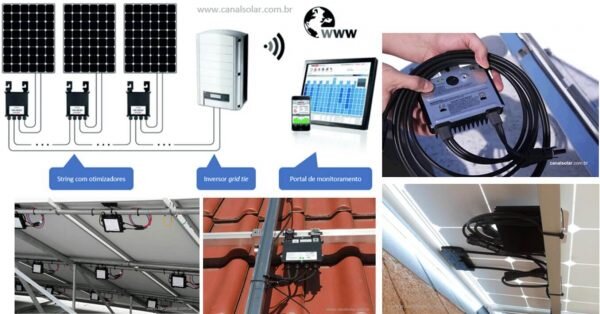
In addition to the issue of shadows and power mismatch, there is another advantage to using optimizers. With them, it is possible to form strings of modules installed in different positions, subject to different solar radiation and very different operating conditions.
This would be impossible with traditional inverters. In complex rooftops or urban installations subject to a lot of shading from nearby objects, the optimizer is a good choice for solar PV design.

And what can we say about bifacial photovoltaic modules? As the name suggests, these are modules that have two sides. Bifacial photovoltaic modules capture light through the front and back surfaces, and can have higher power and generation than conventional modules, depending on the amount of light reflected at the site.
Bifacial solar panels are most useful in solar power plants, where the module is positioned at a distance from the ground, allowing the rear surface to capture a large amount of light reflected by the ground. On roofs, bifacial modules can provide some performance improvement in installations with metal tiles or, especially, in structures sloping over slabs.
The following tables show the electrical characteristics of bifacial modules from the manufacturer Risen Energy, with nominal peak powers from 435 W to 455 W. Every photovoltaic module is specified under STC conditions (25 °C and 1000 W/m2). Traditional solar panels will always have performance equal to or lower than that shown in the STC table in the data sheet.
Bifacial photovoltaic modules, due to the additional capture of light reflected by the ground, can have a “bifaciality gain”, according to which the power, current and operating voltage will be higher than those specified in the STC characteristics table. This means that a module with a nominal power of 450 W can, in practice, operate as a 585 W module if we consider a bifaciality gain of 30%, as the following table shows.
Electrical characteristics tables for Risen RSM144-7-435BMDG-455BMDG modules

The question of compatibility
With the gain of bifaciality, the electrical characteristics of photovoltaic modules are increased, as we mentioned above. This requires special care when specifying other components of photovoltaic systems, including power optimizers.
SolarEdge, the leading manufacturer of power optimizers, issued the technical note “Application Note – Compatibility of bi-facial modules with SolarEdge power optimizers” in January 2020, which describes the correct method for selecting power optimizers for use with bifacial modules .
The correct selection of the optimizer depends on the electrical characteristics of a given module. When designing a solar system with bi-facial modules, it is challenging to estimate the generation gain added by the back of the modules, especially due to the non-uniformity nature of the ground-reflected irradiance.
The gain of reflected light is highly influenced by various conditions, such as geographic location, temperature, tilt of the modules, surface area behind the modules, and so on. In order to provide design flexibility and support a range of modules, SolarEdge power optimizers include a feature that is capable of handling the wide range of current and power expected from a bifacial module, even in extreme cases such as those mentioned above.
When using bifacial modules, SolarEdge allows you to select optimizers that support the maximum power, current and voltage of the modules, considering the front electrical values (in STC) informed in the modules' data sheet.
It is important to note that the optimizer warranty may be void if the power, voltage or current of the selected module in STC (without considering bifaciality gain) is above the specifications of the selected optimizers.
When designing a system (manually or using a sizing tool) it is important to always make the optimizer characteristics compatible with the output characteristics of the photovoltaic module in STC declared in the module data sheet, without considering the power gain caused by nature. bifacial module.
In other words, you should design the system as you have always designed it, even though the module may actually exceed the rated power, current, or voltage due to reflected light collection. Optimizers will be prepared to handle the gain from bifaciality as long as the optimizer selection is made according to this basic guideline.
Sizing example
Bifacial Module Specifications
- Power in STC (with 0% bifacial gain): 400 W;
- Power in STC (with 30% bifacial): 520 W;
- Open circuit voltage at STC: 49,7 V;
- Short-circuit current in STC: 10,22A;
- Current thermal coefficient: 0,03 [%/°C];
- VOC stress thermal coefficient: -0,27 [%/°C].
Optimizer to be selected (considering two modules in series)
- Model (family): P850-4xxxxxx, serial number SJ5019A-xxxxxxxx;
- Maximum power = 850 W (greater than 2 x 400 W = 800 W);
- Maximum input voltage = 125 VDC (greater than 2 x 49,7 V = 99,4 V);
- Maximum input current = 12,5 ACC (greater than 10,22 A).
Selected inverter
- Output power (AC): 25 kW.
Design Considerations
- Maximum string power: 15,75 kW (for a 230 V to 400 V network);
- Maximum input power (DC) of the inverter in STC (135% oversizing): 33,75 kW;
- Maximum number of modules in the string: 15,75 kW / 400 W = 39 (20 power optimizers);
- Maximum number of modules connected to the inverter: 33,750 kW / 400 W = 84 (42 power optimizers).
Note: The above example was taken from the document “Application Note – Compatibility of bi-facial modules with SolarEdge power optimizers”. Please check with your local supplier to check the availability in Brazil of the models mentioned in the example and to check the compatibility of other models.
Conclusion
The power gain provided by bifacial modules can typically reach 30% over the nominal power value of the module. When dimensioning a bifacial module project with power optimizers, it is important to initially ensure that the optimizer characteristics match the characteristics of the photovoltaic module in STC as reported in the catalog (without considering the bifaciality gain).
This basic rule ensures the integrity of the project and prevents the loss of the optimizer's warranty. Following the basic rule, as shown in the example case study, the optimizer is dimensioned with a slight power slack. The same occurs with the total power of the inverter, which in this example was dimensioned 35% above the nominal power of the modules in STC.



Comments (3)
Comments are moderated before publication.Comments should be respectful and contribute to a healthy debate. Offensive comments may be removed. The opinions expressed here are those of the authors and do not necessarily reflect the views of the author. Canal Solar.
Good morning! I don't understand one question: If the selected inverter was 25 kW, and at its input 35% above its capacity (which is that of the modules), then it has no power gap, as said... Could you clarify? Thanks.
When we talk about bi-facial modules, I think it is important to make it very clear that they are a technology designed specifically for soil plants. As suggested in the article, they could even be used on slabs or metal roofs that have inclination correction, but knowing the reality of installations in our country, correcting inclination on roofs, in the vast majority of cases, does not make much sense.
Modules with different power characteristics?
With optimizers.