
Article published in Magazine Canal Solar – Vol. 1, No. 1, December/2020
Thin-film technology is not new to the Brazilian solar market. However, it is still little known and has been largely unexplored. One interesting application for thin films is the manufacture of... photovoltaic tilesOne example of this is Hantile, a photovoltaic tile manufactured using CIGS (copper, indium, gallium, and selenium) technology and distributed in Brazil by [Company Name]. L8 Energy.
CIGS film tiles have advantages over other types of tiles introduced on the market, which are based on conventional crystalline cells.
Film technology allows for better use of roof tile area, provides immunity against shadows, offers better aesthetics, and also has the advantage of a reduced thermal coefficient. thin films in relation to crystalline silicon, among other advantages that we will mention below.
The use of photovoltaic tiles with CIGS film is an evolution that presents itself as a better solution for some applications than traditional silicon modules. The main advantages of CIGS film include:
- Its appearance is homogeneous and aesthetically attractive;
- It is very light and easy to install;
- It is flexible: it adapts to curved surfaces, allowing the generation of solar energy on surfaces not suitable for traditional rigid silicon panels;
- High temperatures and shading from trees and other obstructions have less impact on thin film performance;
- There is no major loss in energy production due to the angle of incidence of solar rays.
- Tiles made from films are resistant to natural disasters (winds, hailstorms and impacts from debris);
- They do not suffer from microcracks, a common problem that affects crystalline cells.
Despite their higher cost and reduced efficiency, photovoltaic modules and CIGS film tiles are gaining market share due to their versatility and superior performance in some situations.
Crystalline silicon modules do not perform well in places with a lot of diffuse radiation (where there is no direct incidence of light), on building facades and on roofs that are heavily affected by shadows.
Furthermore, the relatively higher cost of CIGS devices can be offset by the use of tiles and modules integrated into the architecture, eliminating the need for conventional roofs and architectural elements. Since it is still a new product in Brazil, there are many questions about the performance of CIGS film photovoltaic tiles:
- To what extent is the efficiency actually lower than that of a crystalline module?
- How is the energy generation of a roof covered with CIGS film compared to a roof with conventional modules?
- And the advantages that CIGS tiles bring, such as low impact at high temperatures and the issue of shading?
- In general, how does a CIGS tile perform?
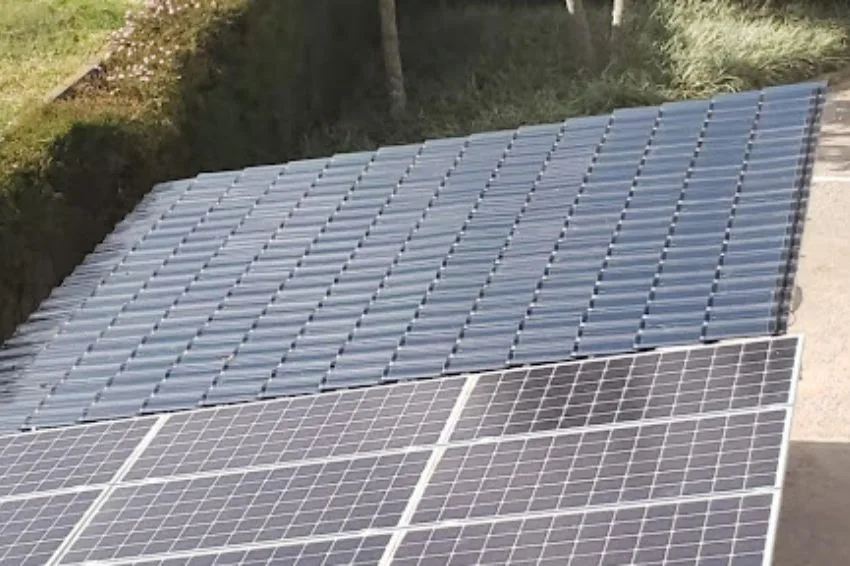
To answer many of these questions, we constructed two carports (Parking canopies) with the same dimensions, each with two parking spaces. One of them was covered with traditional crystalline silicon modules, while the other received CIGS film photovoltaic tiles.
O carport 1 we will call the one with traditional modules. It used 15 monocrystalline modules of 375 kWp from the manufacturer QCELLS and a UNO DM 5.0 inverter from the manufacturer ABB.
The total power output is 5,625 kWp. Carport 2 is the one that received the CIGS solar tiles. 98 solar tiles of 30 Wp each were used, along with an ABB UNO DM 3.3 inverter. Its total power output is 2,94 kWp.
In principle, there is no interference regarding the inverter's power cutoff capacity in energy production. Neither of the two sets of modules or tiles reaches the inverter's power limit.
Both covers face northwest, at a 10-degree angle. What we can initially observe is that the thin film has reduced power per area. This is a reflection of the lower efficiency, i.e., it takes much more area to have the same power with CIGS film than with crystalline devices.
At the same time, we can highlight one of the advantages of thin-film roofing: aesthetics. Without a doubt, tile roofing is very attractive, in addition to providing perfect watertightness against rainwater. However, what interests us most in this study is energy production.
At this point, we want to evaluate the performance of a photovoltaic roof with CIGS film under real operating conditions, especially with regard to the influence of the angle of incidence of the sun's rays and the issue of shading.
Operation under diffuse radiation and shading

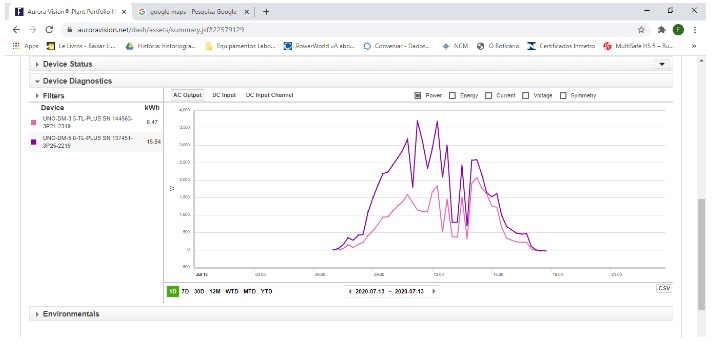
We can clearly see the issue of shading when we check energy production on cloudy days or in locations with a lot of shade. In systems with the same technology but different power outputs, we expect the shading effect to be felt proportionally in both.
The results obtained reveal, however, that the crystalline modules suffer a much greater impact when there is no incidence of direct solar irradiation.
In the graphs below we can see that, despite having almost twice the nominal power, under the study conditions the crystalline modules presented practically the same performance as the CIGS tiles, which have much lower power.
In the graphs presented, it is possible to observe that CIGS film tiles maintain their performance in any type of cloudy condition or time of day. There was a significant reduction in the incidence of solar irradiation due to strong clouds on 12/04 and 17/07.
CIGS tiles had their power reduced in proportion to the intensity of sunlight, while crystalline modules suffered a brutal reduction and had their operating power practically equal to the power of the tiles.
Behavior of CIGS film photovoltaic tiles
This study, although not scientific in nature, demonstrated very interesting results about the behavior of CIGS film photovoltaic tiles. The main observation of this study is that a set of 2,94 kWp CIGS tiles can generate as much energy as a set of 5,625 kWp crystalline modules under certain conditions.
Having a high-power crystalline photovoltaic system is not always a guarantee of optimal performance. CIGS film photovoltaic tiles, despite their reduced efficiency (which translates to lower power per area), can deliver high generation over time.
This is especially true on roofs subject to shadows, facades that do not receive direct light or systems installed in locations with high cloud cover throughout the year.
We cannot forget that temperature is also a factor that must be considered in energy production, which was not evaluated in this study. It is known that thin-film modules perform better at high temperatures compared to crystalline modules.
This may partially explain the superior performances of photovoltaic tiles observed in the graphs presented, especially in the afternoon.
Our aim in this study was to show that there are advantages to using thin films and that these advantages are real. Although they have reduced nominal power and efficiency, their real-world performance can be surprisingly good.
Photovoltaic modules, like roof tiles, are tested and specified in laboratory conditions that do not reflect the multitude of real operating conditions of temperature, solar irradiation and angle of incidence of solar rays.
We cannot say, however, that the advantages of CIGS tiles are sufficient to provide superior financial returns when comparing thin film and crystalline silicon technologies.
What we have to keep in mind is that the thin film brings enormous advantages in some types of systems where the use of traditional modules proves to be unfeasible, such as photovoltaic tiles.
The thin film did not come to replace the crystalline silicon module, but to be an additional option for the market, proving to be attractive for many applications in which crystalline modules may not be the best choice from an aesthetic and architectural point of view.



Comments
Comments are moderated before publication.Comments should be respectful and contribute to a healthy debate. Offensive comments may be removed. The opinions expressed here are those of the authors and do not necessarily reflect the views of the author. Canal Solar.