

Updated October 15, 2025
In photovoltaic systems, SPDs (Surge Protection Devices) are essential to ensure equipment safety against electrical discharges. For them to operate effectively, they must be properly sized. In this article, you'll learn how to calculate the surge current a SPD must withstand, according to technical standards and the most common technologies on the market.
What is a DPS?
A SPD (surge protection device) must conduct high-intensity, short-duration currents, diverting them away from the part of the installation it is designed to protect. After operating during a surge, the surge protection device must return to its initial high-impedance state, when ideally it does not conduct any current. Surge currents are divided into:
- Discharge impulse current for class I SPD tests: IIMP corresponds to the peak value of a discharge current that passes through the SPD with a specific charge transfer Q and a specific energy W/R during a specified time. Normally IIMP corresponds to a wave in the form 10/350 µs;
- Nominal discharge current for class II SPD tests: IN corresponds to the peak value of a current passing through the SPD with an 8/20 µs waveform.
It is very important to differentiate the technology of the surge current for the DPS. Surge protection devices based on spark gaps or diodes conduct an infinite number of surge currents without degrading. Therefore, they are specified with only one current.
Varistor-based SPDs (Figure 1) conduct the surge current a few times before they degrade. That is why they are specified with two currents:
- IMAX → Maximum current, corresponds to the current value that the DPS (varistor) can conduct twice before completely losing its useful life.
- IN → Nominal current, corresponds to the current value that the DPS (varistor) can conduct 20 times before completely losing its useful life.

Therefore, when specifying a SPD that uses a spark gap or diode, it is sufficient to indicate the intensity of the current that it can conduct. However, when specifying a surge protection device that uses a varistor, it is necessary to indicate the value of the nominal current and the value of the maximum current, or at least not write only I = X kA, but rather IN = X kA or IMAX = X kA.
In addition to the impulse current and the nominal surge current, there are other currents that will be mentioned here for information only:
- Subsequent current IF: peak current supplied by the power supply network and which passes through the DPS after a discharge current impulse. This current can be considered something similar to a leakage current. It is not calculated because it is undesirable, and it is up to the DPS to interrupt it;
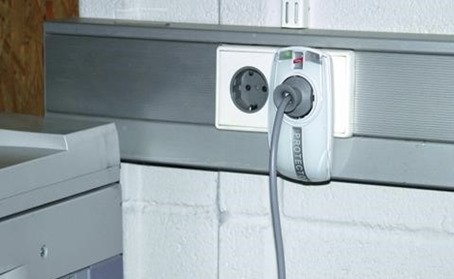
- Nominal load current IL: maximum effective value of the permanent current that can supply a resistive load connected to the protected output of a SPD. The nominal load current is normally specified for class III SPDs, because they are in series with the protected equipment (Figure 2). So if we want to protect a television, for example, the IL of the class III SPD at the television outlet will be equal to the current consumed by the TV multiplied by a safety factor.
Example: Class III DPS to protect a notebook:
1 notebook = 5A I L DPS = 5A X 1,1 = 5,5A
Impulse current calculation for class I DPS
Class I SPDs conduct a portion of the lightning current that tends to enter the building. Determine the SPD level:
Level I = 200 kA Level II = 150 kA Level III / Level IV = 100 kA
Half of the current that flows down through the sensors of the SPDA for grounding returns to the installation through a remote grounding system, power, signal, metal pipes (Figure 3).
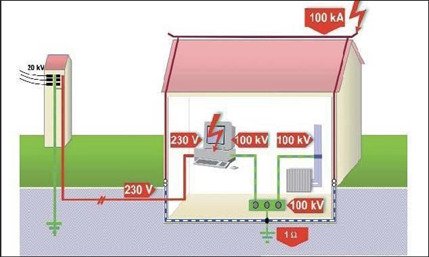
Current returning to the installation:
50% of the current returning at Level I = 200 kA / 2 = 100 kA
Level II = 150 kA / 2 = 75 kA Level III / Level IV = 50 kA
Each class I surge protection device needs to conduct the portion of the current that returns through it. Therefore, considering only the power SPDs, the returning current is divided by the number of phases and the neutral. The neutral, even if grounded, conducts the surge current through it.
Example: Three-phase system with grounded neutral at the input, in a building with SDPA level I protection:
- Level I = 200 kA
- Return to the building: 100 kA
Phases with neutral will conduct:
- 100 kA / 4 = 25 kA
So we need three class I SPDs with IIMP = 25 kA. Since the neutral is grounded at the input, we will not need a class I SPD for the neutral. If the option is a class I spark gap SPD, its current will be 25 kA.
If the option is a DPS class I varistor, its current will be:
IN = 25 kA (10/350µs) or IMAX = 25 kA (10/350µs)
In the first case:
IN = 25 kA (10/350 µs) and IMAX = 50 kA (10/350 µs).
In the second case:
IN = 12,5 kA (10/350 µs) and IMAX = 25 kA (10/350 µs)
To the DPS For signal surge protection devices, the calculation would be more complex because there are numerous types of signal SPDs. Experience shows that it is not necessary to calculate the current of the signal SPD, because each manufacturer provides one or two models at most of class I surge protection devices for signal. Therefore, it makes no sense to calculate the current as, for example, 8,7 kA (10/350 µs), if the models used have a current specification of 15 kA (10/350 µs).
Current calculation for DPS class II or III
The induced currents that may appear for a class II or III surge protection device depend on numerous factors, such as:
- Original lightning current intensity;
- Design of cables within the installation;
- Distance between the point of impact and the frame where the DPS is.
Therefore, what is done is to estimate that the surge currents have an intensity between 1 kA (8/20 µs) and 10 kA (8/20 µs). From a practical point of view, the recommendation is that the following values should be used for class II or III DPS:
- DPS with spark gaps and diodes (used in class III DPS): enough IN;
- DPS with varistors, normally those used as class II: we need to clearly indicate whether we specify IN or IMAX, even better if we indicate both;
- It must be very clear that the current value does not depend on the type of SPD (spark gap, varistor or diode). The current value is what will appear on the board that must be protected during the occurrence of the surge.
general recommendations
Class II DPS
Small facilities (shops, offices, apartments, etc.). Places where cables are relatively short in length, small induction loops:
IN = 5 kA or 10 kA (8/20µs) – if it is a varistor IMAX will be double.
Larger installations (industries, houses, shopping centers, industries). Locations where cables are relatively long and have significant induction loops:
IN = 20 kA (8/20µs) – if it is a varistor IMAX will be double
Class III DPS
For a class III surge protection device, a nominal current of:
IN = 5 kA, maximum IN = 10 kA
Conclusion
By understanding the different forms of surge current and how they impact SPD devices, it's possible to design safer and more durable photovoltaic systems. To learn more about this topic, check out our course on solar system protection or read also: How to know if your DPS needs to be replaced.



Comments (4)
Comments are moderated before publication.Comments should be respectful and contribute to a healthy debate. Offensive comments may be removed. The opinions expressed here are those of the authors and do not necessarily reflect the views of the author. Canal Solar.
What is the main function of a Surge Protection Device (SPD) in an electrical or solar installation?
Good Morning!
Very good explanations about DPS. I understand that the main reference is the discharge current, as it will trigger related information: NP, Protection Class and other guiding parameters for the selection and appropriate choice of the DPS for the protection and safety of electrical and electronic installations installed inside the building.
Thank you very much for the information.
Hug.
Your approach is very good….simple and direct….congratulations
Hi, my name is Douglas and I'm an SPDA inspection technician. I thought the content was great. Congratulations, and thank you for clarifying some doubts.