
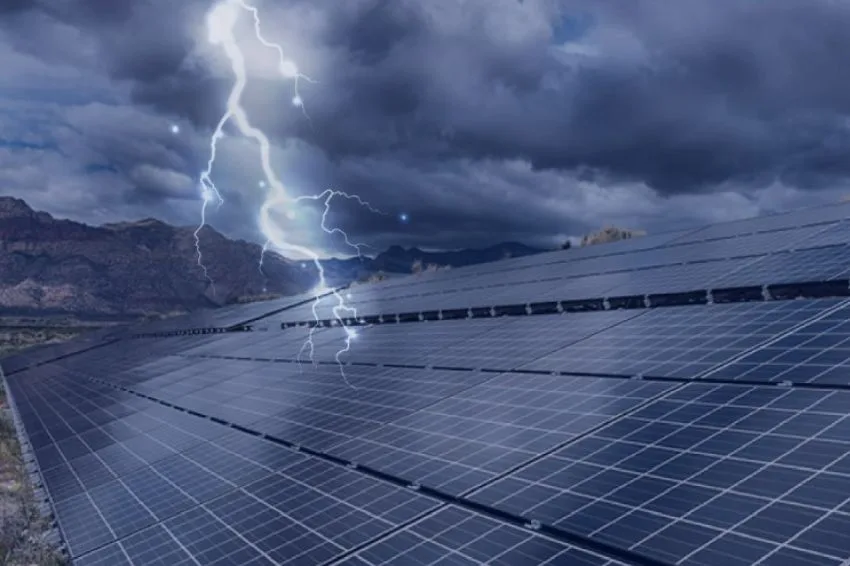
Brazil leads the world ranking in lightning strikes, with approximately 78 million electrical discharges per year, according to [source missing]. INPE (National Institute for Space Research).
This scenario has motivated companies and experts to reinforce protection measures in photovoltaic systems, especially in large power plants.
One of the most efficient solutions is... DPS (Surge Protection Devices), which divert impulse currents caused by lightning strikes or switching surges, preventing damage to inverters, modules and other equipment.
Recent studies from the University of Pernambuco, in partnership with... CLAMPERStudies show that the use of surge protection devices (SPDs) in photovoltaic systems can divert more than 93% of surge energy on the direct current side and more than 99% on the alternating current side.
Inverters without surge protection devices (SPDs) withstood fewer than eight Class II pulses, while those with protection withstood more than 100 pulses, significantly increasing their lifespan.
In addition to the installation of surge protection devices (SPDs), the protection of power plants may include lightning protection systems (LPS) and surge protection measures (SPMs), according to risk analysis following technical standards such as ABNT NBR 5419:2015 and... ABNT NBR 16785: 2019.
These systems reduce risks to human life, power outages, and economic losses.
Lightning strikes can induce voltages and currents up to 2 km away, making large areas of power plants vulnerable.
Therefore, the use of lightning rods, shielding of metal structures, proper grounding, and warning systems for evacuating employees during storms is recommended, according to the results of the risk analysis performed for each facility.
Technical analysis
Experts emphasize that the complete protection of a photovoltaic plant depends on the planning of the entire system, including modules, cables, grounding, and protection devices, and is not limited to just the installation of surge protection devices (SPDs).
With the growth of the solar sector, these measures become essential to preserve equipment, guarantee continuity of supply, and reduce financial losses. According to Lais Andrade, Senior Engineering Analyst at CS Consultoria:
“Failure to use adequate lightning protection measures can cause financial losses, especially to the most exposed and sensitive equipment, such as CCTV cameras. In these cases, to mitigate the constant burning out of such equipment, it is recommended to adopt a power supply isolated from the grid and the power plant, such as a system with batteries and some photovoltaic modules specifically for CCTV.”
all the content of Canal Solar is protected by copyright law, and partial or total reproduction of this site in any medium is expressly prohibited. If you are interested in collaborating or reusing part of our material, please contact us by email: redacao@canalsolar.com.br.


Comments
Comments are moderated before publication.Comments should be respectful and contribute to a healthy debate. Offensive comments may be removed. The opinions expressed here are those of the authors and do not necessarily reflect the views of the author. Canal Solar.