
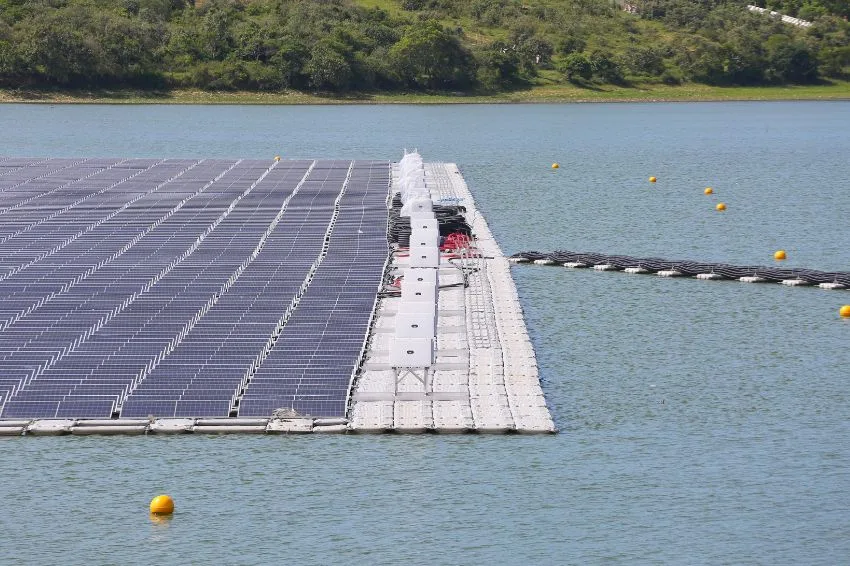
The second phase of EMAE's (Empresa Metropolitana de Águas e Energia) floating solar power plant installation program is expected to enter commercial operation between the end of 2025 and the beginning of 2026.
The start of the works depends only on the release of the license by Cetesb (Environmental Company of the State of São Paulo). The new stage will not focus on the expansion of Brazil's first floating solar plant – the Araucária plant, with 5 MW ac (7 MWp) capacity, in operation since May 2024.
The option now is to implement three new units – each with 2 MW ac totaling 6 MW ac – in different locations in the Billings reservoir, all to be connected to points on the electrical grid of the distributor ENEL São Paulo, whose access opinions are already guaranteed.
The investment planned for these three additional units is estimated at R$30 million – an amount equal to that allocated to Araucária, which cost a little more in relation to its final capacity due to fixed costs that will now be diluted in the expansion of the park.
Expansions
The Araucária project was implemented by Sunlution, a company linked to KWP Energia, one of EMAE's partners in the park. The plant has 10,5 photovoltaic panels, each with 665W ac, mounted on French technology floats.
When fully completed, the Billings complex should reach 130 MW ac of installed power, at a cost of around R$600 million, according to calculations by Gustavo Nasser, director of Finance, Strategy and Institutional Relations at EMAE.
EMAE currently holds a 5% stake in the entire project, which is being run in partnership with KWP Energia, the current owner of the majority stake of 95%, together with the trading company Comerc Energia. The idea, according to Nasser, is for EMAE to increase its presence to at least a 49% stake.
Araucária's production, classified as distributed generation (DG) for self-consumption, was fully negotiated in long-term contracts with large companies. Banco Santander purchased 3 MW ac and Raízen, part of the Cosan Group, acquired 2 MW ac, which will be supplied to the OXXO chain of convenience stores.
Nasser does not hide his optimism about the future prospects of the project, whose first steps were taken during the state-owned phase of the company. Araucária's performance, he highlights, is considered quite positive, with a capacity factor higher than initial estimates.
The prospects for expanding the park beyond the planned 130 MW ac are the best possible, he points out. The current configuration will occupy only about 0,7% of the total area of the Billings reservoir, an EMAE asset that feeds the Henry Borden hydroelectric plant, with almost 900 MW installed.
“All electrical security for São Paulo, the largest load center in the Southeast, is very welcome and we are positioned in a strategic location in the metropolitan region”, explains the director of EMAE.
1 GWp under negotiation
Ediléu Cardoso, CEO of KWA Energia, says that the floating solar power plant segment is booming in Brazil. The company belongs to the holding company KWApar, which also controls Sunlution and CTBM, the exclusive licensee for Brazil of the French company Ciel et Terre. holder of the technology of the floats used in Araucária and which will also be used in the expansion works of EMAE.
According to the executive, there is around 1 GWp being negotiated at the moment, involving large players of the power generation and sanitation sectors. This expectation of greatness already existed even before the consultancy PSR released a recent report in which it points out that the installation of floating solar plants on just 1% of the surface of Brazilian hydroelectric reservoirs could add up to 38 GW of capacity to the national matrix.
“The PSR study helped to intensify consultations, but interest in the modality grew a lot, for several reasons. Hydroelectric and sanitation companies, for example, do not need to pay for concessions to install floating solar plants in their reservoirs, therefore taking advantage of the possibility of investing in a second source of revenue”, explains Cardoso.
The proximity of reservoirs to large load centers, he points out, is another key point. Metropolises do not have large areas available for the installation of solar plants, which makes dams very strategic sites.
Furthermore, Cardoso points out, when installed over water, floating solar plants reduce the evaporation rate, have slightly better performance due to slightly lower temperatures and are also less affected by accumulated dust, a common problem in plants installed on land.
Another important point, according to the executive, is that technology has evolved significantly. Current floats are in their 4th generation. “Today, there is 30% less plastic to support 40% more capacity in panels, diluting costs,” he explains.
Itaipu Binational
KWP Energia, through Sunlution, is also present in the works to implement a floating solar plant on the lake of the plant. Itaipu Binational, together with the Paraguayan company Luxacril.
Construction work is already underway and the project foresees an initial plant with a capacity of 1 MWp. 1.568 JA Solar modules will be installed, each with 705 Wp and 22,7% efficiency. The area to be occupied is estimated at 7 to 10 thousand square meters, on the Paraguayan side of the plant.
The deadline for the execution of the service is 150 days, according to the contract. An additional 180 days will be added for technical assistance, training and final acceptance of the project. Operation is expected to begin in March 2026. The energy generated will meet the demand of Itaipu's offices.
According to an estimate from Sunlution, just 10% of the reservoir's water level would be enough to install a solar plant with 14 thousand MW of installed capacity, in other words, a new Itaipu.
all the content of Canal Solar is protected by copyright law, and partial or total reproduction of this site in any medium is expressly prohibited. If you are interested in collaborating or reusing part of our material, please contact us by email: redacao@canalsolar.com.br.





Comments
Comments are moderated before publication.Comments should be respectful and contribute to a healthy debate. Offensive comments may be removed. The opinions expressed here are those of the authors and do not necessarily reflect the views of the author. Canal Solar.