

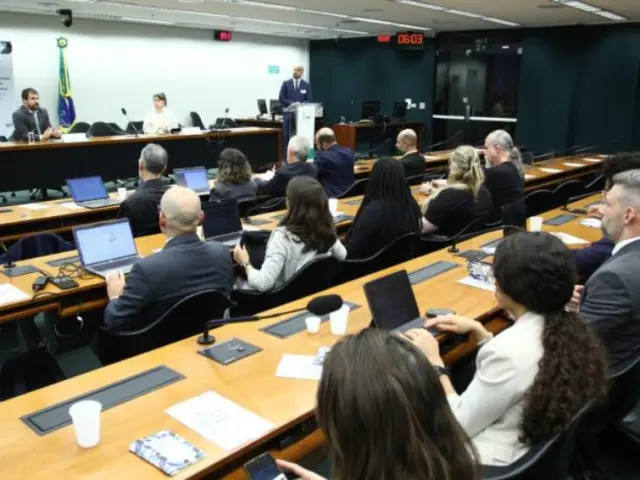
FREPEL (Joint Parliamentary Front for Clean Energy) held a luncheon debate in Brasília on Wednesday (20) to discuss strategic issues facing the Brazilian electricity sector. The meeting brought together parliamentarians and business leaders around three central themes: Provisional Measures 1.300 and 1.304, the curtailment phenomenon, and the prospects for battery-based energy storage.
The meeting was supported by Inel (National Institute of Clean Energy) and brought together public and private representatives committed to promoting an increasingly clean, sustainable and competitive energy matrix for the country.
The event was attended by parliamentarians engaged in the energy transition agenda. Invited experts presented diagnoses and proposals, followed by a discussion among attendees.

Representative Lafayette de Andrada, president of FREPEL, expressed concern about the progress of provisional measures that address the modernization of the sector's regulatory framework.
According to him, there are doubts about the processing of the measure, which is at risk of expiry, since its validity ends on September 17. Andrada explains that PM 1.304 tends to accumulate the central points of the previous proposal.
"MP 1.300 is an urgent issue that concerns the entire electricity sector, as it profoundly changes the sector. We also have MP 1304, which tends to accumulate the central points of MP 1.300. This requires increased attention and coordination from Parliament," he said.
The congressman also highlighted that FREPEL presented a set of amendments to the two provisional measures. "They are the same amendments, all aimed at protecting Law 14.300, the legal framework for distributed generation and responsible for driving DG (distributed generation) in Brazil. These actions preserve Law 14.300 and the spirit that gave rise to it," he noted.
Lafayette de Andrada also noted that the country cannot allow billion-dollar investments in solar and wind energy to stagnate due to a lack of adequate regulation. "It is urgent that we address the curtailment problem, which threatens confidence in the sector and harms consumers and investors,” he added.
Along the same lines, the president of Inel, Heber Galarce, criticized the lack of initiative by the MME (Ministry of Mines and Energy) in conducting MP 1.300 and presented to the parliamentarians present the current situation of the sector with the challenge of addressing the issue of curtailment, which has already generated losses of almost R$3 billion in wasted energy.
About to expire in Congress, the electricity sector's provisional measure worries representatives
"The Brazilian government invites business partners and attracts investment, but when they do join, they suffer attrition rates as high as 58%. This makes any business unviable. While less relevant issues have been resolved, this issue, which is central to the sector, remains open," he highlighted.
Galarce emphasizes that the bottleneck is seriously damaging the country's image in the global market. "If we don't resolve it, no one will invest in Brazil anymore. We need to moralize the curtailment and compensate the large groups that believed in the country," he added.
energy storage
Leandro Vicente, director of planning at Inel's Solar Energy Secretariat, highlighted the importance of energy storage, which he considers to be the new frontier for the Brazilian electricity sector. He explains that batteries were created to store energy produced and use it when needed, ensuring system stability and avoiding waste, as in many cases, clean energy is wasted due to lack of storage, and investments already made are underutilized.
Vicente suggested that parliament act to regulate energy storage. According to him, the lack of clear rules jeopardizes the creation of a market that could generate jobs, revenue, and infrastructure. "Without a specific regulatory framework, Brazil loses investments and fails to fully utilize its installed renewable generation capacity," he commented.
For him, storage is the heart of Brazil's new energy market. "It's the backbone that can ensure system stability, open doors for new investments, and drive the country's economic and social development," he added.
Throughout the meeting, the parliamentarians present emphasized the importance of FREPEL as a forum for dialogue and coordination between Parliament, the productive sector, and society. According to them, the goal is to ensure that Brazil advances in building a cleaner, more competitive, and safer energy matrix.
Deputy Altineu Côrtes, Vice President of the Chamber of Deputies, highlighted Brazil's potential and progress in renewable energy sources, but highlighted the bottlenecks and obstacles that hinder its development, such as the lack of legal certainty for investors in the sector in the country.
"If we look back 15 years, the transformation and the level that energy production has reached is impressive. But we are also ashamed to see dishonest and irresponsible practices, such as the breach of contracts—a truly absurdity. This isn't about political ideology, but about seriousness. No government can disrespect signed contracts," he emphasized.
The congressman considers the issue of energy storage to be emblematic. "We need to translate existing technological solutions into concrete words and legislative proposals, so that parliamentarians can firmly champion this cause. This effort will help strengthen FREPEL and solidify Brazil's position as a leader in clean energy," he concluded.
elementor-template id=”562104″
all the content of Canal Solar is protected by copyright law, and partial or total reproduction of this site in any medium is expressly prohibited. If you are interested in collaborating or reusing part of our material, please contact us by email: redacao@canalsolar.com.br.


Comments
Comments are moderated before publication.Comments should be respectful and contribute to a healthy debate. Offensive comments may be removed. The opinions expressed here are those of the authors and do not necessarily reflect the views of the author. Canal Solar.