
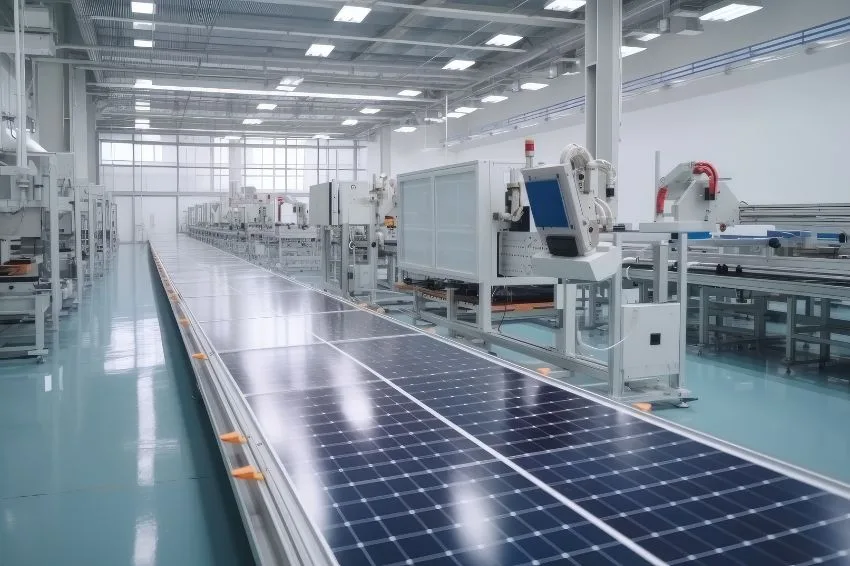
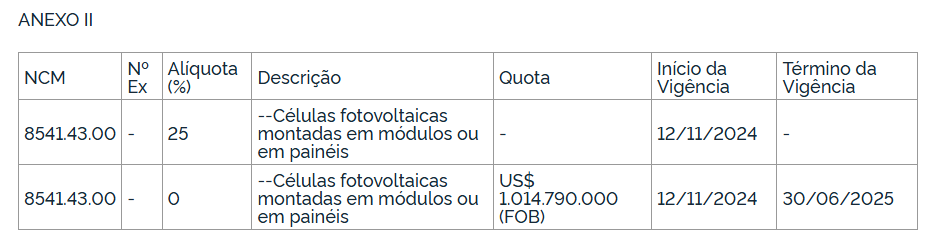
The Federal Government published in the DOU (Official Gazette of the Union) this Wednesday (13) the Gecex Resolution No. 666, which increases the import tariff on photovoltaic modules from 9,6% to 25%. The new rate officially comes into effect today throughout the country.
The decision to increase import tax, as reported yesterday by Canal Solar, was taken at the 220th Ordinary Meeting of Gecex. According to the department, the objective is to value the national industry.
According to the MDIC (Ministry of Development, Industry, Commerce and Services), the decision is a response to two requests to increase the standard rate for solar modules classified under the NCM (Mercosur Common Nomenclature) code 8541.43.00.
The requests for changes were filed by two national manufacturers and, after recommendations from the Tariff Changes Committee, were deliberated and the increase in import tax was approved by Gecex.
The measure refers to photovoltaic cells mounted on solar panels, that is, already assembled photovoltaic modules, commonly used in projects. GD (distributed generation) and GC (centralized generation).
With the change, the impacts on equipment taxation represent additional costs to solar energy projects, since the national market is, in its essence, almost entirely made up of imported products.
Read also How should solar panels be cleaned?
Quotas for importers
According to the document, some companies importing photovoltaic modules will still be able to access the exemption from this rate through a quota of around US$ 1.014.790.000 until June 30, 2025.
This quota, established by Gecex-Camex, will end on the final date of its validity or until the remaining balance of the original amount is consumed in its entirety, as explained by Wladimir Janousek, Secretary of Industry and Commerce at INEL (National Institute of Clean Energy).
“This value takes into account imports already made under the quota regime since July 1st. In the last update released by DECEX on October 24th, the remaining balance of the quota was US$ 509.370.574,00”, he commented.
controversial speech
The controversial decision by the Federal Government takes place during COP 29, a global event in which leaders and representatives from around the world meet to seek solutions for reducing greenhouse gas emissions.
While the conference aims to reinforce commitments to a greener economy, the Brazilian government makes a decision that will impact the solar energy market, one of the main vectors for a clean and affordable energy transition in the country.
In addition, the G20 Leaders' Summit is scheduled for November 18 and 19, 2024, and will take place in Rio de Janeiro (RJ), with Brazil as its chairman and the participation of representatives from the world's main economies.
The G20 agenda includes topics of interest to the world's population, such as trade, sustainable development, health, agriculture, energy, the environment, climate change and the fight against corruption.
With this measure, Brazil's position as one of the leaders in the adoption of renewable energy and in the energy transition may be questioned, as the announced increase in import tax discourages investment in photovoltaic solar generation projects.
For companies in the sector, this scenario reinforces the importance of effective communication strategies — how to advertise on Canal Solar — to increase visibility, inform the public and reinforce the commitment to sustainability process.
all the content of Canal Solar is protected by copyright law, and partial or total reproduction of this site in any medium is expressly prohibited. If you are interested in collaborating or reusing part of our material, please contact us by email: redacao@canalsolar.com.br.





Comments (5)
Comments are moderated before publication.Comments should be respectful and contribute to a healthy debate. Offensive comments may be removed. The opinions expressed here are those of the authors and do not necessarily reflect the views of the author. Canal Solar.
Well, let's get to the burning question, starting with the subtitle: “…allows some importers to have access to an exemption quota until June 30, 2025”. Who are these players?
It's not that Brazilians make jokes about everything. It's just that news like this can ruin anyone's seriousness. Brazil has been going through a "deindustrialization" since the 1990s. The situation gets worse if we look at the Mercosur and European Union (Latin America in the countryside and Europe in the factory). There is no incentive for industrialization in Brazil and the "false support" is to reinforce government revenue. Do the government realize how large the volume of labor involved in the photovoltaic segment is? Do they realize how much they will not impact, but "tie up" business, money circulation, income generation, etc.?
All of this has a huge negative impact on public and economic policies and the country's development. If viewed from the perspective of sustainability and the impacted energy matrix, it gets exponentially worse. In short...it's regrettable!
Unfortunately, the “national industry” does not have the capacity to cover even 5% of the demand…
There are undoubtedly more effective and less damaging measures (for the solar energy sector) to support the national industry.
Everyone draws their own conclusions…
Excellent measure. Incentive to national industry.
First, we create a specific national solar industry, then we tax imports to encourage this national industry that is already fully operational. This is the correct and sensible order. We do not have a national industry in this sector capable of meeting the demand in the short term. In other words, YOU, me, and the PEOPLE will pay much more if they want to have solar panels. Wake up!