
• Sat, April 25, 2026
Facebook X-twitter Instagram Youtube LinkedIn Spotify
  • GC Solar: 22,31 GW
  • GD Solar: 46,56 GW
  • advertise here
  • About us
  • Expedient
logo site solar channel
  • News
    • Market & Investments
    • International market
    • Politics & Regulation
    • Projects & Applications
    • Renewable
    • Sustainability & ESG
    • Technology & Innovation
    • Electric Vehicles
  • Articles
    • Opinion Article
    • Manufacturer's Article
    • Technical Article
  • Latam
  • Batteries
  • Blog
  • Solar Energy Companies
    • Integrators
  • Magazine
    • Magazine Canal Solar
    • Conecta Magazine
  • Consultancy
  • Courses
  • News
    • Market & Investments
    • International market
    • Politics & Regulation
    • Projects & Applications
    • Renewable
    • Sustainability & ESG
    • Technology & Innovation
    • Electric Vehicles
  • Articles
    • Opinion Article
    • Manufacturer's Article
    • Technical Article
  • Latam
  • Batteries
  • Blog
  • Solar Energy Companies
    • Integrators
  • Magazine
    • Magazine Canal Solar
    • Conecta Magazine
  • Consultancy
  • Courses
  • News
    • Market & Investments
    • International market
    • Politics & Regulation
    • Projects & Applications
    • Renewable
    • Sustainability & ESG
    • Technology & Innovation
    • Electric vehicles
  • Articles
    • Opinion
    • technicians
    • Manufacturer Items
  • Latam
  • Blog
  • Solar Energy Companies
  • Integrators
  • Magazine
    • Conecta Magazine
  • About Us
  • Advertise Here
  • CS Consulting
  • Courses
  • International market
  • News
    • Market & Investments
    • International market
    • Politics & Regulation
    • Projects & Applications
    • Renewable
    • Sustainability & ESG
    • Technology & Innovation
    • Electric vehicles
  • Articles
    • Opinion
    • technicians
    • Manufacturer Items
  • Latam
  • Blog
  • Solar Energy Companies
  • Integrators
  • Magazine
    • Conecta Magazine
  • About Us
  • Advertise Here
  • CS Consulting
  • Courses
  • International market
logo site solar channel
Home / Articles / Technical Article / Influence of the number of bypass diodes on the performance of PV panels with shadows

Influence of the number of bypass diodes on the performance of PV panels with shadows

Although the main function of the bypass diode is hotspot prevention, there is an effect on the module's performance.
Follow on Whatsapp
  • Photo by Engineering Team Canal Solar Equipe de Engenharia do Canal Solar
  • July 30, 2021, at 15:47 am
6 min 59 sec read

The problem of partial shading in photovoltaic modules, in addition to causing loss of generation, is often responsible for the appearance of hotspots (heating points) in photovoltaic cells, as illustrated in Figure 1. To avoid the hotspot effect, manufacturers add bypass diodes in parallel with a set of photovoltaic cells. In most commercially available modules there are three bypass diodes.

Typically, shadows cover a certain number of cells in the PV module. However, in extreme situations, localized shadows may occur on a small number of cells – in the worst case, on just one cell – which may prevent the bypass diode from working, leading to the occurrence of a hotspot.
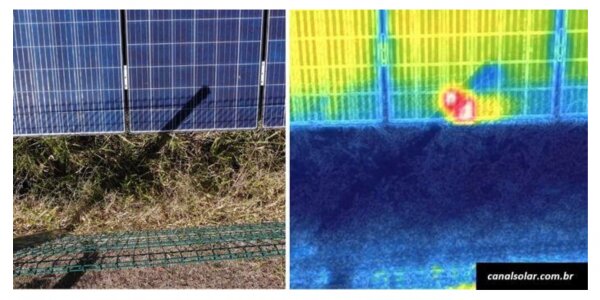
Figure 1: Effect of a shadow located on a conventional photovoltaic module

Localized shadows can be caused by obstacles such as chimneys, poles, power distribution cables or bird litter, as illustrated in Figure 2.
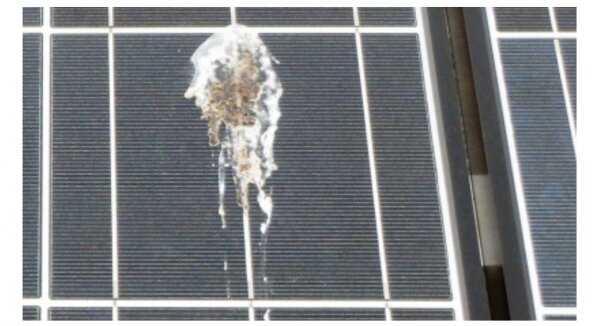
Figure 2: Frequent cause of localized shadow on photovoltaic module

Total hotspot prevention can be accomplished by adding a bypass diode to each cell of the PV module.

Although most manufacturers prefer the collective bypass diode solution (for a group of photovoltaic cells), the individual bypass diode solution (as illustrated in Figures 3 and 4) already exists commercially, having been introduced exclusively to the market. by AE Solar, a photovoltaic module manufacturer based in Germany.
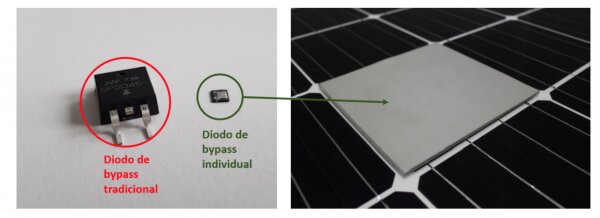
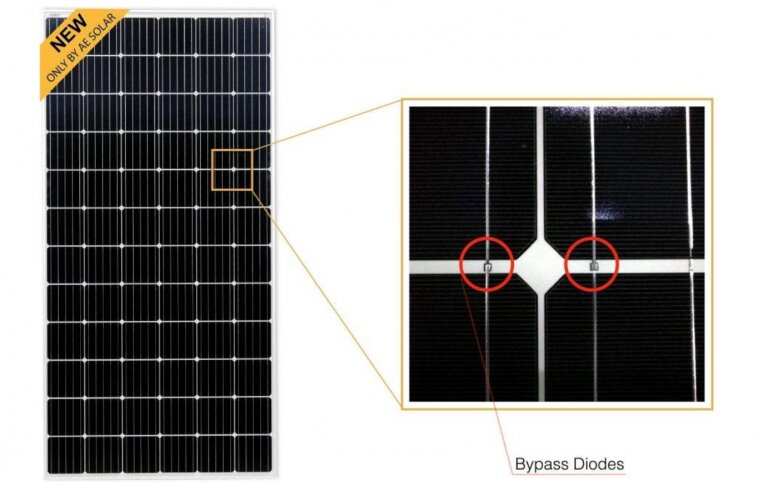
Figure 3: The dedicated bypass diode can be applied individually to the cells of a photovoltaic module. Source: AE SOlar/reproduction
Figure 4: Hotspot-free photovoltaic module from the AE Smart line, from German manufacturer AE Solar, which has a bypass diode for each cell. Source: AE SOlar/reproduction

Experimental study

A study conducted by the Fraunhofer Institute (Germany) with AE Solar modules validated the individual diode solution based on an experiment with two photovoltaic modules, one traditional (with collective diode) and the other with dedicated diode, of the hotspot-free type. The experiment was carried out by applying partial shadows over the modules by adding opaque screens over cells or groups of cells, as shown in Figure 5.

Learn more: AE Solar develops hot-spot-free and shading-resistant module
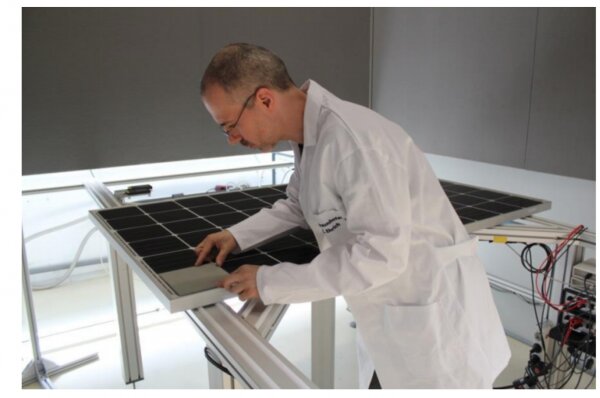
Figure 5: Partial shading experiment conducted by the Fraunhofer Institute with a hotspot-free photovoltaic module from AE Solar. Source: Fraunhofer/AE Solar/reproduction

In the experiment, three conditions were used, applied to the two types of modules analyzed:

  • Test condition 1: Shadowing of only one cell;
  • Test condition 2: Shading of a row of cells;
  • Test Condition 3: Shadowing of multiple rows of cells.

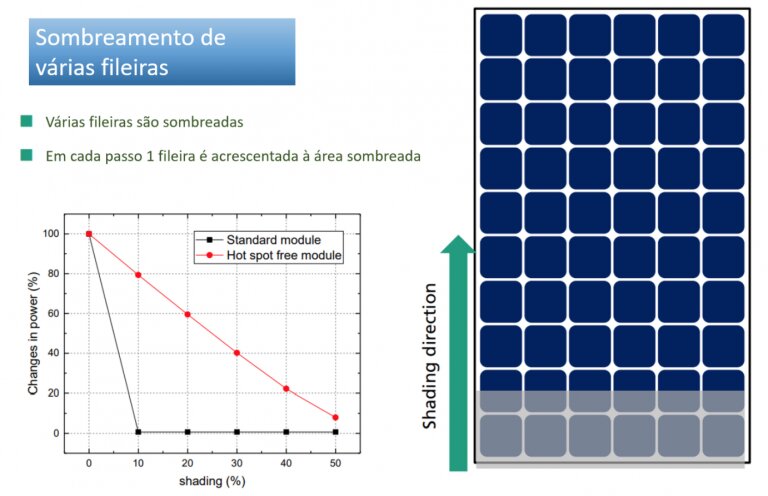
A row of cells is defined as a group of cells aligned horizontally (considering the module in portrait position), but not belonging to the same string, as shown in Figure 6.
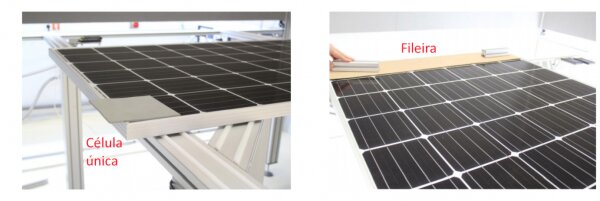
Figure 6: Partial shading conditions used in the study. Source: Fraunhofer/AE Solar/reproduction

Results of the study

The results of the experimental study carried out are shown below. The results show the influence of the effect of the bypass diodes on the power generated by the photovoltaic module. Although the main function of the bypass diode is to protect against the occurrence of hotspots, there is a side effect (desirable) of the diode on the performance of the photovoltaic module.

In the traditional module, the activation of a bypass diode causes the loss of a complete string of cells. In the hotspot-free module, on the other hand, the loss is gradual, proportional to the number of shaded cells, as shown in Figure 7.
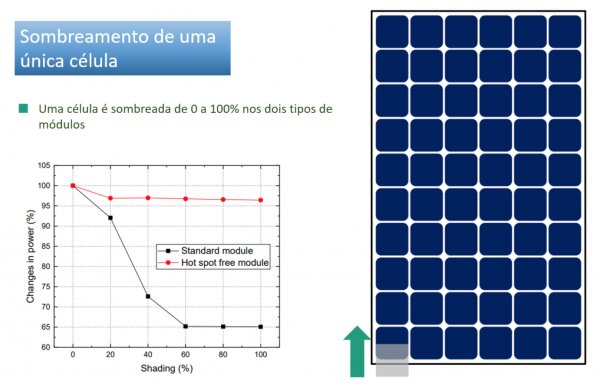
Figure 7: Power loss of photovoltaic modules with test condition 1 – shading of only one cell. Source: Fraunhofer/AE Solar/reproduction

The graph in Figure 7 shows that shading only 60% of a cell causes a loss of 1/3 of the output power of the conventional photovoltaic module. This is explained by the removal of an entire string (20 cells) when one of the bypass diodes is activated. On the other hand, as also shown in Figure 7, in the AE Solar hotspot-free module the power remains around 97% under the same test conditions.

An interesting fact that can be observed in Figure 6 is that there is an almost linear relationship between the shading percentage and the power reduction of the hotspot-free module. In the case shown, only 1 cell (out of 60) of the photovoltaic module is shaded, which would correspond to a shading of 98,3% – considering only the active area of ​​the module, that is, the area corresponding to the surface of the photovoltaic cells.

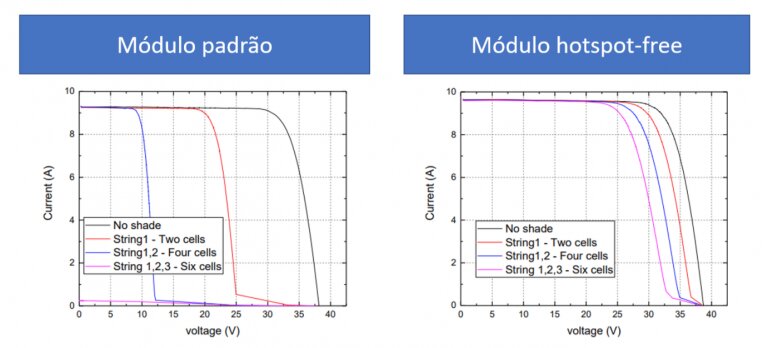
The results in Figure 7 are explained by the IV curves of the photovoltaic modules, shown in Figure 8, when subjected to the conditions described above. Figures 9 to 12 show the results obtained with the other test conditions, that is, with the shading of 1 row and several rows of photovoltaic modules.
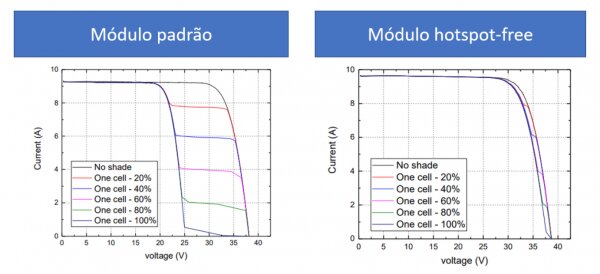
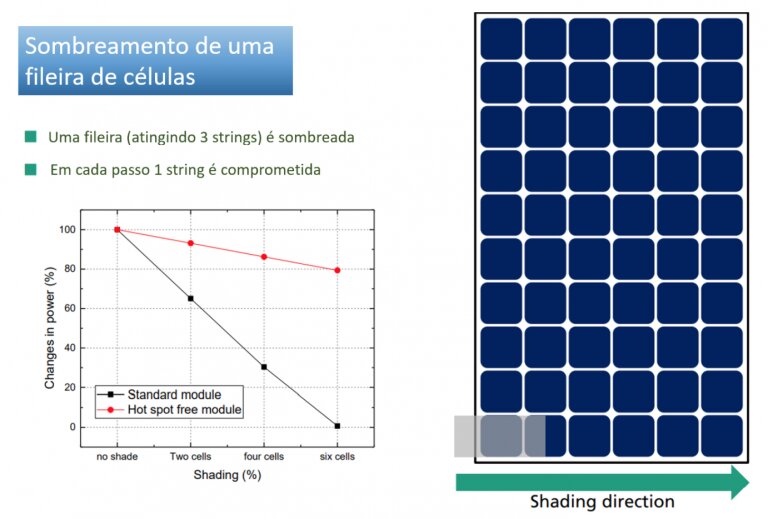
Figure 8: IV curves of the modules in test condition 1. Source: Fraunhofer/AE Solar/reproduction
Figure 9: Power loss of photovoltaic modules with test condition 2 – shading of only one row. Source: Fraunhofer/AE Solar/reproduction
Figure 10: IV curves of the modules in test condition 2. Source: Fraunhofer/AE Solar/reproduction
Figure 11: Power loss of photovoltaic modules with test condition 3 – shading of several rows. Source: Fraunhofer/AE Solar/reproduction
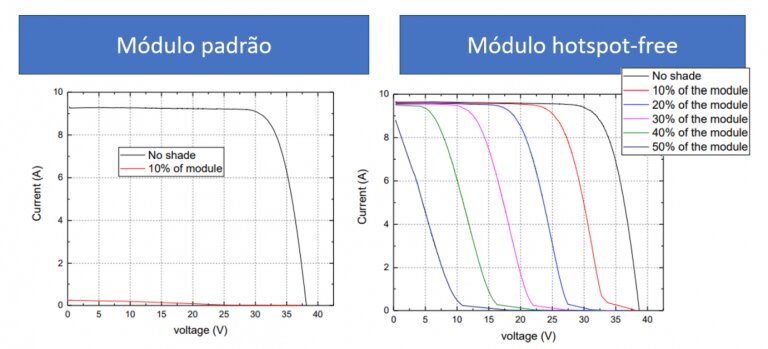
Figure 12: IV curves of the modules in test condition 3. Source: Fraunhofer/AE Solar/reproduction

Analysis of results and conclusion

An experiment was conducted to evaluate the performance of an AE Solar hotspot-free PV module compared to a conventional module under partial shading conditions. The experiment conducted by the Fraunhofer Institute involved tests under different shading conditions, according to three standards applied equally to both types of modules evaluated: single-cell shading, single-row shading and multi-row shading.

With the shading of just one cell, the AE Solar hotspot-free module showed losses of only 3%, while the conventional module lost 35% of its power. With the shading of one row, the standard module loses 100% of its power, with its three bypass diodes activated. In the same condition, the AE Solar hotspot-free module loses only 20% of its total power.

With the shading of several rows, the power of the AE Solar hotspot-free module decreases linearly with the increase in the shaded area of ​​the module. On the other hand, the conventional module loses all its power when 50% of the rows are shaded. It is important to note that the result obtained with the test in condition 3 is only valid when the shading occurs from the bottom to the top.

If the shadow advances in a horizontal direction (from right to left or vice versa), the power loss in the conventional module may be even greater. This article focused on the problem of power loss with partial shadows. This problem can be mitigated by using a greater number of bypass diodes in the PV module – ideally, one diode for each cell, as is the case with AE Solar's hotspot-free modules.

References

Electrical Characterization of hotspot-free and standard module. Hamed Hanifi, Frank Wenger, Jens Schneider, Report No. 389/2018, Fraunhofer
https://hsfsolar.com/smart-hot-spot-free-modules/ – accessed on 28/07/2021
Aerial thermography of photovoltaic solar plants https://canalsolar.com.br/termografia-aerea-de-usinas-solares-fotovoltaicas/ – accessed on 28/07/2021
Grounding and SPDA Course bypass diodes
Photo by Engineering Team Canal Solar
Equipe de Engenharia do Canal Solar
Engineering Team Canal Solar
PreviousPrevious
NextNext

An answer

  1. Ramon Souza said:
    31 July 2021 to 14: 02

    This means that the use of diode per cell is highly effective, high quality article of information, I hope the next article will be about the use of mppt per cell in panels, to solve shading, as they are already being applied by Jinko Solar.

    Reply

Leave a comment Cancel reply

Your email address will not be published. Required fields are marked with *

Comments should be respectful and contribute to a healthy debate. Offensive comments may be removed. The opinions expressed here are those of the authors and do not necessarily reflect the views of the author. Canal Solar.

News from Canal Solar in your Email

Posts

Understand in practice how to size hybrid battery-powered systems.

Understand in practice how to size hybrid battery-powered systems.

ESG in Brazilian Solar Photovoltaic Energy: Governance, Regulation, and Project Engineering

ESG in Brazilian solar photovoltaic energy: governance, regulation and project engineering.

More news

Read More
Canal Solar - Safety in photovoltaic installations what are the main mistakes made

Safety in photovoltaic installations: what are the main mistakes made?

Canal Solar - Deciphering the tracker system

Deciphering the tracker system

USP holds seminar on smart mini-grids applied to interconnected isolated systems

USP holds seminar on smart mini-grids applied to interconnected isolated systems

It is a news and information channel about the photovoltaic solar energy sector. Channel content is protected by copyright law. Partial or total reproduction of this website in any medium is prohibited.

Facebook X-twitter Instagram Youtube LinkedIn Spotify

Site Map

Categories

  • News
  • Articles
  • Interviews
  • Consumer Guide
  • Authors
  • Videos
  • Projects
  • Magazine
  • Electric Vehicles

Channels

  • About Us
  • Contact
  • Privacy
  • Quality Policy
  • Work with us
  • Expedient
  • advertise here

Membership and certifications

Copyright © 2026 Canal Solar, all rights reserved. CNPJ: 29.768.006/0001-95 Address: José Maurício Building – Mackenzie Avenue, 1835 – Floor 3, – Vila Brandina, Campinas – SP, 13092-523
Receive the latest news

Subscribe to our weekly newsletter

Fill in the information above and receive your free copy of Canal Solar magazine.