
• Thu, May 21, 2026
Facebook X-twitter Social media coordinator Youtube LinkedIn Spotify
  • GC Solar: 22,33 GW
  • GD Solar: 47,97 GW
  • advertise here
  • About us
  • Expedient
logo site solar channel
  • News
    • Market & Investments
    • International market
    • Politics & Regulation
    • Projects & Applications
    • Renewable
    • Sustainability & ESG
    • Technology & Innovation
    • Electric Vehicles
  • Articles
    • Opinion Article
    • Manufacturer's Article
    • Technical Article
  • Latam
  • Batteries
  • Blog
  • Solar Energy Companies
    • Integrators
  • Magazine
    • Magazine Canal Solar
    • Conecta Magazine
  • Consultancy
  • Courses
  • News
    • Market & Investments
    • International market
    • Politics & Regulation
    • Projects & Applications
    • Renewable
    • Sustainability & ESG
    • Technology & Innovation
    • Electric Vehicles
  • Articles
    • Opinion Article
    • Manufacturer's Article
    • Technical Article
  • Latam
  • Batteries
  • Blog
  • Solar Energy Companies
    • Integrators
  • Magazine
    • Magazine Canal Solar
    • Conecta Magazine
  • Consultancy
  • Courses
  • News
    • Market & Investments
    • International market
    • Politics & Regulation
    • Projects & Applications
    • Renewable
    • Sustainability & ESG
    • Technology & Innovation
    • Electric vehicles
  • Articles
    • Opinion
    • technicians
    • Manufacturer Items
  • Latam
  • Blog
  • Solar Energy Companies
  • Integrators
  • Magazine
    • Conecta Magazine
  • About Us
  • Advertise Here
  • CS Consulting
  • Courses
  • International market
  • News
    • Market & Investments
    • International market
    • Politics & Regulation
    • Projects & Applications
    • Renewable
    • Sustainability & ESG
    • Technology & Innovation
    • Electric vehicles
  • Articles
    • Opinion
    • technicians
    • Manufacturer Items
  • Latam
  • Blog
  • Solar Energy Companies
  • Integrators
  • Magazine
    • Conecta Magazine
  • About Us
  • Advertise Here
  • CS Consulting
  • Courses
  • International market
logo site solar channel
Home / Articles / Technical Article / Integrated solution for hybrid PV systems with storage

Integrated solution for hybrid PV systems with storage

Hybrid systems will enable consumers’ long-awaited energy independence
Follow on Whatsapp
  • Photo by Engineering Team Canal Solar Equipe de Engenharia do Canal Solar
  • November 22, 2021, at 08:51 PM
5 min 28 sec read
Integrated solution for hybrid PV systems with storage
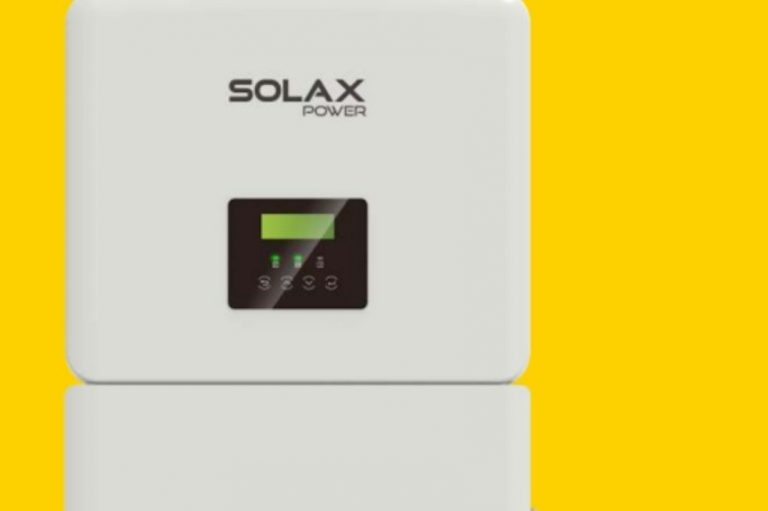
Hybrid systems can operate on-grid or off-grid, use different sources, or combine with electric batteries. Photo: Solax Power/reproduction

Energy storage associated with photovoltaic systems has been gaining ground around the world, whether for economic, technical or political-regulatory reasons.

Previously restricted to off-grid systems, battery banks are now an important complement to grid-connected or hybrid photovoltaic systems, which can operate either connected (on-grid) or acting as a backup (off-grid).

Many manufacturers on the market have been working to provide equipment and solutions for hybrid systems, including inverters and lithium battery banks with BMS (battery management system).

A small parenthesis is in order here: what are hybrid systems? Two definitions are commonly used in the market and they get a little confused.

A hybrid system can be one that operates in two different modes: on-grid or off-grid. On the other hand, a system that uses different energy sources or mixes some source (such as solar photovoltaic) and electric batteries can also be a hybrid.

In some cases, the systems are hybrid in every sense: they use batteries for storage, mix different energy sources and have different modes of operation.

Hybrid energy systems are already a reality on any imaginable scale: from microgeneration to centralized electrical energy generation.

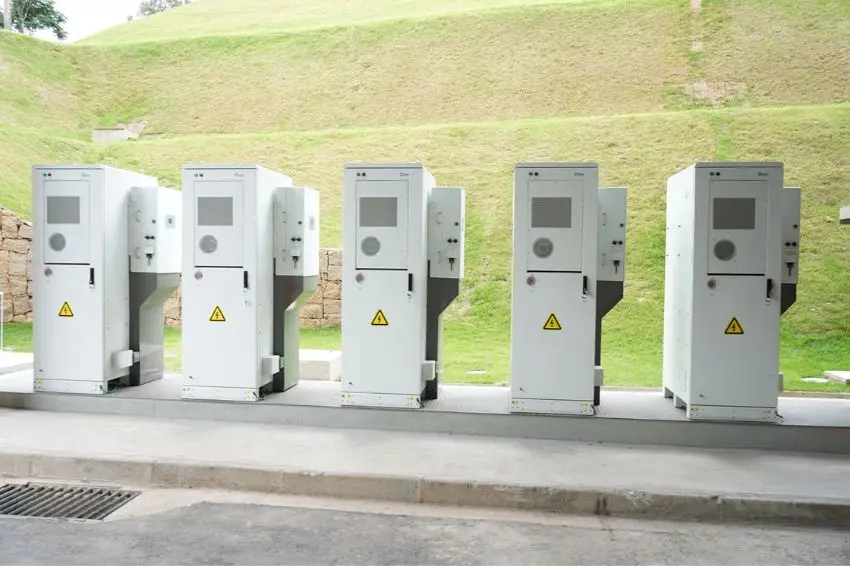
In centralized generation, so-called BESS (battery energy storage systems) are already used, which allow the regulation of the intermittency of energy generation, help control the stability of the electrical system or reduce the LCOE (levelized cost of energy) of photovoltaic and wind plants.

At the micro or mini generation level of electrical energy, hybrid systems can perform several functions:

  • provide better energy management in homes, avoiding the injection of energy into the electrical grid and prioritizing own generation;
  • provide security in commercial facilities through the backup function or by reducing demand during consumption peaks;
  • reduce energy costs with the energy shift strategy (storing and injecting energy at scheduled times);
  • among other possible functions.

Given the complexity of hybrid systems, which require inverters with different characteristics and operating modes, in addition to lithium battery banks, which require complex BMS systems, hybrid systems are currently going through a market entry phase; which may be more or less advanced in different countries.

Here in Brazil, hybrid systems are already beginning to be used and their use is expected to grow in the coming years due to the factors we mentioned at the beginning of this article (economic, technical or political-regulatory) and also due to the rapid reduction in the cost of batteries in recent years. .

After photovoltaic systems connected to the grid, which have already become widespread in the market and have become popular with consumers (in Brazil and around the world), we now live in a time in which storage systems are showing their potential.

Hybrid systems (like the one in the image below) should become a standard in Brazilian homes in the coming years, as is already happening in other countries.

In Australia, for example, many consumers are prevented from injecting energy into the electricity grid, making it practically mandatory to use battery banks associated with photovoltaic systems.

In Brazil, hybrid systems can allow the consumer to benefit from the white tariff (storing energy to consume at peak times) or avoid injecting energy into the electrical grid if the benefits of the distributed generation credit compensation system are reduced (with the charging of charges for injected energy).

In other words, hybrid systems will enable consumers' long-awaited energy independence, without strings attached or restrictions imposed by companies or regulatory agencies in the electricity sector.
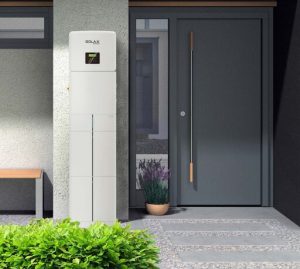
hybrid system (solar PV and batteries) with integrated solution. Source: Solax Power/reproduction
Hybrid system (solar PV and batteries) with integrated solution. Source: Solax Power/reproduction

Basically, two solutions for hybrid systems can be found on the market: multiport inverters, which have inputs for energy sources (solar PV, for example) and battery banks; or systems that integrate components in a modular way, as illustrated in the following figure.
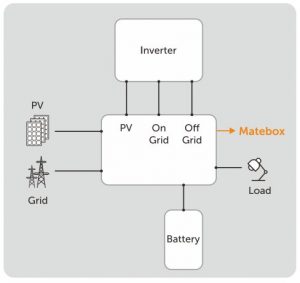
Hybrid system formed by the integration of several components. Source: Solax Power/reproduction

Typically in homes and small systems, one or two multiport inverters may be sufficient. In more demanding or larger systems, the modular solution provided by equipment integration allows greater flexibility and freedom in component sizing.

In the diagram above, the hybrid system is composed of a photovoltaic DC/AC inverter (which can have on- and off-grid outputs, as in the example), a battery system (with built-in DC/AC inverter and BMS system) and an integration panel, which makes connections between devices, power supplies and consumer loads.

The Solax Power solution, which we are exemplifying in this article, allows the integration of all components in an easy and elegant way. A basic cell is made up of a vertical structure that brings together these three components: an on-grid solar inverter (at the top), a Matebox (aggregator box, located in the center) and a bank of lithium batteries (at the bottom).

Through Matebox, multiple vertical columns can be added, with the number of inverters and battery banks required according to the needs of each project.
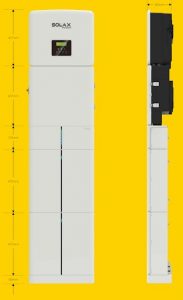
Vertical cell composed of on-grid inverter, Matebox and battery bank. Source: Solax Power/reproduction

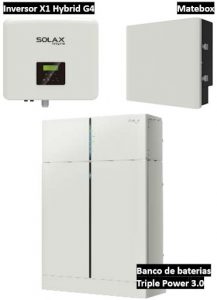
The system illustrated in the figure above employs the following Solax Power components:

  • Inverter from the X1 Hybrid G4 family, available in powers from 4,5 kW to 10 kW, three-phase, with on-grid and off-grid operating modes;
  • Matebox, for aggregating components without the need for external cabling, providing elegant and fast installations;
  • Triple Power 3.0 battery bank.
Solax Power components for hybrid solutions with solar energy and batteries. Source: Solax Power/reproduction
storage course hybrid inverters hybrid systems
Photo by Engineering Team Canal Solar
Equipe de Engenharia do Canal Solar
Engineering Team Canal Solar
PreviousPrevious
NextNext

Answers of 3

  1. Pompilio Neto said:
    23 January 2022 to 16: 19

    Which distributors sell hybrid solar systems in Brazil?

    Reply
  2. David Marconi said:
    December 1 from 2021 to 09: 23

    Good day.
    I am an Integrator company and I have a project that combines the On-Grid and Off-Grid systems.
    How to contact SOLAR X

    Reply
  3. Kayê said:
    22 November 2021 to 15: 53

    Does Solax Power have a national distributor/supplier?

    Reply

Leave a comment Cancel reply

Your email address will not be published. Required fields are marked with *

Comments should be respectful and contribute to a healthy debate. Offensive comments may be removed. The opinions expressed here are those of the authors and do not necessarily reflect the views of the author. Canal Solar.

News from Canal Solar in your Email

Posts

Understand in practice how to size hybrid battery-powered systems.

Understand in practice how to size hybrid battery-powered systems.

ESG in Brazilian Solar Photovoltaic Energy: Governance, Regulation, and Project Engineering

ESG in Brazilian solar photovoltaic energy: governance, regulation and project engineering.

More news

Read More
Canal Solar - El Niño's return raises alert for electrical system operation. 

The return of El Niño raises concerns about the operation of the electrical system. 

Canal Solar - The city with the best quality of life in Brazil also stands out in solar energy.

The city with the best quality of life in Brazil also stands out in solar energy.

Canal Solar - Brazil has already cut almost 3 GW average of solar and wind energy by 2026.

Brazil has already cut almost 3 GW of average solar and wind energy by 2026.

It is a news and information channel about the photovoltaic solar energy sector. Channel content is protected by copyright law. Partial or total reproduction of this website in any medium is prohibited.

Facebook X-twitter Social media coordinator Youtube LinkedIn Spotify

Site Map

Categories

  • News
  • Articles
  • Interviews
  • Consumer Guide
  • Authors
  • Videos
  • Projects
  • Magazine
  • Electric Vehicles

Channels

  • About Us
  • Contact
  • Privacy
  • Quality Policy
  • Work with us
  • Expedient
  • advertise here

Membership and certifications

Copyright © 2026 Canal Solar, all rights reserved. CNPJ: 29.768.006/0001-95 Address: José Maurício Building – Mackenzie Avenue, 1835 – Floor 3, – Vila Brandina, Campinas – SP, 13092-523
Receive the latest news

Subscribe to our weekly newsletter

Fill in the information above and receive your free copy of Canal Solar magazine.