

The PHB Solar engineering team, represented by Rogério Pereira and Ivan Sarturi, presented in their 2026 webinar the new line of three-phase hybrid inverters compatible with low-voltage batteries (Low Voltage – 48Vdc). The launch aims to serve photovoltaic market integrators with a complete B2B solution, previously tested in the laboratory with simulators and bidirectional sources, ideal for residential and commercial projects.
The new line consists of the PHB20K-ETL model, with a nominal power of 20kW and a 380V output, and the PHB12K-ETL, with 12kW and a 220V output. Before launching to the market, PHB conducted tests on all solutions in its laboratory, ensuring that the equipment to be sold actually meets the needs of the battery-hybrid market, which is growing considerably in Brazil.
One of the key technical differentiators revealed is the integration of a flexible port, called the Smart Port. This port enables three advanced operating modes: integration with diesel generators (manual or automatic activation), powering non-priority loads to preserve battery autonomy, or operation as a microgrid.
Non-priority or lower-priority loads can be configured by the customer using the Smart Load port of the PHB hybrid inverter. For example, this functionality can be applied to power an air conditioner or other secondary loads in the installation. In this configuration, during operation powered by batteries or solar generation, if a power outage occurs, the inverter can be programmed to automatically disconnect this Smart Load output when the battery bank reaches, for example, 70% state of charge (SOC). In this way, the stored energy is preserved to increase the autonomy of the priority loads connected to the system's backup output.
This logic can be applied to any load considered non-essential, providing greater flexibility to the customer in managing and prioritizing the loads of the facility.
According to Rogério Pereira, an electronics engineer at PHB, the hybrid inverter allows for the installation of batteries in photovoltaic systems with microinverters. "When the Smart port operates as a microgrid, it's possible to retrofit using AC coupling with both single-phase and three-phase on-grid inverters, and even pre-installed microinverters, as long as their AC power does not exceed the AC power of the hybrid inverter," he states.
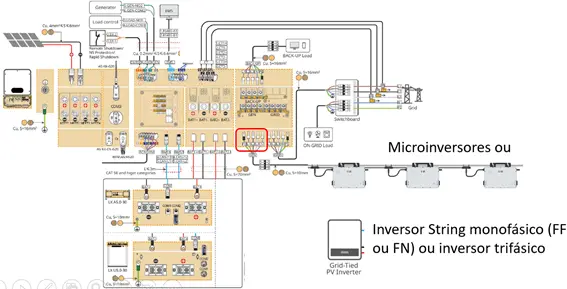
For energy storage, the inverters operate in conjunction with Low Voltage Lithium-Ion batteries, such as the Lynx A G3 and Lynx U G3 models, which can be paralleled in up to 30 modules, reaching up to 150kWh of stored energy. System integrity is ensured by the Battery Management System (BMS), which actively monitors variables such as voltage, current, and temperature. The system prevents operational risks such as thermal runaway, overvoltage, and short circuits, keeping the equipment in its safe operating area.
Aiming to optimize the integrator's experience, PHB Solar offers the sizing and sale of the entire infrastructure through its flexible sales platform. The portal allows the purchase of complete hybrid kits, which include not only the inverter and battery modules, but also essential accessories such as the AC protection panel with bypass (QDCA/139), DC panels, battery power cables, and communication cables.
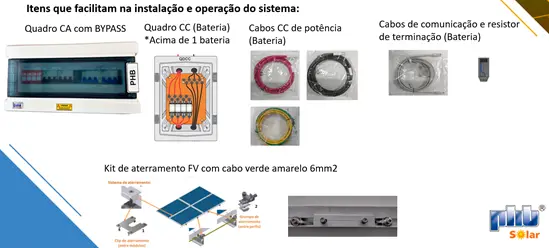
According to the company, providing a complete solution ensures effective after-sales service and avoids warranty disputes between different suppliers, reinforcing the brand's reliability in the energy transition sector.
For more information, watch the full webinar at the link below:
all the content of Canal Solar is protected by copyright law, and partial or total reproduction of this site in any medium is expressly prohibited. If you are interested in collaborating or reusing part of our material, please contact us by email: redacao@canalsolar.com.br.





Comments
Comments are moderated before publication.Comments should be respectful and contribute to a healthy debate. Offensive comments may be removed. The opinions expressed here are those of the authors and do not necessarily reflect the views of the author. Canal Solar.