
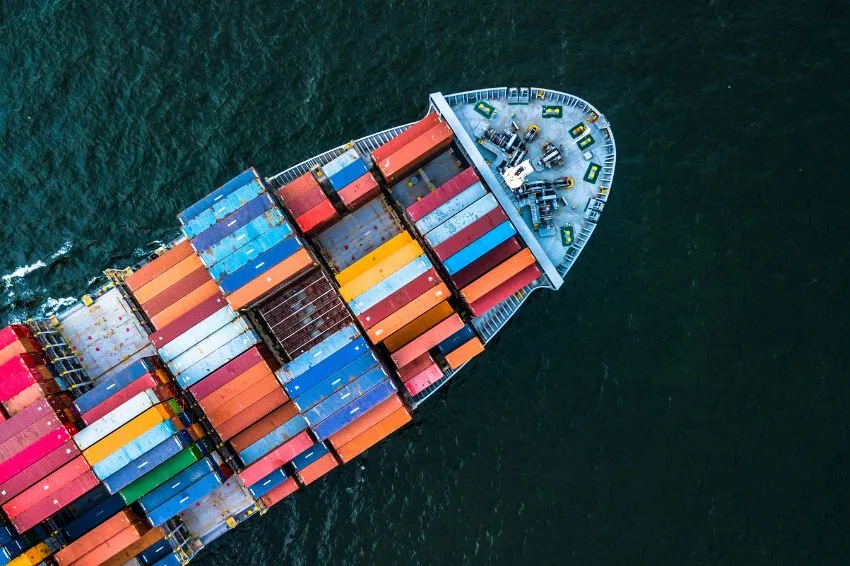
The geopolitical crisis between the United States and China continues to impact global trade and, in the last 12 months, has caused a significant drop in the cost of international maritime freight.
The cost to ship a container, which ranged between US$2.900 and US$3.200 in January 2025, fell to around US$1.400 in January of this year. Market expectations are that freight could reach US$900 in February.
The movement is noteworthy because it occurs precisely during a period that historically sees price increases due to the Chinese New Year holiday. As Eudes Silveira, director of Port Trade, explains, the current scenario completely deviates from the pattern observed in previous years.
“Right now, we are experiencing a very atypical situation compared to what normally happens in previous years. If we stop to think that we are practically on the eve of the Chinese holiday – which begins on February 17th – the normal thing would be to see high pressure on freight rates. But what we are experiencing now is a very abrupt reduction in prices,” he said.
Chinese government cancels subsidy for modules and batteries, impacting the Brazilian market.
According to Silveira, maritime freight is a market product and responds directly to the logic of supply and demand. Currently, the sector is experiencing a high supply of ships and available space, while demand has fallen significantly due to various factors.
One of them is the logistical reorganization promoted by China in recent years. The country modernized its ports and managed to mitigate a problem of container congestion. Previously, cargo was held up for long periods waiting to be shipped. Today, this bottleneck has practically ceased to exist.
During the pandemic, shipping costs reached levels between US$15.000 and US$16.000 per container. In addition to the high prices, logistical delays were significant, with delivery times reaching 90 days and additional fees charged to guarantee shipment.
"Currently, if you need to ship ten containers the following week, there is capacity available. This is because supply is much greater than demand, and this difference is what is driving down freight prices," said the director.
Another relevant factor is the tariff war promoted by United StatesThe adoption of high tariffs on products from various countries, as a way to protect American industry, reduced the global flow of goods and directly impacted the volume of cargo transported.
“It’s important to remember that China is not just a country – it’s the world’s factory, the productive heart of the global economy. It’s practically impossible to think of a production chain today without China. What happened was that this large factory produced expecting high demand, which didn’t materialize,” he said.
"With fewer products to put on the market, ships are emptier, there is no congestion in the ports – and this has been happening since December – and freight rates tend to fall even further," added Silveira.
The drop is not expected to reduce equipment prices.
Although, at first glance, the drop in shipping costs may seem like good news for the photovoltaic sector, this movement is not expected to translate into cheaper solar equipment for the Brazilian consumer.
Alberto Silva, import manager of BluesunHe explains that virtually all photovoltaic panels and inverters imported by Brazil use 40-foot high cube containers, which offer greater volume and better fit the dimensions of the modules.
“In December, we were at the level of $1.600 to $1.500. In January, it dropped to something between $1.300 and $1.200. Now, for February, in the first week alone, we're talking about $900. So, the freight cost has dropped by about 40% in the last three months,” confirmed the distributor.
“In the case of the inverter, for example, this reduction is almost insignificant. We're talking about a container that costs approximately between 330 and 350 dollars in merchandise. Those 600 dollars less in freight don't show up, they don't change anything in the price of the inverter. In the panel, yes, there is some effect. Compared to December, this is roughly one cent per watt-peak. In absolute terms, something between 6 and 7 reais per panel,” he explained.
The problem is that the prices of photovoltaic modules have been following an upward trajectory, pressured by the increased cost of strategic inputs such as silver and aluminum.
“The big problem we are facing today is the high cost of solar panels in China. About 60% of the cell is made of silver, and the price of silver has risen worldwide. Since December, for example, the price has practically doubled. So, we are seeing increases in the cost of panels at the factory in China that are much greater than the discount that the freight is bringing. Although there is this trend of reduced freight costs, this movement will not translate into lower prices for the consumer. On the contrary, it should translate into an increase, because of the cost of the panel at the origin,” warned Silva.
Last Tuesday (27), the price of silver reached a historic level, reaching US$ 108,17 per ounce (1 ounce equals 28,35 grams). This Wednesday, the commodity was traded at US$ 116,01 per ounce, establishing a new record. In a 12-month period, the input has accumulated an appreciation of over 260%.
Despite the challenging manufacturing cost environment, Silveira highlights that greater logistical efficiency in Chinese ports has brought significant gains to the supply chain. While delivery times for equipment could previously reach 90 days, this period has now been reduced to approximately 18 days.
“This greatly helps with inventory management and cash flow. Before, we needed to pay to start production three months before shipment. Today, we pay to start production 18 days before the ship leaves China. This reduces the need for tied-up capital. If the money is borrowed, it costs less. Lower interest rates ultimately mean a smaller impact on the cost for the end customer,” he concluded.
all the content of Canal Solar is protected by copyright law, and partial or total reproduction of this site in any medium is expressly prohibited. If you are interested in collaborating or reusing part of our material, please contact us by email: redacao@canalsolar.com.br.



Comments
Comments are moderated before publication.Comments should be respectful and contribute to a healthy debate. Offensive comments may be removed. The opinions expressed here are those of the authors and do not necessarily reflect the views of the author. Canal Solar.