
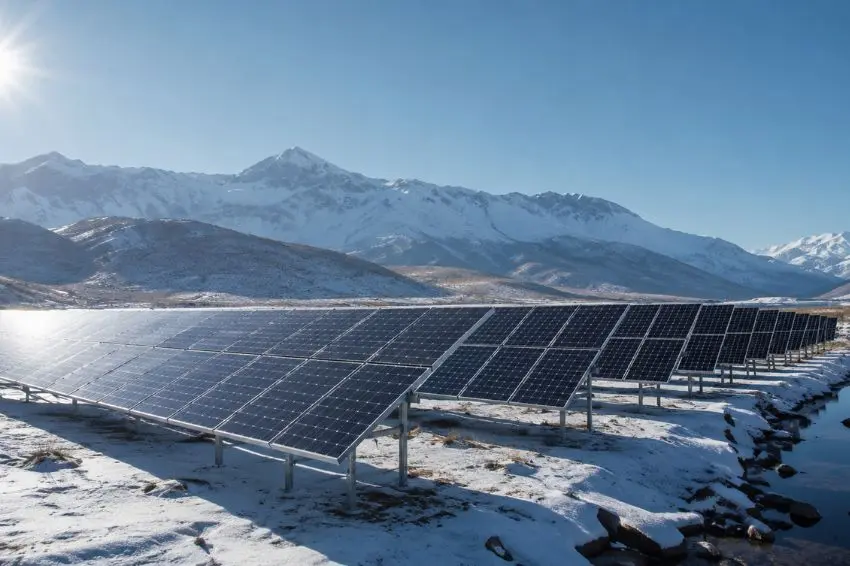
For decades, the Nordic countries of Europe were virtually off the map for solar energy. While the south of the continent concentrated on large photovoltaic projects, the north focused mainly on wind power generation.
This scenario, however, began to change. The drop in equipment costs and the increase in electricity prices made solar energy economically viable even in regions previously considered cold, remote, and with low solar incidence.
As a result, large solar parks are being built near the Arctic Circle, while photovoltaic panels are spreading across rooftops in northern Scotland and even the Faroe Islands.
The expansion offers countries in the region a new way to increase domestic electricity generation, reduce dependence on fossil fuels, and strengthen energy security.
For the first time, investors and utilities have installed more solar capacity than wind power in the Nordic region. This trend is expected to continue in the coming years, according to projections by BloombergNEF.
Sweden has already reached its original target for solar capacity projected for 2030, back in 2023, and is close to achieving an even more ambitious goal. In Finland, the target for the end of 2030 was reached six years ahead of schedule.
Growth is already driving a new investment portfolio. Companies have proposed at least 300 MW of new projects in Lapland, in northern Finland, while another 600 MW are awaiting connection to the electricity grid in northern Sweden.
However, the scenario is different in parts of southern Europe. In Spain, the high installed capacity of solar energy has put pressure on electricity prices during periods of peak generation, reducing the return on new investments.
In the Nordic countries, the costs of panels and equipment have fallen by about 30% since 2021, while higher electricity prices have made projects more attractive, according to Aurora Energy Research.
Cold and snow help generate energy.
The Simo solar park, by Exilion, located south of the Arctic Circle, is already producing electricity for almost 22 hours a day during the peak of summer, less than three years after the project began.
According to the European Commission's solar calculator, approximately 82% of the annual generation of a project in northern Finland occurs between April and September. In a similar project in Madrid, this percentage would be approximately 58%, showing how the long summer days compensate for the harsh winter.
During the colder months, solar production decreases significantly. It is during this period that wind energy takes over in the region, a role further reinforced by the increasing use of battery storage systems.
Furthermore, lower temperatures increase the efficiency of photovoltaic modules, while snow reflects more light onto bifacial panels, increasing energy production.
Expansion reaches previously unlikely regions.
In northern Scotland, nearly 2 homes installed solar panels in the six months ending in April, despite the region receiving just over half the solar radiation seen in southern Spain.
The movement has also reached the Faroe Islands, an archipelago located in the North Atlantic and considered one of the cloudiest places in the world. Just a few years ago, the region had only a few solar farms.
Today, the local energy company SEV estimates that there are more than 60 photovoltaic installations, while another 25 to 30 are awaiting approval.
Even with low solar incidence, the technology plays an important role in the local electricity system by complementing wind and hydroelectric generation during the summer. This allows the islands to reduce diesel consumption precisely at the time of year when dependence on this fuel usually increases.
all the content of Canal Solar is protected by copyright law, and partial or total reproduction of this site in any medium is expressly prohibited. If you are interested in collaborating or reusing part of our material, please contact us by email: redacao@canalsolar.com.br.

Comments
Comments are moderated before publication.Comments should be respectful and contribute to a healthy debate. Offensive comments may be removed. The opinions expressed here are those of the authors and do not necessarily reflect the views of the author. Canal Solar.